How Long Does a Roof Last? Real Ranges by Material
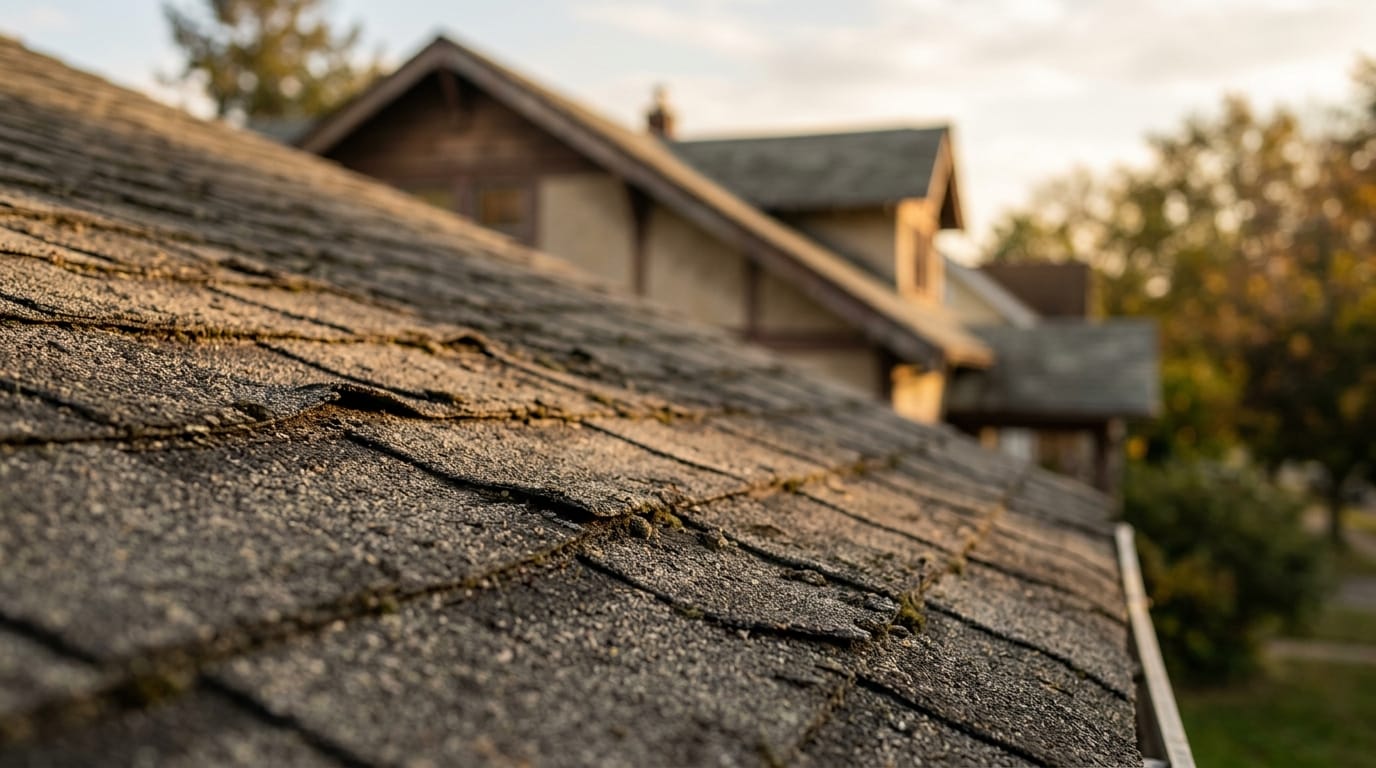
A 3-tab asphalt roof runs about 20 years. Architectural asphalt runs about 30. Wood shake spans 20 to 40. Standing seam metal projects around 50. Clay tile is commonly rated for 60. Slate spans the widest range of any material — 60 to 125 years or more, graded by an actual standard. None of those numbers is the warranty length, and the gap between the two is worth understanding before you buy.
How Long Does Each Material Actually Last?
Anywhere from 20 years to well over a century. The spread is the honest answer.
The same figures in text:
| Material | Expected service life | Source |
|---|---|---|
| 3-tab asphalt | ~20 years | NAHB life expectancy study |
| Wood shake | 20 – 40 years | USDA Forest Service; Oregon State University Extension |
| Architectural asphalt | ~30 years | NAHB life expectancy study |
| Standing seam metal | ~50 years | Metal Construction Association / ZAC projection |
| Clay tile | ~60 years | Tile Roofing Industry Alliance |
| Slate | 60 – 125+ years | ASTM C406 grading; National Park Service |
Slate is the one material with a real number behind it. ASTM C406 grades roofing slate into three classes, tested by breaking load, water absorption and a softening test. S1 is rated for an expected service life over 75 years. S2 runs 40 to 75. S3 runs 20 to 40. Federal historic-preservation guidance backs this up separately. It states that properly installed slate roofs "will last 60 to 125 years or longer depending on the type of slate, roof configuration, and geographic location." Some slate is known to exceed 200 years (National Park Service Preservation Brief 29, retrieved 2026-08-03). If someone tells you quarry slate lasts a century, that is not marketing. A federal document and a standards grade both say the same thing.
The NAHB figures for asphalt and wood carry a real catch. The study itself was compiled from a telephone survey of manufacturers and trade associations in 2006 — self-reported by sellers, not measured in the field. Treat it as the best available consensus number, not a laboratory result. It also has no entry for metal roofing at all. That is why the metal figure below comes from a different source.
Is the Longest-Lived Roof the Cheapest?
No — and this is worth checking before longevity alone decides your purchase. Our metal roof cost and tile roof replacement guides run this same arithmetic in more depth for those two materials specifically, and roof replacement cost covers the full breakdown for asphalt.
The same arithmetic in text:
| Material | Midpoint cost per square | Service life | Cost per square, per year |
|---|---|---|---|
| Architectural asphalt | $500 | 30 years | $16.67 |
| 3-tab asphalt | $400 | 20 years | $20.00 |
| Standing seam metal | $1,400 | 50 years | $28.00 |
| Clay tile | $1,800 | 60 years | $30.00 |
| Slate | $2,250 | 75 years | $30.00 |
For example, take a 2,000 sq ft roof — 20 squares — over a 60-year horizon, in today's dollars. Architectural asphalt at $500 a square costs $10,000, done twice across that span, plus one tear-off around $140 a square: about $22,800 all in. Clay tile at $1,800 a square costs $36,000, installed once. The longer-lived roof costs roughly $13,200 more over the same sixty years.
That is not an argument against tile, metal or slate. Durability, fewer installs, and climate fit are real reasons to pick any of them. It is a caution against one specific claim: that a long-lived roof is a cheap one. On the numbers we price, it is not.
Why Doesn't the Warranty Match the Real Lifespan?
Because the warranty and the roof's real life answer two different questions.
A roofing warranty is a legal promise, and it covers less than it sounds like it does. Federal Trade Commission rules on the Magnuson-Moss Warranty Act draw a real distinction. Roofing sold as a retail product carries standard consumer-warranty obligations. Roofing already built into a house — most new construction and re-roofing work — is treated differently under warranty law (16 CFR § 700.1, via Cornell Legal Information Institute, retrieved 2026-08-03). A "50-year shingle" is a promise about defects in the material, tested in a lab. It is not a promise that your roof, on your house, in your climate, will last fifty years.
We looked for a source that puts a number on how far real-world life falls short of the warranty number. A percentage, a year figure, anything — we could not find one from any regulator or standards body. The specific percentages and "your 25-year shingle really lasts 12 to 20 years" claims online come only from roofing-company marketing. None of them name a method behind the number. We are not repeating a number we cannot source. What is solidly true is simpler. Ask what the warranty actually covers — materials only, or installation too. And ask if it is prorated, meaning the payout shrinks as the roof ages. Those two questions matter more than the headline year figure on the brochure. Our roof warranty guide covers what the major manufacturers actually offer tier by tier, and why the answer to both questions often depends on your contractor's certification level, not just which shingle you buy.
What Actually Shortens a Roof's Life?
Four real factors, and none of them is simply "cheap materials."
The same factors in text:
| Factor | Mechanism | What helps |
|---|---|---|
| Poor attic ventilation | Heat and moisture build up under the deck | Balanced intake and exhaust venting |
| Installation errors | The most commonly documented cause of early failure | Verify workmanship, not just material grade |
| Deferred maintenance | Debris and moss trap moisture against the surface | Clear debris, address moss early |
| Severe climate exposure | UV and freeze-thaw cycling accelerate aging | Expect the shorter end of any published range |
How the roof gets installed matters more than most buyers assume. The National Roofing Contractors Association says so plainly: "despite problems associated with bad roof design and specification, poor fieldwork nonetheless accounts for most failures" (NRCA, retrieved 2026-08-03). One failure case the association studied traced back to design flaws. Poor workmanship, done under cost pressure, made those flaws worse (NRCA, retrieved 2026-08-03). The practical point: a premium material installed badly can lose to a mid-grade material installed well.
Ventilation matters, but no headline number is attached to it. Attic airflow keeps the space cold in winter, which cuts ice-dam risk. In summer, it moves overheated air out from under the deck, protecting the shingles above it and clearing out moisture (ENERGY STAR, retrieved 2026-08-03). We could not find a source that puts a number on how many years bad ventilation costs you. So we are not printing one. The problem is real even without a number attached. Our roof ventilation guide covers the actual intake/exhaust mechanics and the code ratios behind this, if you want the deeper mechanism rather than just the warning.
Maintenance follows the same pattern: real problem, no clean number. University extension guidance warns that overhanging branches and built-up debris trap moisture. That moisture grows moss and fungus, and both shorten a roof's life. The same guidance warns against hard pressure-washing or scraping too — both strip off the granules a shingle depends on (Oregon State University Extension, retrieved 2026-08-03). Again: real mechanism, no credible specific year figure to attach to it, so none is offered here.
Climate speeds up wear, and it has been tested rather than assumed. An independent insurance research group runs roof-aging test sites in five states. The goal is to see how sun, UV light and swinging temperatures wear down roofing differently in each climate (IBHS, retrieved 2026-08-03). That the research exists at all confirms climate genuinely matters. The institute's detailed comparative results are not publicly available. In harsh climates, expect the short end of any published range rather than a firm number.
What About Flat or Low-Slope Sections?
Different materials — and a rubber membrane holds up better than you'd expect.
Many homes have a small flat section — a porch roof, an addition, a garage tie-in. Those are usually covered in EPDM rubber or TPO, not shingles or tile. An industry survey of 569 roofing professionals, combined with lab research, found that properly installed and maintained EPDM "routinely delivers at least 38 years of service life." Many respondents reported EPDM roofs still working past 45 years (EPDM Roofing Association, retrieved 2026-08-03). TPO's life depends heavily on which grade you buy. Accelerated-aging research published in the roofing industry's own trade journal found utility-grade TPO projecting around 15 years, standard-grade around 25, and higher-specification TPO exceeding 35 (Professional Roofing, NRCA, retrieved 2026-08-03). These come from two different methods — a field survey for EPDM, lab-aging tests for TPO. Treat them as two separate data points, not one clean comparison.
Remaining roof life matters for more than just planning a replacement — if you're considering solar panels, a roof with fewer years left than the panel warranty is a real sequencing problem, not just a hypothetical one.
Frequently Asked Questions
Which material lasts the longest?
Slate, by a wide margin — ASTM's top grade is rated for an expected service life over 75 years, and federal preservation guidance documents real installations exceeding a century. It also costs the most to install.
Is a 50-year shingle actually going to last 50 years?
The 50 years is a manufacturing-defect warranty tested under laboratory conditions, not a field guarantee for your specific roof. Real-world life depends heavily on ventilation, installation quality, climate and maintenance — all of which sit outside what the warranty covers.
Does a metal roof really last twice as long as asphalt?
Roughly, on the figures available — about 50 years projected for standing seam against about 30 for architectural asphalt. The metal figure is a projection based on 14 tracked commercial installations with actual histories up to 35 years, not a completed field measurement to 50.
What shortens a roof's life the most?
Installation quality, on the evidence available. The roofing industry's own trade association states that poor fieldwork accounts for most failures, ahead of material defects. Ventilation, maintenance and climate all matter too, but none of them has a well-sourced specific number attached — treat any "X years shorter" claim you see elsewhere with real skepticism.
Should I replace my roof before it's actually failing?
Not on age alone. Insurance frequently will not pay for a roof replaced purely for being old rather than damaged. A roof within its expected range, with no signs of failure — missing granules, curling, active leaks — may have real life left in it. An inspection can tell you which situation you are in.
Service life ranges are published figures from associations, standards bodies and federal research, not guarantees for any specific roof. Cost data updated August 2026.
What do you want to do next?
Three ways we can help from here.
Get the free contractor checklist → 7 questions to ask any roofer before you call. Know what to ask, and what a good answer sounds like.