Tile Roof Replacement: Weight, Underlayment, and What Actually Fails
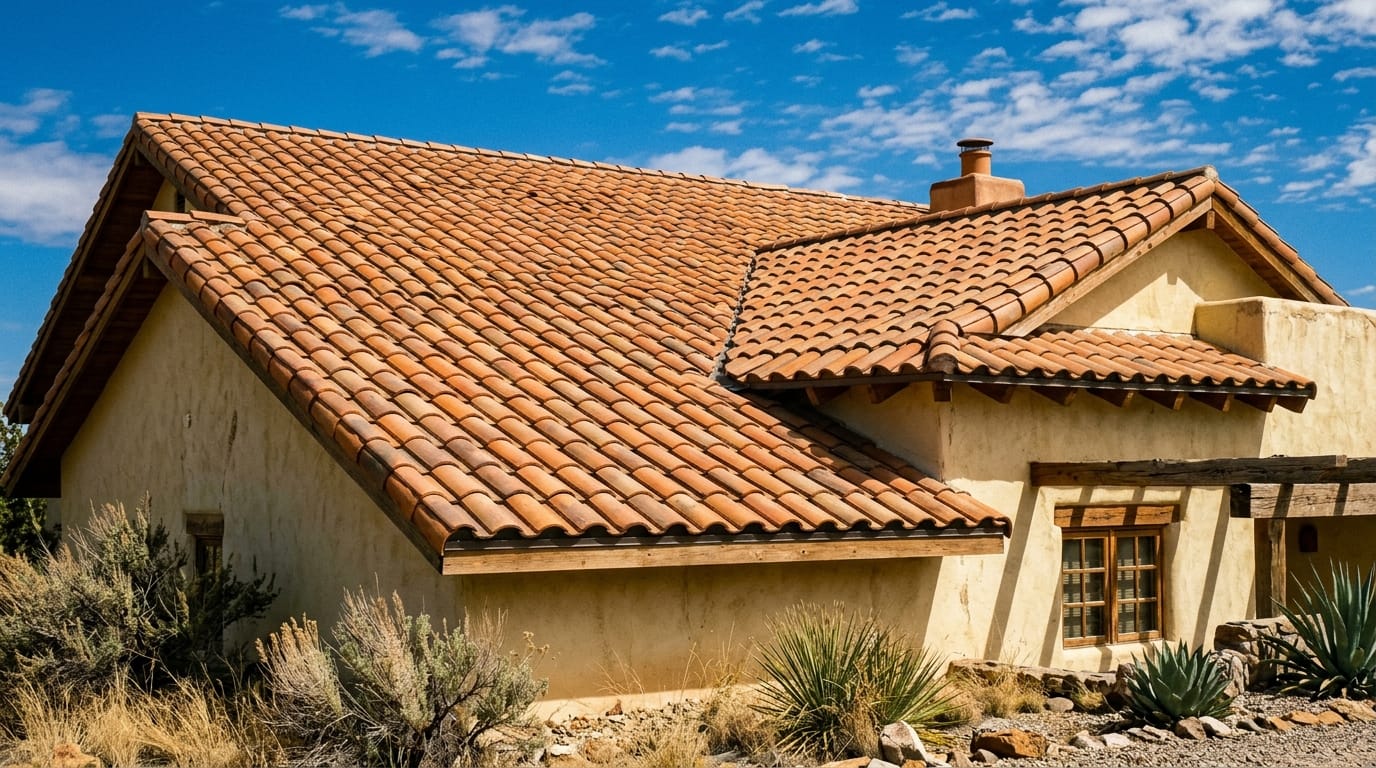
Clay tile runs $1,100 to $2,500 per square installed — a square being 100 square feet — against $400 to $600 for architectural asphalt. Two things decide whether that number is the real number. Whether your framing can carry the load, because standard-weight tile starts at 9 pounds per square foot. And what the underlayment beneath the tile costs, because on most tile roofs the underlayment is the part that failed, not the tile.
What Does a Tile Roof Cost?
Between $1,100 and $2,500 per square for clay, before any structural work.
The same figures in text:
| Material | Installed cost per square | Expected service life |
|---|---|---|
| Architectural asphalt | $400 – $600 | ~30 years |
| Standing seam metal | $1,000 – $1,800 | ~50 years |
| Clay tile | $1,100 – $2,500 | ~60 years |
| Natural slate | $1,500 – $3,000 | ~75 years |
Concrete tile generally prices below clay, and our own dataset does not split the two — treat the figures above as clay-weighted and ask any quote to name which you are buying. For your roof's size, pitch and access, our roof cost calculator runs these figures with tear-off and permits included.
One line item to watch for. None of these numbers include reinforcing the structure underneath, and on a house not originally built for tile that can be the largest single cost in the project.
Can Your Roof Actually Carry Tile?
This is the first question, not a detail — and it is the one most cost pages skip entirely.
Tile is heavy in a way asphalt is not. The industry association defines a standard-weight roof tile as one with an installed weight of 9 pounds per square foot or greater, excluding all other roofing components (Tile Roofing Industry Alliance, retrieved 2026-08-03). "Excluding all other roofing components" is the phrase doing the work — that 9 pounds is the tile alone.
The dead load is everything together. The same manual defines it as "the weight of all materials of construction incorporated into the roof assembly including but not limited to, fixed service equipment, roof tiles, battens, underlayment, flashing, roof deck." It then instructs that "sheathing must be structurally adequate to support the loads involved" and recognized in a code evaluation report or approved by the local building official (Tile Roofing Industry Alliance, retrieved 2026-08-03).
Two practical consequences follow.
If your house already has tile and you are replacing like with like, the structure has been carrying it. That question is usually settled.
If you are switching to tile from asphalt, it is not settled. Nobody can tell you it is by looking at the roof from the driveway. The manual is direct about who decides: "local building officials should be consulted for engineering criteria or other special requirements."
Get the structural opinion in writing before you sign anything. A quote that prices tile on a house that has never carried tile, without a word about framing, is not a complete quote.
Is Tile Cheaper Over the Long Run?
Not on cost per year — which is a different claim from lasting longer, and both can be true. See roof replacement cost for the same math across every material we price, and our metal roof cost guide if you're weighing tile against metal specifically. And clay and concrete tile aren't the same product with two names — our tile roof lifespan guide covers the real lifespan and weight gap between the two, and why the underlayment beneath the tile usually needs replacing well before the tile does.
The same arithmetic in text:
| Material | Midpoint cost per square | Service life | Cost per square, per year |
|---|---|---|---|
| Architectural asphalt | $500 | 30 years | $16.67 |
| Standing seam metal | $1,400 | 50 years | $28.00 |
| Clay tile | $1,800 | 60 years | $30.00 |
| Natural slate | $2,250 | 75 years | $30.00 |
For example, take a 2,000 sq ft roof — 20 squares — over 60 years, in today's dollars. Clay tile at $1,800 per square is $36,000, installed once. Architectural asphalt at $500 per square is $10,000, done twice across that span, plus one tear-off at roughly $140 per square: about $22,800. Tile costs roughly $13,200 more over sixty years. That ignores any structural reinforcement the tile might require.
The arithmetic leaves things out. You install once rather than twice. Tile is genuinely durable. And in the hot, dry states where it is concentrated, it suits the climate. Those are real reasons to choose it. Lower lifetime cost is not one of them, and any quote arguing otherwise is doing selective arithmetic.
What Actually Fails on a Tile Roof?
Almost always the underlayment, not the tile — and this reframes the whole project.
Tile is inert. The industry association describes tile's "characteristics of strength over age" and its durability as contributing to long-term life expectancy (Tile Roofing Industry Alliance, retrieved 2026-08-03). The most-cited home component study lists clay and concrete tile with a lifetime expectancy, against about 20 years for asphalt (NAHB life expectancy study, retrieved 2026-08-03).
The underlayment underneath does not share that lifespan. It is a felt or membrane layer. It is what actually keeps water out where tile alone would not, and it ages. Requirements are set by code: underlayment "shall be installed per IBC 1507," with two layers required on the shallower slopes between 2.5:12 and 4:12 (Tile Roofing Industry Alliance, retrieved 2026-08-03).
So when a tile roof "needs replacing," the honest description is usually different. It needs the tile lifted, the underlayment replaced, and the tile put back. That is a labor-heavy job rather than a materials-heavy one, and it prices differently from a full tear-off. Ask any quote which one it is, because a quote for new tile on a roof whose tile is fine is a quote for the wrong job.
One consequence worth pricing: not all tile survives being lifted and relaid. Expect some breakage, expect to buy replacement tile, and expect matching to get harder the older the roof is. We could not find an authoritative published breakage rate. The figures in circulation come from contractors rather than any association or standards body, so treat them as estimates rather than data.
What Should You Settle Before Signing?
Four things, and they are all cheaper to answer before the job than during it.
The same checklist in text:
| Question | Why it matters | What to ask for |
|---|---|---|
| Can the framing carry it? | Standard-weight tile is 9 lbs/sq ft or more | A structural opinion in writing |
| What is the underlayment? | This is what wears out, not the tile | The spec and the layer count, named |
| Does it freeze and thaw here? | Repetitive cycling needs a graded tile | ASTM C1492 or C1167 compliance |
| How is it attached for wind? | Mortar, foam and mechanical differ | The method matched to local code |
On freeze-thaw, the association is explicit. Its general recommendations are "meant for areas that may experience occasional storms, but not regular repetitive freeze thaw cycling." Tile used in freeze-thaw regions "must have passed the requirements of ASTM C1492 (Concrete) ASTM C1167 (Clay)" (Tile Roofing Industry Alliance, retrieved 2026-08-03). If you are in a cold climate, that compliance is a specification to require, not a nicety.
On wind, attachment is where tile roofs are won or lost. The requirements are regional. Florida has its own high-wind installation manual, sixty pages of attachment tables and aerodynamic uplift calculations (Tile Roofing Industry Alliance, Florida High Wind Manual, retrieved 2026-08-03). If you are in a hurricane region, ask which manual and which code edition your installer is working to.
Does Tile Help With Cooling?
It can, through reflectance rather than through the material itself.
Tile is concentrated in hot states, so this matters. What governs the effect is a surface's solar reflectance and thermal emittance. A roof reflecting 80% of sunlight runs roughly 55°F cooler than one reflecting 20%. A cool-colored surface reflecting 35% runs about 22°F cooler than a conventional one reflecting 10% (Lawrence Berkeley National Laboratory, retrieved 2026-08-03).
Keep the money in proportion. Federal guidance puts residential cool-roof savings at "up to $0.05/ft²" a year, greatest in hot and warm climates (DOE/LBNL, retrieved 2026-08-03) — roughly $100 a year on a 2,000 sq ft roof at the top of that range. Tile also creates an air gap that asphalt does not, which helps. We found no authority quantifying that separately. Ask for reflectance figures rather than accepting "tile keeps the house cooler" as a spec.
Frequently Asked Questions
Can you walk on a tile roof?
Carefully, and preferably not at all. The association notes that steep-slope roofs "can be dangerous to walk on when wet" and recommends contacting a professional for cleaning (Tile Roofing Industry Alliance, retrieved 2026-08-03). Beyond the fall risk, tile cracks under point loads. The practical version: keep satellite, solar and HVAC installers off the tile unless they know how to walk it. Inspect after any trade has been up there.
Is concrete tile the same as clay?
No. They are different materials with different weights, water absorption and color behavior. Concrete tile color is often applied to the surface rather than running through the body, so weathering shows differently. Freeze-thaw compliance is graded under separate standards, ASTM C1492 for concrete and ASTM C1167 for clay.
My tile looks fine but the roof leaks. Do I need a new roof?
Probably not a new tile roof. Leaks on an otherwise sound tile roof usually point at three things: the underlayment, the flashing at penetrations, or breakage from someone walking on it. Get an inspection that says which, before anyone quotes you for tile.
How long does the underlayment last?
Less than the tile. How much less depends on the product, the climate and how many layers were installed. We could not find an authority publishing a single expected service life for underlayment beneath tile. Treat any number you are quoted as the installer's estimate, and ask what product it is based on.
Will tile work in a cold climate?
Only if it is graded for it. Standard installation guidance is written for regions without regular repetitive freeze-thaw cycling. Cold-region installations need tile meeting the relevant ASTM freeze-thaw requirements, plus a cold-climate installation approach.
Cost figures are published US ranges from our own cost dataset and exclude any structural reinforcement. They vary by region, roof complexity and access. Cost data updated August 2026.
What do you want to do next?
Three ways we can help from here.
Get the free contractor checklist → 7 questions to ask any roofer before you call. Know what to ask, and what a good answer sounds like.