Tile Roof Lifespan and Tile vs. Shingle Roofing Compared
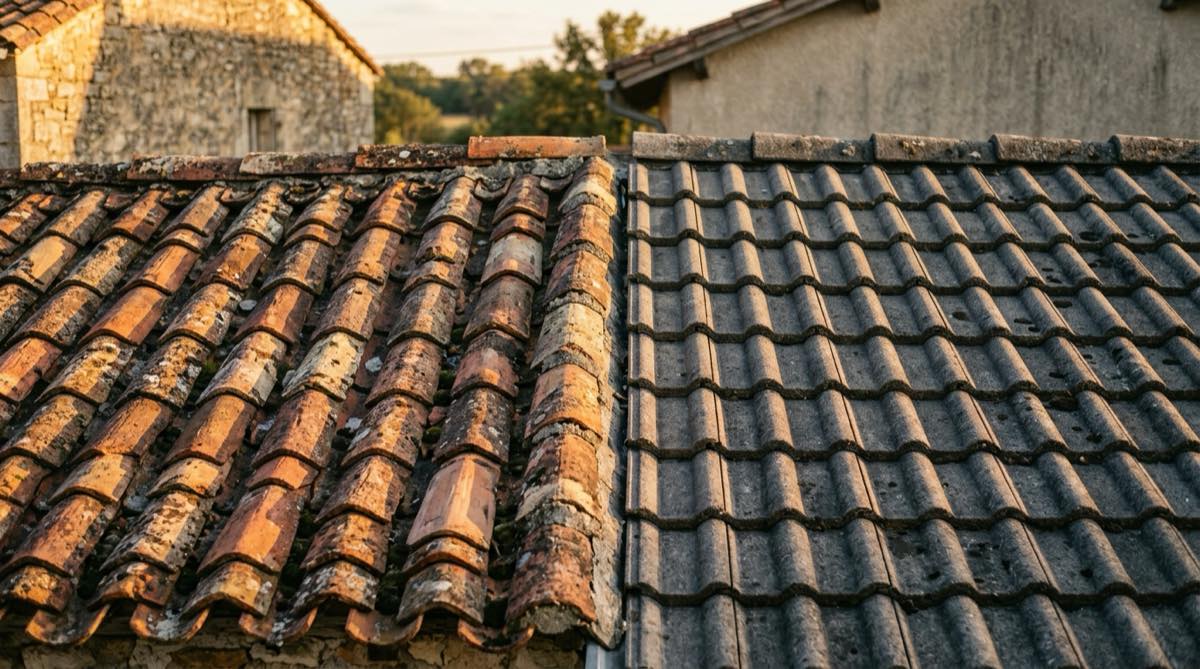
"Tile roofs last 100 years" is one of those roofing facts that's technically true and still misleading, because it depends entirely on which tile and which part of the roof you're talking about. Clay and concrete tile are genuinely different products — different weight, different lifespan, different failure pattern — and the part of a tile roof that actually needs replacing first usually isn't the tile at all.
Clay vs. Concrete: The Real Difference
These aren't two colors of the same product — they're manufactured differently and perform differently as a result.
Clay tile is fired at high heat, the same basic process used for centuries, and it holds up accordingly: clay commonly lasts well over 100 years under proper conditions, with lower water absorption (roughly 6%) that helps it resist the freeze-thaw cracking that shortens the life of more porous materials. Concrete tile is cast and cured rather than fired, runs meaningfully shorter — commonly cited anywhere from 30 to 70 years depending on the source and local conditions — and absorbs more water (roughly 13%), which adds real weight to the roof when it's wet and contributes to a shorter service life (Cedur, retrieved 2026-09-03).
| Clay tile | Concrete tile | |
|---|---|---|
| Typical lifespan | 80–100+ years | 30–70 years |
| Weight per square (100 sq ft) | ~600–650 lbs | ~820–1,100 lbs |
| Water absorption | ~6% | ~13% |
That's also why the two aren't simply interchangeable at quote time. Our tile roof replacement cost guide covers the actual dollar figures for both, but the lifespan and weight gap above is the reason a fair quote should specify which one you're pricing, not just "tile" as a single line item.
Why Does the Weight Difference Actually Matter?
Because it's a structural question, not just a spec sheet number.
A roof designed for asphalt shingle framing isn't automatically rated to carry concrete tile's roughly 900–1,000 lbs per square, let alone the added weight concrete picks up when wet. Our tile cost guide covers what that means for your specific house in more depth — whether an engineer needs to confirm your existing framing before tile goes on — but the underlying reason is exactly the weight gap in the table above: clay's lighter weight gives it more flexibility on older or lighter-framed homes than concrete does, even though clay itself often costs more per square.
The Part of a Tile Roof That Actually Fails First
It's almost never the tile itself — it's what's underneath it.
Tile is a rain-screen system, not a fully sealed membrane: the tiles shed the bulk of the water, but the underlayment beneath them is doing the actual waterproofing work, especially at valleys, penetrations, and wherever wind-driven rain gets under the tile's edges. That underlayment typically needs replacement every 20 to 30 years, even while the tile above it remains fully serviceable for decades longer (FoxHaven Roofing, retrieved 2026-09-03) — our underlayment guide covers what that material actually is and the felt-versus-synthetic lifespan gap in more depth. Practically: a "50-year tile roof" quote that doesn't separately address underlayment replacement partway through that life is leaving out a real, predictable future cost, not offering a genuinely maintenance-free half-century.
How Does Tile Actually Compare to Shingle?
Longer-lived, heavier, and not automatically the better financial choice — the same shape of tradeoff metal roofing presents against asphalt.
Tile's service life dwarfs architectural shingle's roughly 30-year rating, even on the shorter concrete end of the range. But our roof replacement cost guide runs the cost-per-year math across every material we price, and tile — like metal — typically doesn't come out cheaper per year of service than architectural shingle, because the upfront cost premium outpaces the extra years. The honest way to frame the choice: tile buys fewer future tear-offs and a different look, not a lower lifetime bill.
There's also a practical, easy-to-overlook difference: individual tiles are brittle underfoot in a way shingle isn't, and a technician walking a tile roof carelessly for an unrelated repair — a satellite dish install, a chimney sweep — can crack tiles that then need individual replacement. If tile is on your roof or in your plans, it's worth telling any contractor working up there for any reason, not just a roofer.
One real regional data point: in our Phoenix location guide, tile is the metro's most common roofing material, largely for the same heat-resistance reasons covered above — a useful example of where the tradeoff clearly favors tile despite the higher upfront cost.
What to Ask Before You Sign
Confirm whether the quote is for clay or concrete specifically, not just "tile" — the price, weight, and lifespan are different enough that the two shouldn't be treated as interchangeable line items.
Ask whether your existing roof structure has been engineered or confirmed for the tile's actual weight, especially for concrete. And ask what underlayment is specified beneath the tile and its expected replacement interval — a straight answer here is a good sign the quote accounts for the roof's real lifecycle, not just the tile's marketing lifespan. For the rest of what a complete estimate should itemize, how to read a roof estimate covers it line by line.
Frequently Asked Questions
Does clay tile really last 100 years?
The tile itself commonly does, under proper conditions — clay is consistently cited in the 80-100+ year range. What usually gets replaced well before then is the underlayment beneath it and any cracked individual tiles, not the roof covering as a whole.
Why is concrete tile so much heavier than clay?
Concrete tile commonly weighs 820 to 1,100 pounds per square (100 sq ft) against clay's roughly 600 to 650 pounds — close to 40% more. It's a different manufacturing process (cast, cured concrete vs. fired clay) that produces a denser, heavier unit for the same coverage.
Does the underlayment under tile really need replacing before the tile does?
Commonly, yes. Underlayment beneath tile typically needs replacement every 20-30 years, while the tile itself can remain serviceable for 50-100+ years — meaning a single tile roof's covering often outlasts two or three underlayment replacements underneath it.
Is tile actually cheaper than shingle over time?
Not on cost per year in most published figures, even though it lasts longer — the same pattern that holds for metal versus asphalt. Our roof replacement cost guide runs that math across every material we price.
Figures are published industry estimates and vary by product, region, and roof structure.
Want the real cost of a tile roof for your own house?
Open the calculator