Ice-and-Water Shield and Roof Underlayment Explained
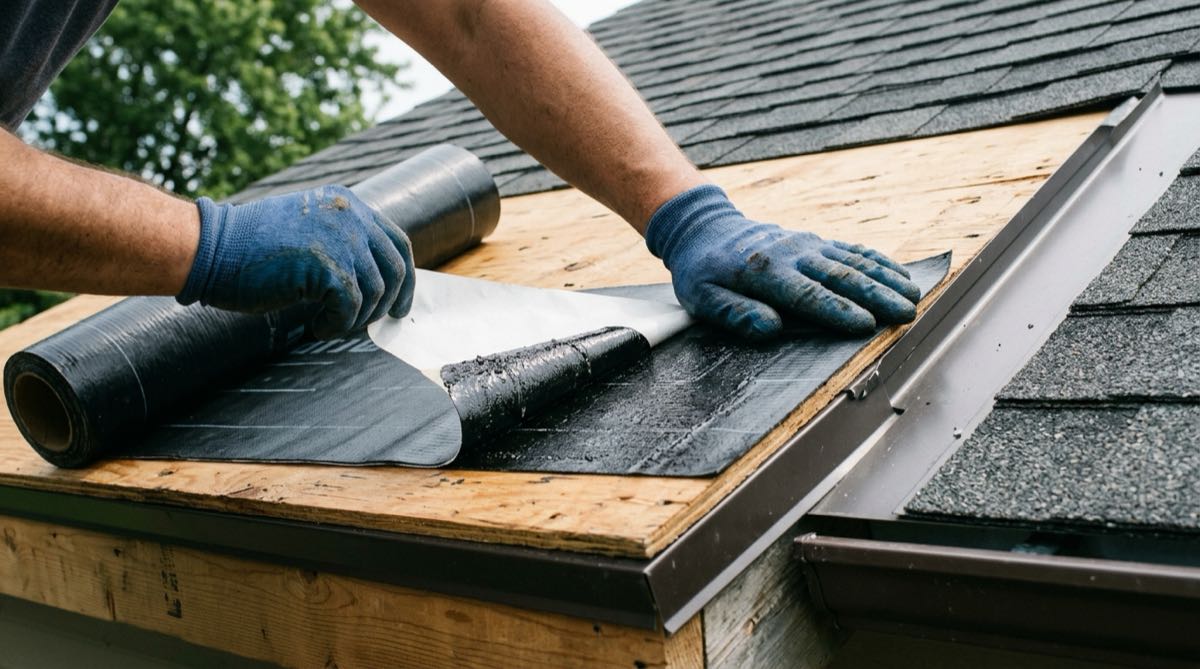
"Ice-and-water shield" and "underlayment" get used almost interchangeably in casual conversation about a new roof, and they shouldn't be — one is a specific, code-regulated product used in specific places, and the other is the general term for what covers the rest of the deck. Confusing the two is how a homeowner ends up assuming a roof is fully protected against ice-dam water when only the code-minimum strip actually is.
What Is Ice-and-Water Shield, Exactly?
A specific product category, not a synonym for "good underlayment."
Ice-and-water shield is built from two bonded layers: an aggressive rubberized asphalt adhesive backed by a slip-resistant, cross-laminated polyethylene film. During installation, a release paper is peeled away and the rubberized asphalt bonds directly to the roof deck — no separate fasteners or adhesive application (CertainTeed, retrieved 2026-09-02). That self-sealing property is the entire point: standard underlayment sheds water that's moving downhill under gravity, but it isn't designed to hold back standing water pooling behind an ice dam, and it isn't designed to seal itself around the nail penetrations the shingles above it create. Ice-and-water shield does both, which is why code singles it out as a distinct product rather than just specifying "underlayment" everywhere.
The product is also engineered to seal around fasteners driven through it — a roofing nail passing through the membrane doesn't leave an open path for water, because the rubberized asphalt closes back around the shaft. That detail matters specifically at the eaves and valleys, where the shingles above are nailed directly through it.
What Does the Building Code Actually Require?
A specific, measurable coverage distance — not a general "use ice-and-water shield" instruction left to a contractor's judgment.
Under the International Residential Code, Section R905.1.2, roofs in areas with a documented history of ice forming along the eaves and causing water backup must have an ice barrier — at least two layers of cemented underlayment, or a self-adhering polymer-modified bitumen sheet like the product described above — extending from the roof's lowest edge to at least 24 inches inside the exterior wall line, measured along the roof slope. On steeper roofs, at or above an 8:12 pitch, that coverage has to extend to at least 36 inches instead. Several of our own location guides — Ohio, Massachusetts, Maryland, and Minneapolis — cite this same code section for exactly this reason: cold-climate ice damming is common enough in those states that it isn't optional coverage.
The practical read: a contractor quoting a shorter run of ice-and-water shield than the code minimum for your pitch and climate isn't offering a budget-friendly alternative — they're describing a roof that may not pass inspection. Ask for the coverage distance in writing, not just confirmation that "ice-and-water shield is included."
Felt vs. Synthetic Underlayment: What's Actually Different
Away from the eaves and valleys, the rest of the roof deck gets standard underlayment — and here the real choice is between felt and synthetic, two genuinely different products with a real cost and lifespan gap between them.
| Felt underlayment | Synthetic underlayment | |
|---|---|---|
| Composition | Recycled paper and sawdust, saturated with asphalt | Woven or laminated polypropylene/polyethylene |
| Cost per sq ft | $0.05–$0.10 | $0.17–$0.25 |
| Typical lifespan | 12–20 years | 25–40 years |
| Tear resistance | Tears easily during install and in wind | Resists tearing around fasteners |
Felt is the traditional, cheaper option, and it's still code-compliant almost everywhere — the tradeoff is a shorter service life and a real risk of tearing during a windy install (Western States Metal Roofing, retrieved 2026-09-02). Synthetic costs more upfront but commonly outlasts the shingles above it and holds up better to foot traffic and weather exposure during the install itself, before the shingles even go on. Neither felt nor synthetic is a substitute for ice-and-water shield at the eaves — they're not self-adhering, and they're not rated to hold back standing water the way the code specifically requires in that zone.
Where Else Does Ice-and-Water Shield Belong?
Beyond the eave coverage code requires, it's standard practice — not always a strict code mandate, but a real gap if skipped — at every place water concentrates or the roof surface is interrupted: valleys, where two roof planes meet and funnel water together; around chimneys and skylights, where the roofing has to be cut and flashed against a vertical surface; and at any other roof penetration, like a plumbing vent boot. These are the same junctions our roof leak repair guide identifies as where most leaks actually start — the water finding its way in usually isn't coming through the open shingle field, it's finding the seam at one of these transitions.
Ask specifically whether valleys and penetrations are getting ice-and-water shield or just the standard underlayment continuing through — it's a small material cost difference with an outsized effect on where the roof actually fails first.
Why This Is Different From Attic Ventilation
Because one is a barrier and the other is a mechanism, and they solve different halves of the same cold-climate problem.
Ice-and-water shield is a physical, code-mandated barrier: if an ice dam forms and water backs up behind it, this membrane is what stops that water from reaching the roof deck. It does nothing to prevent the ice dam itself. Our roof ventilation guide covers the actual mechanism behind ice damming — warm air escaping a poorly ventilated attic melts snow unevenly, and that meltwater refreezes at the colder eaves — and how balanced intake and exhaust airflow keeps the roof surface cold enough, end to end, that the uneven melting driving the whole problem doesn't happen in the first place. Our ice dam prevention guide covers the fuller prevention picture beyond ventilation alone, including where it actually ranks in priority against air sealing and insulation. A well-ventilated attic and code-compliant ice-and-water shield aren't alternatives to each other; a roof genuinely built for a cold climate has both, addressing cause and consequence separately.
What to Ask Before You Sign
Get the ice-and-water shield coverage distance in writing, tied to your roof's actual pitch and climate zone — not a general assurance that "code is included."
Ask whether valleys, chimneys, and skylights are getting the same self-adhering membrane or just standard underlayment continuing through those junctions. And ask directly whether the quote specifies felt or synthetic for the rest of the deck, since that's a real, visible line-item difference worth seeing named rather than left as an unspecified "underlayment" allowance. For the rest of what a complete estimate should itemize, how to read a roof estimate covers it line by line.
Frequently Asked Questions
Is ice-and-water shield the same thing as underlayment?
No. It's a specific, self-adhering type of underlayment used at the eaves, valleys, and penetrations — the rest of the roof deck is typically covered with standard felt or synthetic underlayment instead, which isn't self-adhering and isn't rated for standing water the way ice-and-water shield is.
How far up the roof does ice-and-water shield need to go?
Under IRC Section R905.1.2, at least 24 inches inside the exterior wall line, measured along the roof slope from where the wall meets the roof deck. On roofs with a slope of 8:12 or steeper, that coverage extends to at least 36 inches.
Is synthetic underlayment worth the extra cost over felt?
For most homeowners, yes. Synthetic commonly runs $0.17 to $0.25 per square foot against felt's $0.05 to $0.10, but synthetic typically lasts 25 to 40 years versus felt's 12 to 20, and resists tearing during installation and wind exposure far better.
Does ice-and-water shield replace the need for attic ventilation?
No — they solve different halves of the same problem. Ice-and-water shield is a physical barrier that stops meltwater from reaching the deck if an ice dam forms. Attic ventilation addresses the actual cause, keeping the roof surface cold enough that uneven melting doesn't happen in the first place.
Figures are published estimates and vary by product, region, and installer.
Want to know what a full roof replacement costs, ice-and-water shield included?
Open the calculator