Roof Replacement Cost in Maryland: What You'll Actually Pay
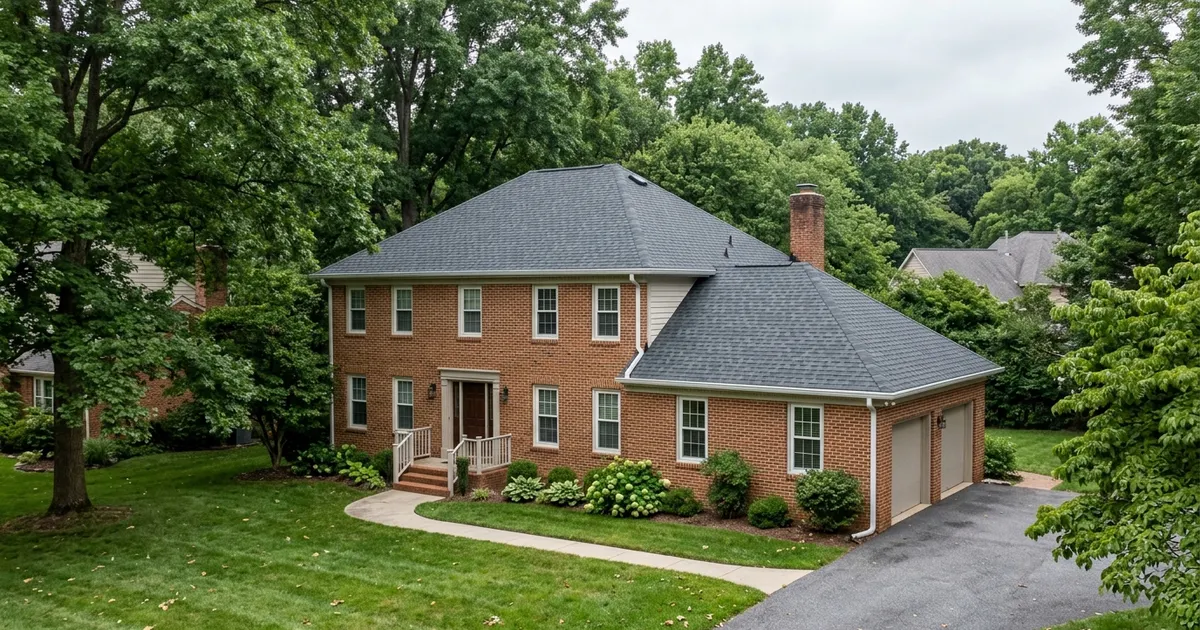
Maryland is one of a smaller group of states where a roofer legally cannot sign a home improvement contract with you at all without a specific state license number. Hire around that requirement, even unknowingly, and you give up a real financial backstop if the job goes wrong.
What Does a Roof Replacement Cost in Maryland?
$13,300 to $18,100 for a typical single-story home before anything unexpected turns up under the old shingles.
That range comes from a 0.93× Maryland labor multiplier and a $210 baseline permit fee, run against a 2,000 sq ft home with architectural shingle, moderate pitch, and a single layer of tear-off. Size, pitch, material, and layer count each move the number from there — run the calculator below against your own roof for a tighter range.
First time here? for a 2,400 sq ft home.
We can't load current pricing data right now — and we'd rather show you nothing than guess at a number this big. Please refresh in a moment.
Why Licensing Isn't Optional in Maryland
Nearly any residential roofing contract above $500 in Maryland — labor and materials combined — legally requires a contractor holding a Maryland Home Improvement Commission license, under the state's Business Regulation Article (Maryland Business Regulation §8-101, retrieved 2026-08-09). A $450 labor job with $200 in materials already crosses that line. Most states have no equivalent statewide licensing requirement specifically for home improvement work.
The reason to care isn't the paperwork. Licensed contractors pay into the MHIC Guaranty Fund, and homeowners who hire one can file a claim against it if the job is abandoned or the work is defective — recovering up to the amount paid the contractor, capped at $30,000 per claim (Maryland Home Improvement Commission, retrieved 2026-08-09). Hire an unlicensed contractor and that fund simply isn't available to you, no matter how bad the outcome.
| MHIC-licensed | Unlicensed | |
|---|---|---|
| Contract validity | Legally valid | May not be enforceable |
| Guaranty Fund claim | Available, up to $30,000 | Not available |
| How to recover if the job fails | File a claim with MHIC | Civil suit, at your own cost |
| Legal status of the work | Compliant | Contractor is operating illegally |
How Permitting Actually Works Across Maryland's 24 Jurisdictions
The building code is set at the state level, but the office that reviews your permit — and how long that takes — depends entirely on where in Maryland the house sits.
In Montgomery County, one of the state's largest permitting jurisdictions, the Department of Permitting Services typically returns first-round review comments on a standard residential application in about four weeks, or roughly 30 calendar days, for properly submitted plans (Montgomery County Department of Permitting Services, retrieved 2026-08-29). That's for a full review cycle — a straightforward like-for-like reroof without structural changes can move faster, but the office won't commit to a number over the phone, which is exactly why it's worth asking your contractor how they've timed similar jobs in your specific jurisdiction rather than assuming a statewide average.
That variation is structural, not incidental. Maryland's 23 counties plus Baltimore City each run their own permitting office, inspection schedule, and — in some cases — local code amendments layered on top of the statewide Maryland Building Performance Standards. A contractor who works across county lines regularly should be able to tell you which office your permit routes through and roughly what that office's current backlog looks like, without you having to call and find out yourself.
What Does Maryland's Wind Code Actually Require?
It depends heavily on how close to the water you are — and that's a real, structural difference within the state, not just a coastal marketing angle.
Maryland's design wind speeds run from roughly 90 to 115 mph inland up to considerably higher on the Eastern Shore, under ASCE 7 as adopted through the Maryland Building Performance Standards. Worcester County — Maryland's only true oceanfront county, home to Ocean City — sits in a 125 mph wind speed zone with Exposure C, and requires shingles installed per the manufacturer's specific high-wind-zone instructions rather than a standard nailing pattern (Worcester County Department of Development Review & Permitting, retrieved 2026-08-29). The county's own guidance is blunt that actual storm winds can exceed even that 125 mph design figure — a reminder that the code sets a legal minimum, not a ceiling on what the roof might actually face.
Practically: if you're anywhere near the Chesapeake Bay or the Atlantic side of the Eastern Shore, ask your contractor directly what wind zone your specific address falls under and whether the quoted fastening pattern matches it — a standard six-nail asphalt install common inland isn't necessarily what a high-wind zone requires.
Does Maryland's Humidity Actually Affect Which Material You Should Pick?
Yes, in one specific, visible way — and it's worth pricing into the decision rather than discovering it on the north side of your own roof a few years in.
The dark streaking that shows up on asphalt shingle roofs, especially on shaded, north-facing slopes, is Gloeocapsa magma, a blue-green algae that produces a dark pigmented sheath to protect itself from UV exposure. The trade association representing asphalt shingle manufacturers is direct that coastal or humid climates create the most conducive conditions for it to take hold (Asphalt Roofing Manufacturers Association, retrieved 2026-08-29) — a description that fits Maryland's Chesapeake Bay-moderated summers about as well as it fits anywhere on the East Coast. The same guidance names two real preventive options worth asking a contractor about at replacement time: zinc or copper strips installed along the ridge, or a shingle product manufactured with algae-resistant copper granules mixed in.
Neither option is required by code, and algae staining itself is cosmetic rather than structural — it won't shorten your roof's functional life the way a code violation would. But it's a real, visible, Maryland-relevant question worth asking before you sign, not an upsell to reflexively decline: ask whether the quoted shingle line offers an algae-resistant option, and if it doesn't, ask what that would add to the price.
What to Verify Before You Sign in Maryland
Look up the contractor's MHIC license number directly through the state before anything else — a name and a logo on a truck don't confirm it.
Beyond the license itself, permitting in Maryland is still handled locally even though the underlying building code is set statewide, so ask which of the state's 24 jurisdictions — 23 counties plus Baltimore City — your permit runs through and what that office typically requires. For the rest of what a fair quote should contain, how to read a roof estimate covers it line by line, and how to get roofing quotes walks through comparing three bids fairly before you pick one.
Frequently Asked Questions
Is a roofing license actually required in Maryland?
Yes. Any home improvement contract over $500 in combined labor and materials requires an MHIC-licensed contractor by law. Roofing replacement almost always exceeds that threshold.
What does the MHIC Guaranty Fund cover?
Financial losses from a licensed contractor's poor workmanship or an abandoned job, up to $30,000 per claim. It only applies to work performed by a contractor who held a valid MHIC license at the time.
How do I check if a contractor is MHIC-licensed?
Search the contractor's name or license number directly through the Maryland Department of Labor's licensing lookup before signing anything, rather than taking a contractor's word for it.
Will homeowners insurance cover storm damage to a Maryland roof?
Often, for sudden covered causes like wind or hail, though your specific policy and deductible structure control the outcome. Our insurance claim guide covers what insurers typically look for when reviewing a claim.
How long does a roofing permit take to approve in Maryland?
It depends on the jurisdiction, since each of Maryland's 23 counties plus Baltimore City runs its own office. In Montgomery County, standard residential review typically takes about 30 calendar days for a first round of comments. Ask your contractor how long permits have taken recently in your specific county.
Do Maryland roofs need special wind-rated construction?
It depends on location. Inland counties design to roughly 90-115 mph under ASCE 7. Worcester County, on the Atlantic coast, requires a 125 mph wind speed zone rating with shingles installed per the manufacturer's high-wind instructions. Ask which zone your specific address falls under.
Does Maryland's climate cause algae staining on roofs?
It can, especially on shaded, north-facing slopes. The dark streaking is Gloeocapsa magma, a blue-green algae that thrives in humid, coastal-adjacent climates like Maryland's. Zinc or copper strips, or a shingle with algae-resistant copper granules, are the two real preventive options worth asking about at replacement time.
Cost data updated August 2026. Figures are published estimates and vary by roof size, pitch, material, and local permit fees.
What do you want to do next?
Three ways we can help from here.
Get the free contractor checklist → 7 questions to ask any roofer before you call. Know what to ask, and what a good answer sounds like.