Metal Roof Cost: What You Pay by System, Metal, and Service Life
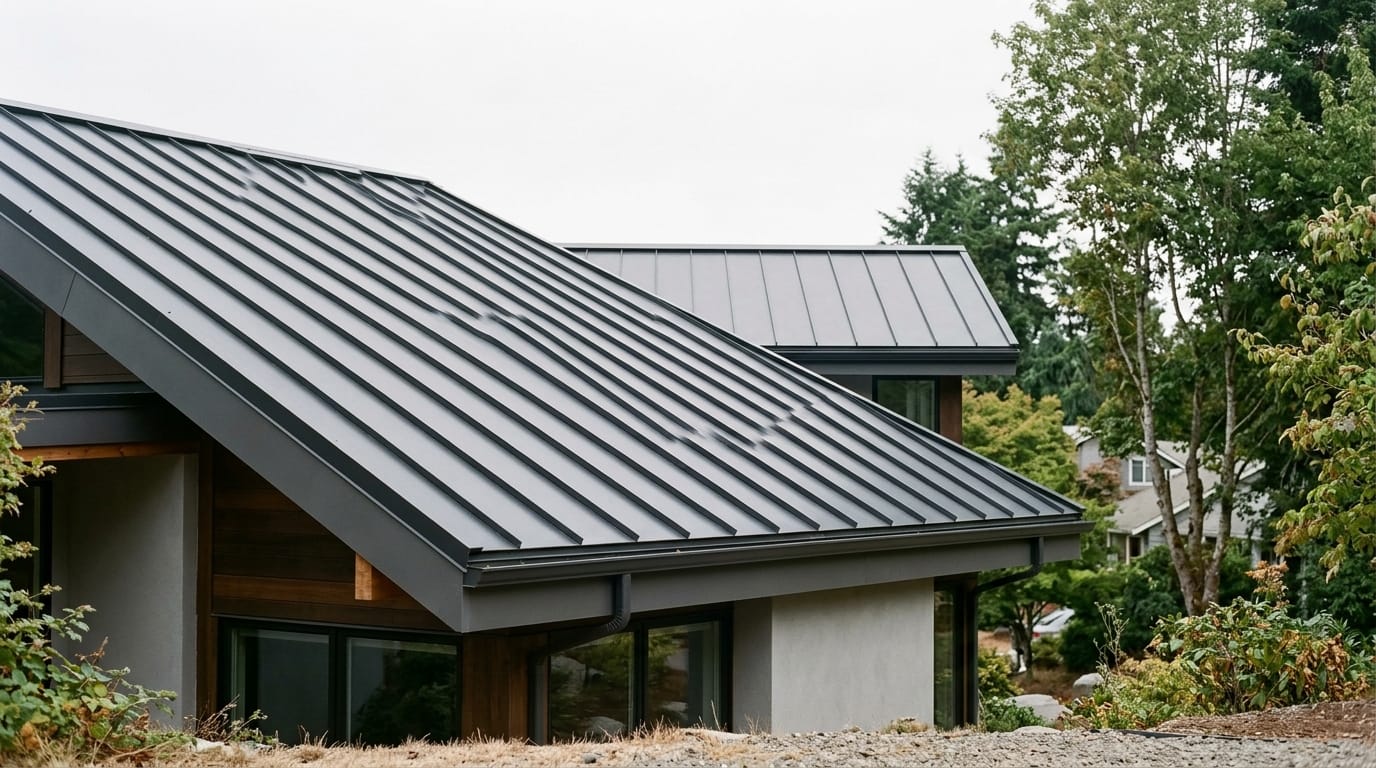
Metal roofing runs $600 to $1,400 per square for metal shingle and $1,000 to $1,800 for standing seam, against $400 to $600 for architectural asphalt. A square is 100 square feet, so a 2,000 sq ft roof is 20 squares. Metal lasts far longer — but divided across that life, it is not automatically the cheaper roof, and the arithmetic below shows why.
What Does a Metal Roof Cost Per Square?
Between $600 and $1,800 installed, depending on which system you buy.
The same figures in text:
| System | Installed cost per square | Expected service life |
|---|---|---|
| 3-tab asphalt | $350 – $450 | ~20 years |
| Architectural asphalt | $400 – $600 | ~30 years |
| Metal shingle | $600 – $1,400 | ~45 years |
| Standing seam metal | $1,000 – $1,800 | ~50 years |
The metal shingle range is unusually wide because "metal" is four different purchases. Steel sits near the bottom. Aluminum costs more and handles salt air better. Zinc and copper sit at the top, and copper is effectively a lifetime material. Ask which metal a quote is priced on before comparing two of them.
For your own roof size and pitch, our roof cost calculator runs these same figures with tear-off, permits and access included. If you're still deciding between metal and shingle rather than pricing metal specifically, our decision guide covers the factors beyond cost — HOA rules, wildfire-zone requirements, and how long you plan to own the house.
What Does a "Tin Roof" Cost Per Square Foot?
Divide the per-square figures above by 100, since a roofing square is 100 square feet, and "tin roof" pricing looks like this:
| System | Installed cost per sq ft |
|---|---|
| 3-tab asphalt | $3.50 – $4.50 |
| Architectural asphalt | $4.00 – $6.00 |
| Metal shingle | $6.00 – $14.00 |
| Standing seam metal | $10.00 – $18.00 |
Worth clearing up directly: almost nobody selling a "tin roof" today is actually selling tin. Tin roofing historically meant iron or steel sheets dipped in a tin (or tin-lead "terne") coating, popular through the late 1800s before asphalt shingles took over the market in the early 1900s. The name stuck in everyday language even as the material changed — what's sold and installed as a "tin roof" now is standing seam or corrugated steel, aluminum, or Galvalume, not literal tin (DECRA, retrieved 2026-08-26). So if a quote uses the word "tin," ask which of the systems in the table above it's actually describing — the per-square-foot price depends entirely on that answer, not on the word itself.
A note on location-specific pricing: if you're comparing "metal roof cost in Valdosta, GA" specifically, our cost model doesn't carry a city-level multiplier for Valdosta — it prices at the state level. Georgia's statewide labor and permit figures are in our Georgia location guide, and the per-square-foot ranges above apply on top of that state baseline the same way they would anywhere else.
Is Metal Actually Cheaper Over the Long Run?
Usually not, on published figures — and this is the claim worth checking hardest. Our roof replacement cost guide runs the same arithmetic across all six materials we price, and how long a roof actually lasts covers the service-life side in depth.
The same arithmetic in text:
| System | Midpoint cost per square | Service life | Cost per square, per year |
|---|---|---|---|
| Architectural asphalt | $500 | 30 years | $16.67 |
| 3-tab asphalt | $400 | 20 years | $20.00 |
| Metal shingle | $1,000 | 45 years | $22.22 |
| Standing seam metal | $1,400 | 50 years | $28.00 |
Metal roofing marketing leans hard on service life, and the life is real. But longer life does not automatically mean lower cost per year, because the purchase price rises faster than the lifespan does. On midpoint figures, architectural asphalt is the cheapest roof per year of service that we price.
For example, take a 2,000 sq ft roof — 20 squares — over a 60-year horizon, in today's dollars. Architectural asphalt at $500 per square costs $10,000, and you do it twice across 60 years, plus one tear-off of the old layer at roughly $140 per square: about $22,800 all in. Standing seam at $1,400 per square costs $28,000, once, and is still in service at year 60. The metal roof costs about $5,200 more over that period.
That number leaves out what matters to some owners and not others. You do the job once instead of twice. You are not exposed to two future labor markets. And you do not live through a second tear-off. That is a real benefit. It is just not a saving, and anyone selling it as one is rounding in their own favor.
Standing Seam or Exposed Fastener?
Standing seam hides its fasteners; corrugated and through-fastened panels drive screws through the panel face. That single difference drives most of the durability gap.
Metal expands and contracts constantly. Panel surface temperatures "may range more than 200°F in a season, 150°F in a single day, and 100°F within minutes" as cloud cover moves and rain arrives. That cycling happens "tens of thousands of times in a single year" (Metal Construction Association, retrieved 2026-08-03).
Standing seam handles this with concealed clips that let panels slide. The industry body describes concealed-clip systems as eliminating fastener penetration of the weathering surface, and calls them "premium technologies over face-fastened panel designs from a weathering and durability standpoint at a modest increase in cost" (Metal Construction Association, retrieved 2026-08-03). Worth noting that "modest" is the trade association's word — our own pricing puts standing seam well above metal shingle, so treat the cost gap as real.
Exposed-fastener panels are cheaper and constrain that movement. Every screw carries a rubber washer that ages under UV and thermal cycling, and those washers are the maintenance item. Budget for re-torquing or replacing fasteners periodically rather than assuming a metal roof is maintenance-free.
One failure mode to know: where clips do not allow enough travel, the result is "panel buckling, clip damage, fastener distress and objectionable noise to room side" (Metal Construction Association, retrieved 2026-08-03). That ticking and popping is thermal movement, not rain.
What About Gauge and Metal Type?
Lower gauge numbers mean thicker metal, and the number alone is not a specification.
Residential steel panels commonly run 24, 26 or 29 gauge, thickest first. Two cautions. Steel and aluminum use different gauge systems, so the numbers are not comparable across metals. And gauge tolerances vary between suppliers.
Ask for the decimal thickness rather than the gauge number. A real product approval quotes it that way — one code-listed steel panel is specified at 0.017 inch coated thickness over an aluminum-zinc alloy coating (ICC-ES ESR-1754, retrieved 2026-08-03). A quote that will not give you a decimal is not giving you a specification.
We could not find an authoritative gauge-to-decimal table for residential roofing from a standards body or trade association — the charts in circulation come from suppliers and fabricators. Treat gauge directionally and get the decimal in writing.
Will It Corrode?
Not on its own, but it will corrode where it touches the wrong thing.
Galvanic corrosion needs two conditions: incompatible metals, and moisture completing the circuit. Chlorides in seawater or de-icing salt are strong electrolytes (Metal Construction Association, retrieved 2026-08-03).
From the same technical bulletin, the specifics worth carrying into a site meeting:
- Copper is severely corrosive to steel, aluminum and zinc — including simple runoff from copper gutters, pipes or HVAC onto the roof below.
- A galvanized nail in an aluminum roof is the classic failure. Aluminum fasteners in an aluminum-zinc coated steel roof are fine.
- Graphite from an ordinary pencil is extremely corrosive to aluminum. Do not let anyone mark panels with one.
- Preservative-treated lumber and cementitious materials such as mortar and stucco attack aluminum-zinc coatings.
- In marine or severe industrial exposure, 316L stainless is generally the minimum, fasteners included.
The bulletin closes with a caution worth repeating: relying solely on a galvanic scale "does not always provide accurate guidance." If you are near salt water, make corrosion the first question you ask, not the last.
Does a Metal Roof Save Energy?
Some, in hot climates, and far less than the marketing implies.
The physics are real. A clean white roof reflecting 80% of sunlight runs about 55°F cooler than a gray roof reflecting 20%, and a cool-colored roof reflecting 35% runs about 22°F cooler than a conventional roof of the same appearance (Lawrence Berkeley National Laboratory, retrieved 2026-08-03).
The money is smaller than the temperature drama suggests. Federal guidance puts a cool-colored roof on a home at annual energy savings "worth up to $0.05/ft²," greatest in hot and warm climates. It also notes a cool roof can cut annual air-conditioning energy use of a single-story building by up to 15% (DOE/LBNL fact sheet, retrieved 2026-08-03). On a 2,000 sq ft roof, five cents a square foot is roughly $100 a year at the upper bound — and that is air-conditioning energy, not the whole bill. The same guidance notes two things worth holding onto. Reflectance drops as roofs soil. And it is "rarely economical to replace a mechanically sound roof just to increase its solar reflectance."
One marketing claim to retire. If a quote advertises an "ENERGY STAR certified" roof, the certification it names has not existed since June 1, 2022, when the EPA ended the roofing programme — no roofing product has carried the mark since (Cool Roof Rating Council, retrieved 2026-08-03). Ask for solar reflectance and thermal emittance figures instead.
Will It Survive Hail, and Will Insurance Discount It?
Impact resistance is graded on a standard scale, but the discount is not standard at all.
UL 2218 rates products Class 1 through 4 by dropping steel balls of increasing size — 1.25, 1.5, 1.75 and 2.0 inches — from the height needed to match the kinetic energy of a hailstone of the same size. A product fails if the strike produces a tear or crack visible on the back of the material; crushed granules and surface dents do not count as failure (IBHS, retrieved 2026-08-03).
Two findings from that testing deserve more attention than they get. First, the tests "do not exactly replicate natural hailstone impacts," and the pass criteria "do not necessarily reflect the performance criteria used by insurance companies in determining whether to repair or replace." Second, of the products tested, none passed more than Class 2 impacts without at least one location failing. Class 4-rated impact-resistant architectural shingles passed only about 41% of Class 4 impact locations (IBHS, retrieved 2026-08-03). That testing covered asphalt shingles, not metal, so read it as a caution about what a Class 4 label promises rather than as a metal result.
On the discount, one state regulator confirms UL 2218 Class 1–4 as the qualifying standard, with Class 4 earning the highest credit. It also states plainly that "the amount of discount for each class of roofing material is established by the insurance company on a company-by-company basis" (Texas Dept. of Insurance, retrieved 2026-08-03). The classification is standardised. The discount is not, and it varies by state and by carrier. Ask your own insurer for a number before you price a decision around it.
What Does It Return at Resale?
More dollars than asphalt and a smaller percentage — and most write-ups get this backwards.
The same figures in text:
| Asphalt shingle | Metal | |
|---|---|---|
| Job cost | $31,871 | $51,865 |
| Resale value added | $21,501 | $25,972 |
| Cost recouped | 67.5% | 50.1% |
National averages across 119 markets (JLC Cost vs. Value 2025, retrieved 2026-08-03). Metal recoups a lower percentage because the job costs about 63% more, not because buyers value it less. In absolute terms it adds roughly $4,500 more to resale than asphalt does. If you are choosing on resale alone, read the dollars; if you are choosing on efficiency of spend, read the percentage.
Is It Noisy in the Rain?
Nobody has published a study that answers this, and the numbers you will find are not measurements.
This deserves plain speaking. The decibel figures circulating for metal versus asphalt trace back to a single manufacturer marketing sheet. That sheet cites an unnamed study attributed to a Swedish university, with no author, year, title or link (ATAS International, retrieved 2026-08-03). The specific decibel numbers repeated across dozens of roofing blogs do not even appear in that sheet — it contains an unlabelled bar chart, and the figures appear to have been read off it by eye.
So we are not going to give you a decibel number. What is uncontroversial is what actually governs the sound: whether panels sit on a solid deck or on open framing, the underlayment beneath them, the attic air space, and the ceiling insulation below. A standing seam roof on a solid deck over an insulated attic is a very different acoustic proposition from corrugated panels on purlins over an open barn. Most residential installations are the former.
Does Metal Attract Lightning?
The industry body says no. There is no independent research we could find either way.
The Metal Construction Association holds that a metal roof "is no more or less likely to be struck by lightning than any other type of roofing material." It points to NFPA 780 as the standard governing lightning protection systems. Note that MCA is the industry's own trade association (Metal Construction Association, retrieved 2026-08-03).
We looked for a fire-safety or lightning-research body making the same statement and did not find one. Many articles attribute this consensus to NFPA and others; we could not verify that attribution. What is true regardless of roof material is that lightning protection is governed by NFPA 780, so if you are in a high-strike area, that is the conversation to have.
Frequently Asked Questions
Can a metal roof go over existing shingles?
For some products, yes, and it is code-recognised rather than a workaround. One evaluation report permits installation over existing asphalt shingle, built-up, wood shake or wood shingle roofs where the slope complies and the relevant IRC or IBC re-cover provisions are met, with fasteners long enough to penetrate the deck (ICC-ES ESR-1754, retrieved 2026-08-03). That is one manufacturer's approval, not blanket permission — and local codes override. Los Angeles, for instance, forbids installing those panels over wood shakes or shingles.
How long does asphalt actually last, for comparison?
About 20 years on the most-cited industry figure, from a 2007 study of home component life expectancy (NAHB study, mirrored copy, retrieved 2026-08-03). Two caveats travel with that number. The study was compiled from a telephone survey of manufacturers and trade associations, so it is self-reported by sellers. And it contains no entry for metal roofing at all — the "NAHB says metal lasts 40–50 years" line in circulation is simply not in the document.
Is standing seam worth the premium over metal shingle?
It buys concealed fasteners, better handling of thermal movement, and roughly five more years of expected life. That runs about $400 more per square at the midpoint. Whether it is worth it depends on how long you intend to own the house, and on whether you want to avoid the periodic fastener maintenance exposed systems require.
Does a metal roof need maintenance?
Standing seam is low-maintenance but not zero — sealants at penetrations and terminations age. Exposed-fastener systems need washers checked and fasteners re-torqued or replaced periodically. Both need debris kept out of valleys. Both also need care about what touches them, since copper runoff and treated lumber are corrosion risks.
Will my roof deck need work first?
Possibly, and it is the line item most likely to change your quote after work starts. Metal is light: one code-listed panel installs at about 1.3 pounds per square foot. So the issue is usually the deck's condition rather than its capacity. Ask for a price per sheet of decking in writing before the job starts.
What does a tin roof cost per square foot?
Between $6.00 and $18.00 per square foot installed, depending on the system: metal shingle runs $6.00–$14.00 per sq ft, standing seam $10.00–$18.00. Almost nobody selling a "tin roof" today is actually installing tin — the word is colloquial for steel, aluminum, or Galvalume metal roofing.
Cost figures are published US ranges from our own cost dataset and vary by region, roof complexity and access. Cost data updated August 2026.
What do you want to do next?
Three ways we can help from here.
Get the free contractor checklist → 7 questions to ask any roofer before you call. Know what to ask, and what a good answer sounds like.