Metal Roof vs. Shingles: How to Actually Decide
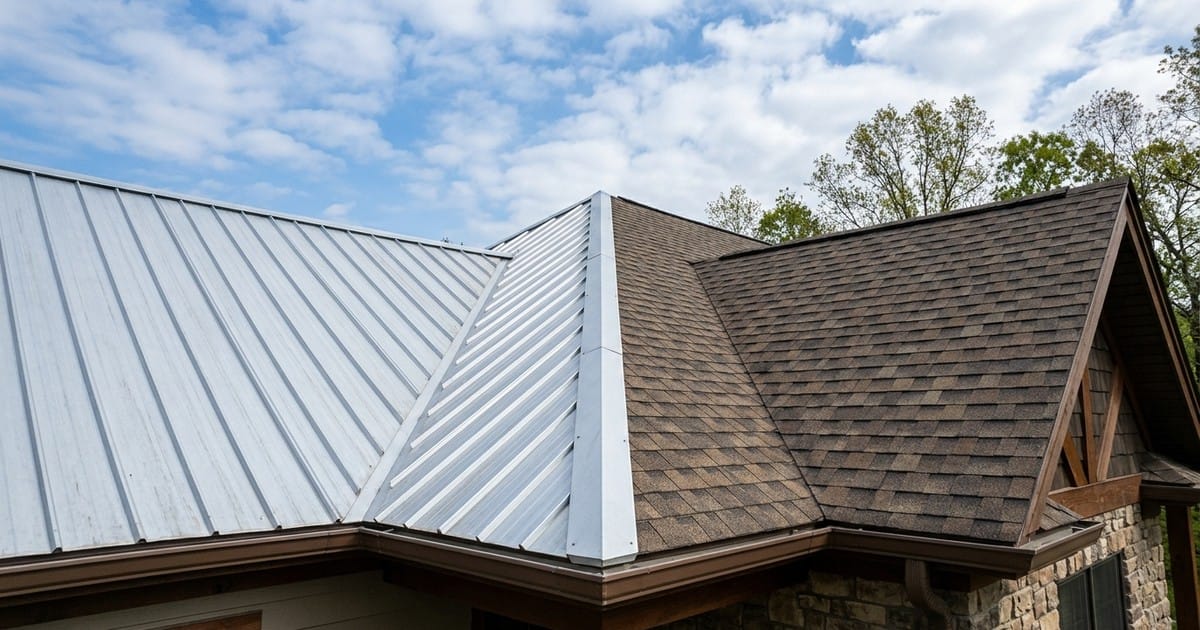
One metal-roof owner, describing the first hard rain after installation, said it sounded "like Chinese water torture." The same owner said they were thrilled with the roof anyway. That's the actual shape of this decision — real tradeoffs pulling in different directions, not a clean winner one side keeps insisting on.
Our metal roof cost guide already runs the pricing and service-life arithmetic in detail — cost per square, cost per year of service, resale return by dollar and by percentage. This post is the companion to that one: not what metal costs, but which of the two actually fits your situation, which depends on things the spec sheet doesn't cover.
The Comparison Most Guides Skip
Price and lifespan get all the attention. Three other factors decide this just as often, and rarely make it into a cost breakdown:
| Factor | Shingle | Metal |
|---|---|---|
| Whether your HOA allows it | Rarely restricted | Historically restricted by some HOAs on aesthetic grounds |
| How it performs in a wildfire-hazard zone | Meets Class A only as part of a tested assembly | Naturally noncombustible, commonly used to meet Class A requirements |
| What changes if you sell in 5-10 years | Lower upfront cost, output matches shorter horizon | Higher upfront cost recouped less as a percentage, but more dollars added at resale |
Does Your HOA Actually Allow It?
This is worth checking before you fall in love with either option, because it can end the decision on its own.
Some homeowners associations have historically restricted metal roofing purely on appearance grounds — treating it as "too industrial" for the neighborhood's established look, independent of how well it performs. That's changing in places. Florida's Senate Bill 600, passed in 2024, requires HOA boards to adopt hurricane-protection specifications that conform to building code and prohibits denying an application for hurricane protection — a term the law explicitly includes metal roofing under (The Florida Senate, bill analysis, retrieved 2026-08-04). The HOA can still require a specific finish or color to match the neighborhood; it generally can't refuse metal outright anymore in Florida.
That's one state's law, not a national rule. Read your own CC&Rs before you commit to either material, and ask your HOA board directly rather than assuming either way.
How Long You're Staying Matters More Than the Spec Sheet
A 50-year roof is a genuinely different purchase if you're planning to own the house for 8 years versus 30.
If you're not staying long, the lifespan story that metal roofing marketing leans on doesn't fully apply to you — you'll sell the house long before either roof needs replacing. What matters more at that horizon is upfront cost and what you get back at resale. On that specific point, our cost guide's finding holds: metal recoups a lower percentage of its cost than asphalt, but adds more dollars to resale value, because the job itself costs substantially more. Which number matters to you depends on whether you're optimizing for efficient spending or for the largest absolute return — the full breakdown is here.
If you're staying long enough to actually use the extra service life, the calculus shifts toward metal, and the "install once instead of twice" argument becomes real rather than theoretical.
If You're in a Wildfire or Hail Zone, the Decision Changes
Geography can override personal preference here.
In areas with a mapped wildfire hazard, some jurisdictions require a Class A fire-rated roof covering as part of the building code — our California cost guide covers this in detail for homes in a designated Wildland-Urban Interface zone. Metal is naturally noncombustible and commonly used to meet that requirement, though asphalt shingle can also be manufactured and installed as a tested Class A assembly. Check your own property's fire hazard zone designation before assuming either material qualifies or is required.
Hail is a different geography problem with its own testing standard (UL 2218), already covered in depth in the cost guide, including the honest caveat that no product tested — metal or asphalt — passed every impact location without at least one failure. If hail is your primary concern, read that section before choosing on hail resistance alone.
What Actually Bothers Owners After Install
The rain-noise complaint above is real and common, and it's usually not really about the metal.
What actually governs how loud a roof sounds in rain is the attic setup underneath it — solid decking versus open framing, the underlayment, and how much insulation sits between the roof and the living space below. A well-insulated attic under metal is a different listening experience than an open barn roof, and most residential installations are built closer to the first case. If noise is a real concern, ask your contractor about underlayment and insulation specifically, rather than ruling out metal on the strength of one forum comment.
| Situation | Reason | Recommendation |
|---|---|---|
| HOA restricts metal, or you're unsure | Check your CC&Rs first | This may decide it before cost does |
| Property in a mapped fire-hazard zone | Class A covering may be required | Metal commonly qualifies |
| Selling within 5-10 years | Won't personally use the longer lifespan | Weigh upfront cost and resale dollars, not lifespan |
| Staying 20+ years | Long enough to use the extra service life | The "install once" case gets real |
| ## Frequently Asked Questions |
Is metal roofing allowed by my HOA?
It depends on your specific HOA and, increasingly, your state. Some HOAs restrict metal roofing for appearance reasons, but that authority is being narrowed in places — Florida law now prevents HOAs from denying metal roofing as a form of hurricane protection. Read your CC&Rs and ask your board directly rather than assuming either way.
Which one should I pick if I'm selling in five years?
Lean toward whichever gives you the better return for your specific timeline rather than the longer lifespan — the 50-year service life a metal roof offers isn't something you'll personally use if you sell well before then. Compare upfront cost against resale dollars added for both options using our metal roof cost guide.
Is metal roofing worth it in a wildfire zone?
If your property sits in a mapped Wildland-Urban Interface or Fire Hazard Severity Zone, check whether a Class A fire-rated roof covering is required first — that's a code question, not a preference question. Metal commonly meets that requirement, but so can a properly tested asphalt shingle assembly, so the requirement doesn't automatically decide the material for you.
Cost figures referenced here are covered in full in our metal roof cost guide, updated August 2026.
What do you want to do next?
Three ways we can help from here.
Get the free contractor checklist → 7 questions to ask any roofer before you call. Know what to ask, and what a good answer sounds like.