How to Find a Roof Leak: A Step-by-Step Guide Before You Call a Roofer
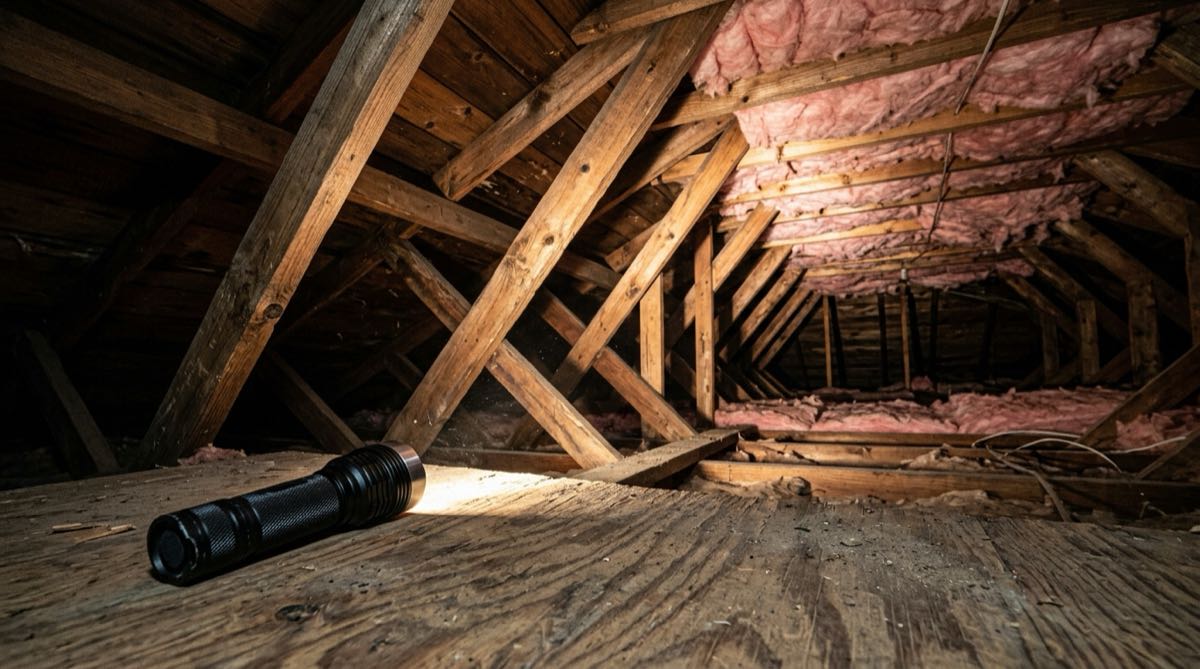
The water stain on your ceiling tells you where the leak ended up, not where it started. Water that gets past a roof's surface runs along the underside of the deck and along the rafters before it ever drips — sometimes for several feet — which means the actual opening in your roof is very often nowhere near the spot you're staring at from the room below. Finding it takes a specific, systematic method, not a guess based on which room the stain is in.
Is It Actually a Leak, or Is It Condensation?
Worth settling before you spend an afternoon chasing the wrong problem.
A real leak tends to show up during or shortly after rain, as a localized, genuinely wet or saturated patch — often near a penetration, valley, or roof edge. Condensation tends to show up on a cold, dry night with no rain at all, as a more diffuse pattern across the attic — light droplets or damp insulation spread over a wider area rather than one soaked spot, along with rust forming on exposed nail heads over time. The mechanism is warm, moist indoor air reaching the cold underside of the roof deck and condensing there, which is a ventilation and air-sealing problem, not a hole in the roof — our attic ventilation guide covers the intake/exhaust mechanics behind it if that's what you're actually dealing with. If you genuinely can't tell which one you have, treat it as a leak until proven otherwise — the downside of an unnecessary inspection is smaller than the downside of ignoring a real one.
Why the Water Isn't Where You Think It Is
Because the roof deck and rafters act like a set of rails, not a flat pane of glass.
Water that gets past the roof's surface lands on top of the decking and runs downhill along the slope — sometimes six or eight feet — until it hits a seam, a nail, or a rafter edge. It then often follows that rafter sideways before finally dripping down onto the ceiling drywall below, where it spreads outward like a stain on a paper towel. That's why the entry point is frequently upslope and to the side of the interior stain, not directly above it — a pattern confirmed by independent roofing-industry inspection guidance (National Roof Certification and Inspection Association, retrieved 2026-09-03). Keep that direction in mind for every step below: you're not looking for a spot, you're following a trail.
The Systematic Attic Walkthrough
Do this with a flashlight, ideally during or right after rain, when the trail is easiest to see.
- Start at the stain and look up, then look uphill. Note the ceiling location, then go to the attic directly above it and work toward the roof's ridge from there, not straight up.
- Check every penetration first. Vent pipes, exhaust fans, chimneys, and skylights rely on flashing and sealant to stay watertight, and they fail far more often than an intact field of shingles or membrane. Our roof flashing guide covers exactly why flashing fails in the first place, if you want the mechanism.
- Look for the trail, not just a wet spot. A brown or black stain running along the decking or a rafter, transitioning from dark to normal-colored wood, points toward the true entry at its highest, darkest end.
- Note valleys and old nail holes too. A valley is where two roof planes funnel water together, concentrating flow onto a single seam. An old nail hole left from a satellite dish mount, a since-removed vent, or a re-roof over the original layer is an easy, easy-to-miss entry point.
- Check daylight. If you can see daylight coming through the decking anywhere, water can get in the same way.
The Controlled Water Test
For when the attic walkthrough narrows the area but doesn't pinpoint the exact spot.
This takes two people and a garden hose. One person stays in the attic with a flashlight; the other runs water over a small, specific section of the roof from the lowest point up — starting near the eave below the suspected area and working uphill in stages, waiting several minutes at each stage before moving higher. The moment the person inside sees water start to drip, you've isolated the zone. Testing from the bottom up matters: water sprayed indiscriminately near the ridge can find its way in anywhere along the path down, giving you a false positive far from the real problem.
What If You Don't Have Attic Access, or It's a Flat Roof?
The method above depends on an attic to trace water through — a finished ceiling with no access, or a flat or low-slope membrane roof, needs a different approach.
No attic access: without a way to see the underside of the deck, DIY tracing is genuinely limited. A contractor with a moisture meter or a borescope can check without opening drywall; for anything beyond a quick look, this is usually the point to call a professional rather than start cutting into a ceiling.
Flat or low-slope roofs don't leak the same way pitched roofs do, and the surface can look completely dry while the insulation underneath is saturated. Our flat roof leak repair guide covers the actual detection method used there — infrared thermography and moisture meters, not a visual attic walkthrough — in depth.
Document What You Find
Photograph every stain, wet spot, and suspected entry point, with the date. This does two things: it gives a roofer a head start instead of having them re-trace your steps from scratch, and it's the documentation an insurance claim needs if one follows — our insurance claim guide covers what a claim actually requires and the timeline for filing.
When Should You Stop and Call a Pro?
The attic walkthrough above is safe for most homeowners — you're on solid framing, not a sloped, potentially wet roof surface. Getting onto the roof itself is where the real risk starts, and it's also where the DIY value drops off: professional fall-protection requirements exist for a reason once work moves above six feet (OSHA, retrieved 2026-09-03), and a trained inspector can usually find in minutes what takes a homeowner hours. If the attic walkthrough and water test don't isolate the source, or the roof itself needs to be walked to check further, that's the handoff point. Regular inspection catches most of this before it ever leaks — our roof inspection checklist covers what you can safely check from the ground on an ongoing basis, separate from active-leak diagnosis.
Once You've Found It, What's Next?
Finding the source is half the job — what it costs to actually fix, by the type of failure you found, is the other half. Our roof leak repair cost guide breaks that down by cause, including the point where a repair stops making financial sense and a full replacement takes over.
Frequently Asked Questions
Why isn't the leak directly above the ceiling stain?
Because water runs along the underside of the roof deck and along rafters before it drips. It can travel several feet — sometimes further on a low-slope section — before it hits something that makes it fall. The stain marks where the water exited downward, not where it entered the roof.
How do I know if it's a roof leak or just attic condensation?
Timing and pattern are the two biggest tells. Moisture that shows up during or right after rain, in one localized, saturated area near a penetration or valley, is usually a leak. Moisture that shows up after a cold night with no rain, spread more diffusely across the attic with light droplets rather than a soaked patch, is usually condensation from poor ventilation — a different problem with a different fix.
Can I find a roof leak myself without going on the roof?
Often yes, if you have attic access. Most leaks can be traced from inside the attic with a flashlight, following the water stain uphill toward its source, without ever climbing onto the roof itself. Going onto the roof surface is where the real risk starts, and it's the point where hiring a professional makes more sense than continuing on your own.
What's different about finding a leak on a flat roof?
Flat and low-slope roofs usually don't give you an attic to trace water through, and a membrane surface can look completely dry while the insulation underneath is saturated. Professional detection there typically uses infrared thermography or a moisture meter rather than a visual attic walkthrough — our flat roof leak repair guide covers that method in depth.
Guidance here is general practice, not a substitute for a professional inspection on a roof you can't safely or confidently assess yourself.
Found the source and want a realistic repair number?
Open the calculator