Flat Roof Leak Repair: What It Actually Costs by Cause
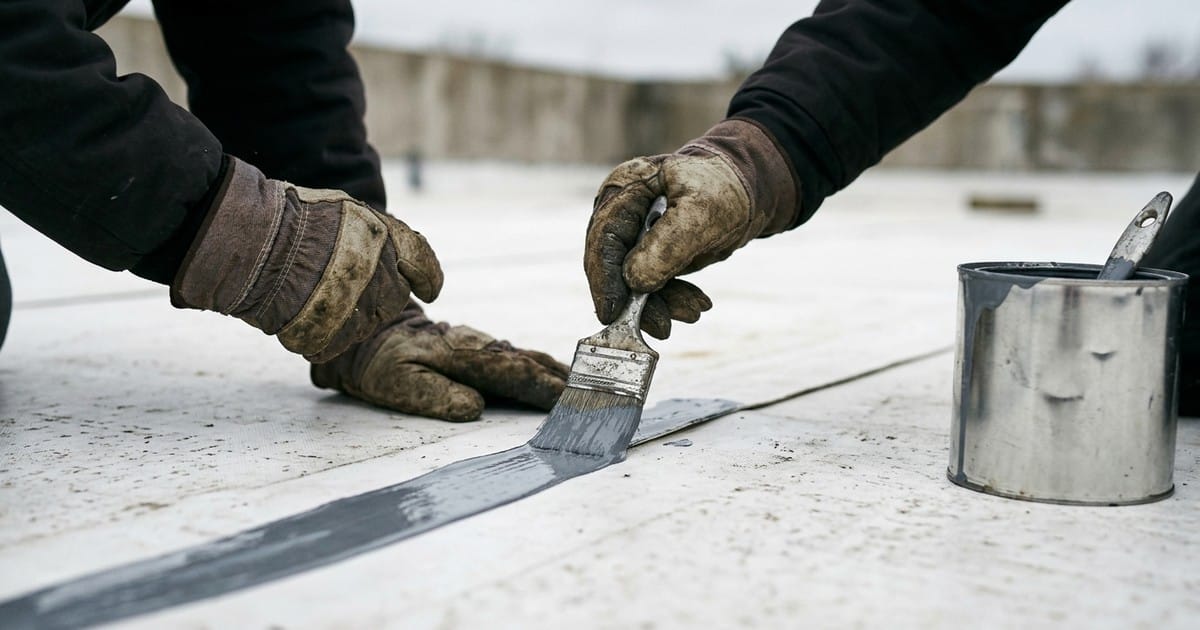
A pitched roof leaks where it meets something — a chimney, a vent pipe, a valley. A flat roof doesn't have those same junctions doing most of the work, so it fails differently: at membrane seams, at punctures, at blisters where moisture got trapped during installation, and at low spots where water sits instead of draining. If you're pricing a flat roof leak using what a shingle repair costs, you're pricing the wrong roof.
Flat Roofs Leak Differently Than Pitched Roofs
The mechanism is different, so the repair is different.
A shingled roof sheds water by gravity, and it leaks where that shedding gets interrupted — a cracked pipe boot, lifted flashing, a gap in a valley. Our roof leak repair guide covers those pitched-roof failure points in detail, and our leak-finding guide covers how to actually trace one to its source via the attic — a method that doesn't apply here, since a flat roof's membrane hides moisture differently, covered below. A flat or low-slope roof has no gravity assist, so it's built from a continuous membrane instead — TPO, EPDM, or modified bitumen — and that membrane fails at its own weak points: the seams where two sheets join, punctures from foot traffic or dropped tools, and blisters where trapped moisture pushes the material up from underneath.
The three membranes don't repair the same way, either. EPDM's own trade association notes it "can be repaired without access to power and without the need for specialized tools," and that the repair characteristic holds up "over its entire service life" even on an aged membrane (EPDM Roofing Association, retrieved 2026-08-06). TPO is the opposite case — a proper seam repair needs a heat gun to weld the patch in, not just adhesive. Knowing which membrane you have changes what a "simple patch" actually involves.
How Each Membrane's Seams Actually Get Fixed
The original seam method decides the repair method — you can't cross them.
TPO seams are hot-air welded during original installation, fusing the overlapping sheets into a bond that, done correctly, is actually stronger than the membrane itself. A proper TPO repair uses the same technique: a heat gun re-melts and re-fuses the patch to the existing membrane. Installation quality matters enormously here, since a poorly welded seam — original or repaired — is the failure point that shows up later (Sundra, retrieved 2026-08-10).
EPDM seams are joined with adhesive or specialized seam tape rather than heat, and that's the tradeoff for not needing power tools on site: those adhesive seams are EPDM's most common failure point, since UV exposure and thermal cycling degrade the bond over time. A repair uses the same adhesive-and-tape approach as the original install, which is why EPDM patching genuinely can be done without specialized equipment — but it also means a repaired seam carries the same long-term vulnerability as the one it replaced.
Modified bitumen can be installed and repaired by torch application, hot-mopped asphalt, cold adhesive, or self-adhering sheets, and its multi-layer construction gives it a real advantage the other two don't have: even if the top layer is compromised, a base sheet underneath still provides a second line of defense against water reaching the deck. That redundancy is why modified bitumen roofs sometimes tolerate a missed leak longer before it becomes a structural problem — not a reason to delay the repair, just a different failure curve.
| Cause | Repair cost |
|---|---|
| Simple ponding fix (clogged drain) | $70–$750 |
| Seam repair | $200–$1,000 |
| Blister repair | $250–$1,500 |
| Membrane patching (punctures, cracks) | $250–$1,750 |
Ranges reflect professional repair, cause-dependent (Fixr, retrieved 2026-08-06). Labor is the bigger share of that number, not material — locating the actual leak source on a featureless membrane, prepping the surface, and using a compatible patch material take real time, and a patch using the wrong material for the membrane is a repair that fails again within a season.
When a Patch Isn't Enough
A patch fixes a point failure. It doesn't fix a membrane that's failing broadly.
If you've patched the same roof more than twice in a year, or if failures are showing up in different areas rather than the same weak spot, that's not a repair pattern — it's a membrane telling you it's past its service life. The same logic applies if a "leak" turns out to be structural ponding rather than a clogged drain: a low spot that holds water because the roof itself doesn't drain correctly won't be fixed by a patch, and repeatedly patching a spot that's sitting under standing water is a losing pattern. Our flat roof replacement guide covers tapered insulation and the recover-vs-tear-off decision for exactly that situation.
One more flat-roof-specific trap: a membrane can look intact on the surface while the insulation underneath is already saturated from an earlier, smaller leak. Patching over that doesn't fix anything — the moisture is already inside. If a leak has been active for more than a few weeks before repair, ask specifically whether the insulation below has been checked, not just the visible membrane.
How Do You Actually Confirm Wet Insulation Under an Intact Membrane?
Not by looking at it — the surface can be completely dry while the insulation underneath is saturated.
Infrared thermography is the standard non-destructive method: wet insulation absorbs more solar heat during the day, then releases that stored heat more slowly than dry insulation once temperatures drop at night. A thermal camera picks up that lag as a distinct warm patch, sometimes only a few degrees different from the surrounding dry roof, which is enough for a trained operator to map exactly where moisture has gotten in without cutting into the membrane at all (IKO Commercial, retrieved 2026-08-10). A nuclear moisture meter is the other common method — it measures hydrogen content in the roof assembly directly, which makes it useful for confirming what an infrared scan found, or as an alternative where reflective coatings or debris would throw off a thermal reading.
Either method costs money a simple patch quote doesn't include, but skipping it on a roof with a history of leaks means patching a membrane over insulation that's already compromised — a repair that looks finished and isn't.
Why Do Flat Roofs Pond in the First Place?
Sometimes a clogged drain. Sometimes the roof itself was never built to drain correctly.
Building code sets a real minimum for this: the International Building Code requires a design slope of at least 1/4 inch per foot — 2 percent — on low-slope roofs specifically so water reaches a drain instead of sitting (IIBEC, retrieved 2026-08-10). A roof built to that minimum, or close to it, and then aging with even slight structural sag can develop low spots that hold water well past a normal 48-hour drain-off. That's not a repair problem a patch or a cleared drain fixes — it's a slope problem, and the real fix is tapered insulation added during a recover or replacement, not another round of patching the same wet spot.
Match the Membrane, Check What's Underneath
These two details matter more than the patch price on the page.
Ask what membrane you have, and confirm the patch material matches it. TPO, EPDM, and modified bitumen use different adhesives and patch systems — a patch material meant for one doesn't bond reliably to another, and a mismatched repair is a repair that fails again. Ask whether they checked for water in the insulation, not just the membrane surface. A dry-looking patch job over saturated insulation buys you a short delay, not a fix.
Frequently Asked Questions
Why does my flat roof keep leaking in different spots?
That's usually a sign the membrane itself is aging out, not that you have unusually bad luck with punctures. A membrane nearing the end of its service life develops new weak points faster than they can reasonably be patched — at that point, compare the cumulative repair cost against a full replacement rather than continuing to chase individual leaks.
Is ponding always something to repair immediately?
Water that clears within about 48 hours of rain is generally normal. Water that sits longer, or that's pooling in the same spot every time, is worth investigating — sometimes it's as simple as a clogged drain, and sometimes it's a structural low spot that only tapered insulation actually fixes.
Can I patch a TPO or EPDM leak myself?
Small, temporary patches exist for emergency use, but a proper repair needs the correct membrane-matched material and surface prep to bond reliably — a mismatched or poorly prepped patch commonly fails within a season. Treat a DIY patch as a stopgap until a professional repair, not a substitute for one.
How do roofers find wet insulation without cutting open the roof?
Usually with an infrared thermal camera, which detects the heat wet insulation retains longer than dry insulation after sunset — no membrane cutting required. A nuclear moisture meter is sometimes used alongside it to confirm the reading, especially where reflective coatings would interfere with a thermal scan.
Is my flat roof supposed to be perfectly level?
No — code requires a minimum slope of about 1/4 inch per foot (2 percent) specifically so water reaches a drain rather than sitting. A roof that ponds well past 48 hours after rain, especially in the same spot repeatedly, usually means that minimum slope isn't actually being achieved anymore, not that ponding is normal for a flat roof.
Cost data updated August 2026. Figures are published estimates and vary by membrane type, roof size, and access.
What do you want to do next?
Three ways we can help from here.
Get the free contractor checklist → 7 questions to ask any roofer before you call. Know what to ask, and what a good answer sounds like.