What Is a Roofing Square? How to Estimate Your Own
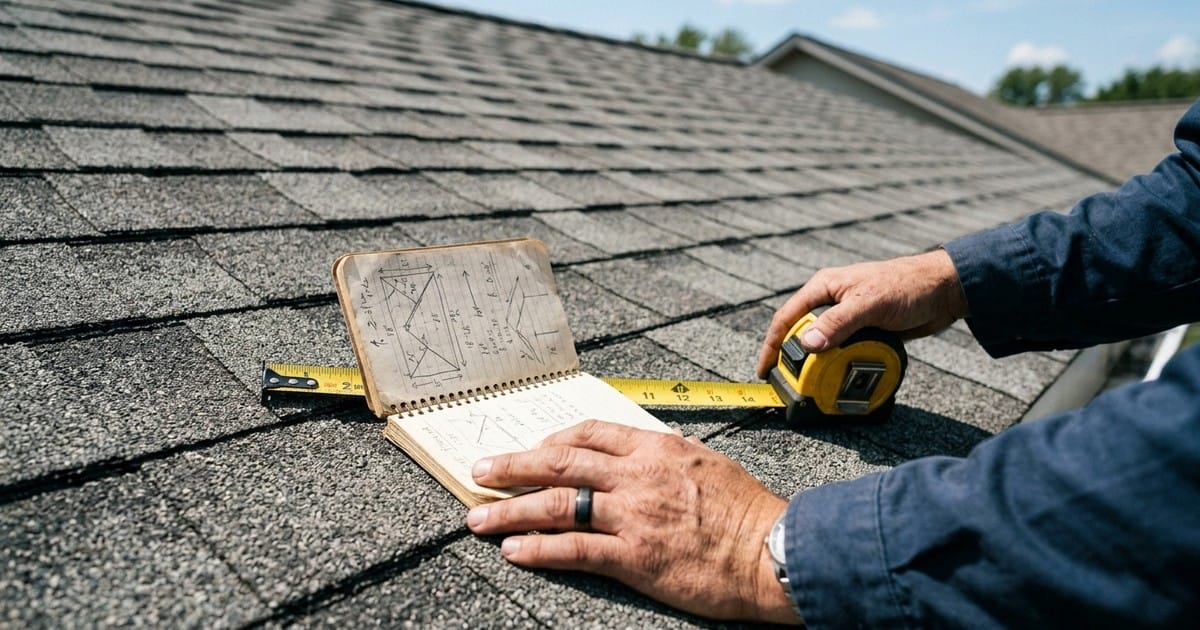
A contractor tells you the job is "22 squares" and says nothing else, and that number means nothing until you know what it's counting. A roofing square is 100 square feet of roof surface — not your house's square footage, not your lot size, just the roof itself, measured flat and then adjusted for how steep it is.
That gap between "my house is 2,000 square feet" and "my roof is 22 squares" is exactly where quotes start to feel like they don't match up with each other, or with what you expected to pay.
Why Your Roof Isn't the Same Number as Your House
Two things inflate a roof's area past your home's footprint: pitch and overhang.
A flat roof over a 2,000 sq ft house would be close to 2,000 sq ft of roofing. Almost no residential roof is flat. Pitch adds surface area because a sloped plane covers more ground than the flat footprint beneath it — the steeper the pitch, the bigger the gap. Overhangs add a bit more, since the roof extends past the walls at the eaves. Add both together and a 2,000 sq ft house commonly needs somewhere around 22 to 24 squares of material, not a flat 20.
| Area | |
|---|---|
| House footprint | 2,000 sq ft |
| Roof surface area | ~2,200–2,400 sq ft |
| ## How to Estimate Your Own, Before You Call Anyone |
This won't be precise enough to order material, but it's precise enough to sanity-check a quote.
Start with your home's footprint — length times width, in feet — and convert to square feet. Then apply a slope factor for your roof's pitch: a common industry reference puts a 4-in-12 pitch (a gentle, common residential slope) at a multiplier of about 1.0541, with steeper pitches carrying larger multipliers (EagleView, retrieved 2026-08-04). Multiply your footprint by that factor, divide by 100, and you have a rough square count.
Then add a waste factor, because material gets cut, trimmed, and occasionally wasted at every valley, hip, and edge. The same source puts typical waste at 10-15% for a simple gable roof — and warns it can run dramatically higher on complex rooflines, citing one real metal roof that needed a 41% waste factor once every dormer, valley, and cut was accounted for. Our own roof cost calculator runs this same footprint-times-pitch logic internally, with its own overhang adjustment, when you price a job by state and material.
| Roof type | Waste factor |
|---|---|
| Simple gable roof | 10–15% |
| Complex roof (valleys, dormers) | up to 41% |
| ## What Ground Measurement Can't Tell You |
This method is for budgeting, not ordering.
EagleView is direct about the limitation: ground-based estimates are "not good for accurately ordering roofing materials or bidding jobs," because there's real detail a tape measure and some arithmetic will never catch from the driveway — a valley here, a dormer there, a chimney cutting into a plane. That's not a reason to skip the estimate; it's a reason to treat it as a starting range rather than a final number. The gap between your ground estimate and your contractor's actual measurement is worth asking about directly if it's large, since it tells you something concrete about the roof's complexity that a flat quote doesn't.
What to Ask When a Quote Uses "Squares"
A vague square count becomes something you can actually check once you ask two specific questions.
Ask how many squares the quote is based on, and compare it against your own rough estimate — a wildly different number is worth a direct question, not an assumption that the contractor is wrong or that you measured badly. Ask whether the waste factor is included in the total or added separately, since a quote that's silent on waste is either padding it into the base number or hasn't accounted for it at all. Our full roof replacement cost guide covers what else a complete estimate should itemize beyond the square count.
If you're curious about the name: "square" is genuinely the roofing industry's own unit of measure, and it's part of where this site's name comes from — not a coincidence we're pointing out to be cute, just the actual term contractors have used for it for a very long time.
Pitch is the other number that changes your square count, and it's worth understanding on its own — our roof pitch guide covers what the X:12 ratio actually means and why steeper roofs need more squares to cover the same footprint.
Frequently Asked Questions
Is a roofing square the same as my house's square footage?
No. Your house's square footage measures the livable floor area; a roofing square measures the roof surface itself, which is larger because of pitch and overhang. A rough rule some contractors use is multiplying house square footage by about 1.5 to estimate roof square footage, but that's a shortcut, not a substitute for measuring your actual roof.
How many squares does a typical house need?
For a roughly 2,000 sq ft home with a common pitch, somewhere around 22 to 24 squares is typical once pitch and overhang are factored in — but your actual number depends on your specific footprint, pitch, and roof complexity. Use our roof cost calculator for a figure based on your own inputs.
Why does my quote's square count seem higher than my estimate?
Usually roof complexity — valleys, dormers, hips, and multiple roof planes all add material and cutting that a simple footprint estimate doesn't capture. A contractor who's actually measured your roof, rather than estimated from the ground, will reasonably land on a higher and more accurate number.
What do you want to do next?
Three ways we can help from here.
Get the free contractor checklist → 7 questions to ask any roofer before you call. Know what to ask, and what a good answer sounds like.