Roof Flashing Repair Cost: By Flashing Type
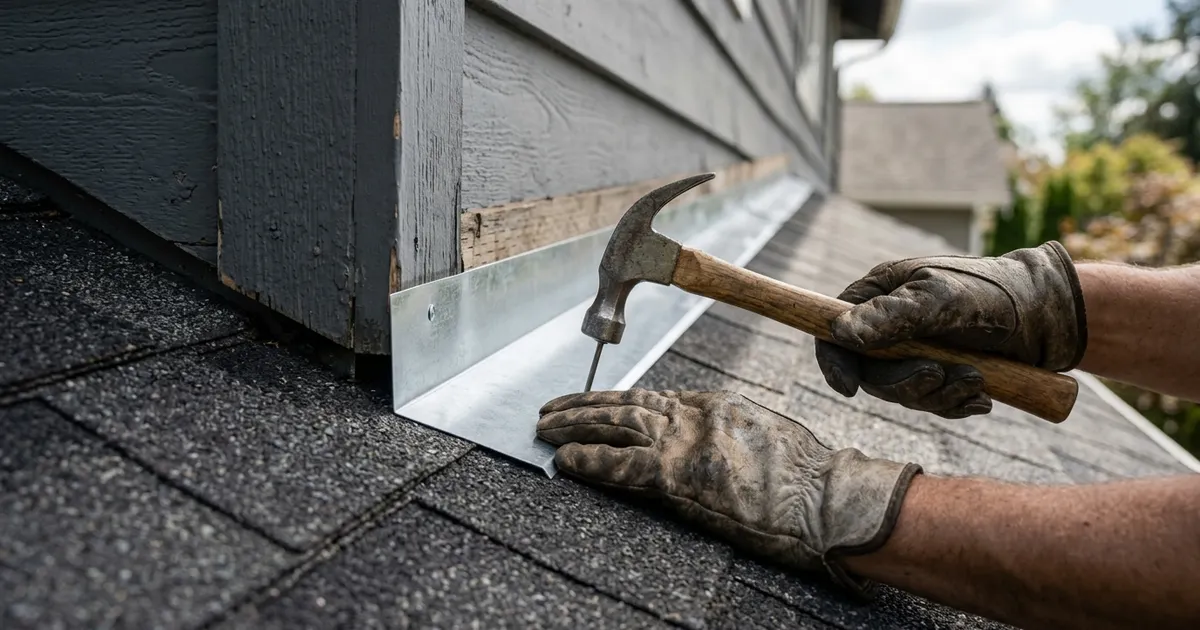
The "$200 to $600" figure you'll see for flashing repair — including on our own roof leak repair cost guide — is real. It's also an average across four genuinely different jobs. Step flashing, valley flashing, chimney flashing, and drip edge fail differently, get fixed differently, and price differently. Knowing which one you actually need is what makes a quote easy to check instead of just trust.
What Does Roof Flashing Repair Cost by Type?
Here's the same average broken into what's actually driving it, sourced by type rather than treated as one job (Modernize, retrieved 2026-08-09).
| Flashing type | Typical repair cost | Why the range moves |
|---|---|---|
| Step flashing | $250 – $600 | Number of courses affected, whether siding has to come off too |
| Chimney / counter flashing | $300 – $800 (up to $1,800 full replacement) | Chimney size, whether masonry mortar joints need resealing too |
| Valley flashing | $400 – $1,000+ | Valley length, and whether shingles must come off to reach it |
| Drip edge | $1.50–$3/ft during reroof; $5–$9/ft standalone | Whether it's done alongside a reroof or as its own job |
Why Does Drip Edge Cost So Much More on Its Own?
Because reaching it means undoing work that's already finished.
Installed during a reroof, drip edge goes down before the underlayment and shingles — no extra labor to access it, which is why it prices at roughly $1.50 to $3 per linear foot, often $150 to $600 total for a typical home's perimeter. Installed as a standalone repair on an existing roof, a contractor has to pull back or remove shingles along the edge first, which is real labor on top of the material itself — pushing the per-foot cost to roughly $5 to $9 (Angi, retrieved 2026-08-09). It's the same strip of metal; the price difference is entirely about what has to come apart to reach it.
What Actually Moves the Price Within Each Type?
Three things, more than the flashing metal itself.
Accessibility matters first — flashing reachable from a ladder costs less to fix than flashing high on a steep or complex roof needing scaffolding. Material matters second: copper flashing costs more than aluminum or galvanized steel, and mixing metals carries its own risk — our flashing guide covers why copper draining onto steel or aluminum accelerates corrosion at the joint. What's hidden underneath matters most: a flashing leak caught early is often just the flashing. One left long enough can mean rotted decking or sheathing behind it, which turns a flashing repair into a larger job before the flashing itself is even addressed. Our deck rot guide covers what that adds to the cost and how to tell a real finding from an upsell.
How Do You Know You're Getting a Real Fix, Not a Reseal?
Ask whether the quote is re-detailing the flashing or just resealing the existing joint with new caulk.
Those are different jobs at different prices, and only re-detailing — correcting the lap direction, adding missing overlap, replacing corroded sections — addresses why the joint failed. A quote that's meaningfully cheaper than the ranges above is worth a direct question: is this actually fixing the flashing, or buying a year or two before you're back here again? Our flashing guide covers when a simple caulk touch-up is legitimate and when it's a stopgap masking a bigger problem.
If flashing failure is one of several issues turning up on an aging roof, roof leak repair cost covers the full by-leak-type picture and the point where repairing stops making sense compared to replacing.
Frequently Asked Questions
Why does this page show different numbers than the "$200–$600" figure I've seen for flashing repair?
That figure is a genuine average across all flashing types. This page breaks it into what you're actually being quoted for — a $250 step flashing fix and an $900 valley rebuild both round into that same average, but they're not the same job.
Is flashing repair covered by homeowners insurance?
Sometimes, if the damage traces to a sudden cause like a storm or falling debris. Flashing that failed gradually from age, corrosion, or poor original installation is typically treated as maintenance, not a covered event.
Can I repair flashing myself?
Simple resealing of a small, accessible crack is within reach for some homeowners. Re-detailing — correctly lapping and integrating flashing with shingles — is precision work best left to a roofer, and working at height carries real fall risk regardless of the task.
How do I know if my flashing needs repair or the whole roof needs replacing?
One or two isolated flashing failures on a roof under 15 years old is normally a targeted repair. Flashing problems showing up alongside granule loss, multiple other leaks, or a roof already past 20 years is when a replacement estimate is worth getting alongside the repair quote.
Cost data updated August 2026. Figures are published US ranges and vary by region, roof complexity, and access.
What do you want to do next?
Three ways we can help from here.
Get the free contractor checklist → 7 questions to ask any roofer before you call. Know what to ask, and what a good answer sounds like.