Is Your Roof Deck Rotted? What It Adds to a Replacement Quote
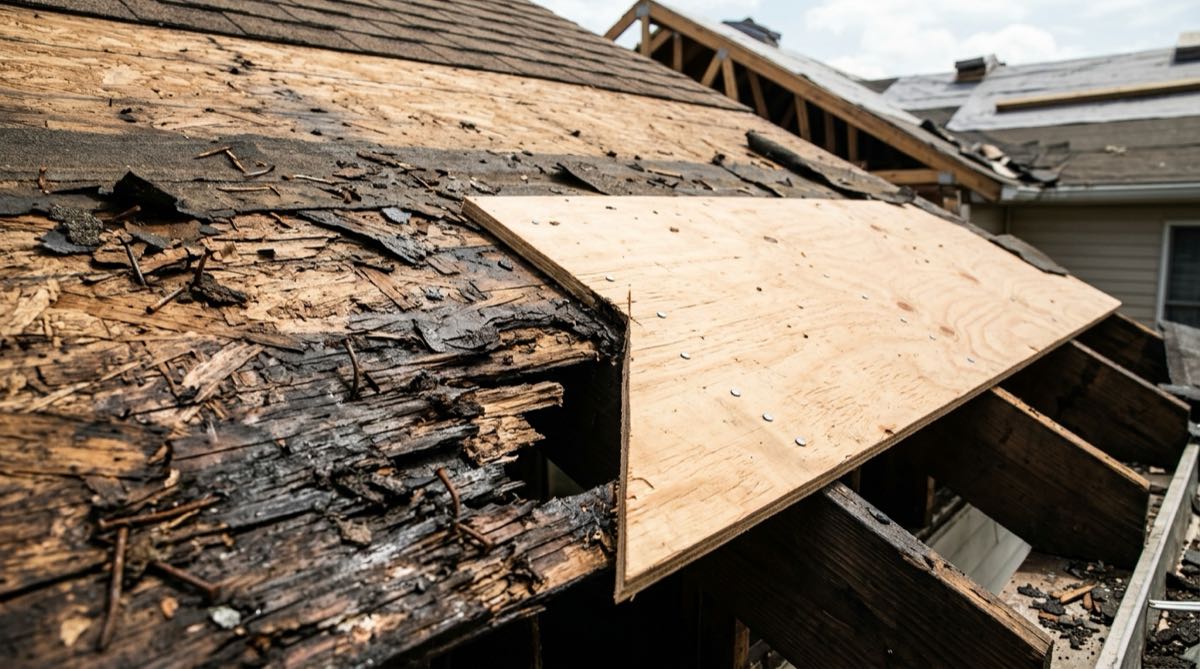
"We found rot once we opened up the roof" is one of the most common mid-project conversations in the industry, and it puts a homeowner in a genuinely uncomfortable spot — is this a real, necessary finding, or the start of an upsell? The honest answer is that deck rot is real and common enough that a fair quote should already account for the possibility, and there's a specific, checkable way to tell a legitimate finding from a pressure tactic.
What Actually Causes Deck Rot?
Water, sitting against wood for long enough to break it down — never the wood failing on its own.
The most common path is a moisture source that went unaddressed for a long time: a flashing failure that let water reach the deck repeatedly, a slow leak nobody traced to its source, or an attic with poor airflow trapping condensation against the underside of the sheathing. Our roof flashing guide covers why flashing fails in the first place, and our ventilation guide covers the intake/exhaust mechanics behind the condensation path — both are the actual root causes behind most deck rot, not the rot itself.
The Signs You Can Catch Before Tear-Off
A pre-replacement inspection can find real evidence, when the damage is far enough along to show.
- Attic staining. Dark, discolored areas on the underside of the decking, visible with a flashlight from inside the attic.
- A moisture meter reading above roughly 20%. Sound, dry sheathing reads well under that; a reading above it means the wood is actively wet, not just previously exposed.
- Sagging or a visible dip in the roofline from outside, or wavy, bowed boards visible from inside the attic — a sign the wood has lost enough strength to bend under the load above it.
- Shingle delamination — missing shingles or visible flashing separating from the surface, which can be the deck losing its ability to hold fasteners properly underneath.
These signs are real and worth checking for during any pre-replacement inspection (Rescue My Roof, retrieved 2026-09-03) — but finding none of them doesn't guarantee a clean deck underneath, which is the honest limit covered next.
Why It's Often Only Found Once the Roof Is Open
Because the signs above require the damage to be advanced enough to show through intact shingles — earlier-stage rot, or rot in a spot without attic access, simply isn't visible from an inspection.
By the time a leak is actually noticeable inside the house, the rot behind it may already be established rather than just beginning. That's not a failure of inspection — it's a real limit of what can be assessed without removing the roofing material itself. A fair contractor should say this plainly rather than imply a pre-replacement inspection can guarantee a rot-free tear-off; the honest position is that most of the deck's condition genuinely can't be confirmed until it's exposed.
What Does Deck Replacement Actually Add to a Quote?
A real, specific number — not an open-ended "we'll see."
Deck sheathing replacement commonly runs $2 to $5 per square foot installed, or roughly $70 to $150 per 4x8 sheet including labor — OSB toward the lower end of that per-sheet range, plywood toward the higher end (Roof Installation, retrieved 2026-09-03). Labor typically makes up 50 to 60 percent of that cost, since replacing sections mid-tear-off — cutting out bad wood, fitting new sheets around existing framing, matching thickness — is slower work than sheathing a bare frame from scratch. Roof pitch adds further cost on top: steeper roofs slow the crew down the same way they do on any part of the job.
Is This a Legitimate Finding or an Upsell?
Usually legitimate — but the line is documentation, and you're entitled to see it.
Deck rot is common enough, for the moisture reasons covered above, that a contractor citing it isn't automatically trying to inflate your bill. What separates a legitimate finding from a pressure tactic is whether they can show you the actual damage: ask for photos of the rotted decking before agreeing to the added cost, taken clearly enough to see the wood condition yourself, not just a verbal description. This is the same verification instinct our guide to spotting a roofing scam covers for the initial-inspection stage — it applies just as much once work is already underway.
What Does a Fair Quote Do About This in Advance?
Price the possibility before it happens, not invent a number once it does.
A fair quote handles the deck-rot risk one of two ways: a stated contingency allowance built into the total for a reasonable amount of anticipated deck work, or a clearly stated per-sheet rate that applies only if and when bad decking is actually found and photographed. Either approach means the number isn't improvised mid-project — it was agreed to before the crew ever pulled the first shingle.
What to Ask Before You Sign
Ask directly how the contract handles unexpected deck replacement — a contingency allowance, a per-sheet rate, or neither (a real red flag if the quote is silent on it). Ask what the per-sheet rate actually is, in writing, and compare it against the ranges above. And ask whether photo documentation of any rotted decking is standard practice before extra work begins — a contractor who already does this as policy is telling you something.
Frequently Asked Questions
What actually causes roof deck rot?
Prolonged moisture intrusion, almost always traceable to a flashing failure, a long-ignored leak, or poor attic ventilation trapping condensation against the underside of the deck. The wood itself doesn't fail on its own — something let water reach it repeatedly over time.
Can you tell if your roof deck is rotted before tear-off starts?
Sometimes, not always. Attic staining, a moisture meter reading above roughly 20%, sagging, and shingle delamination can all be spotted during a pre-replacement inspection. But rot hidden under intact shingles, in a spot without attic access, or in its early stages often isn't visible until the old roofing is stripped off and the deck is exposed.
What does roof deck replacement actually cost?
Commonly $2 to $5 per square foot installed, or roughly $70 to $150 per 4x8 sheet including labor — OSB runs toward the lower end of that range, plywood toward the higher end. Labor is typically 50 to 60 percent of the total, since accessing and replacing sections mid-tear-off is slower work than framing a new deck from scratch.
Is a contractor who finds deck rot mid-project trying to upsell me?
Not necessarily — it's a genuinely common, real finding, and a fair quote should already have a plan for it (a contingency allowance or a stated per-sheet rate) rather than treating it as a shock. The line between a legitimate finding and a pressure tactic is documentation: ask for photos of the actual rotted decking before agreeing to the added cost.
Figures are published industry estimates and vary by region, wood type, roof pitch, and access.
Want a realistic total that already accounts for the unknowns?
Open the calculator