Roof Coating and Restoration: A Cheaper Alternative to Replacement?
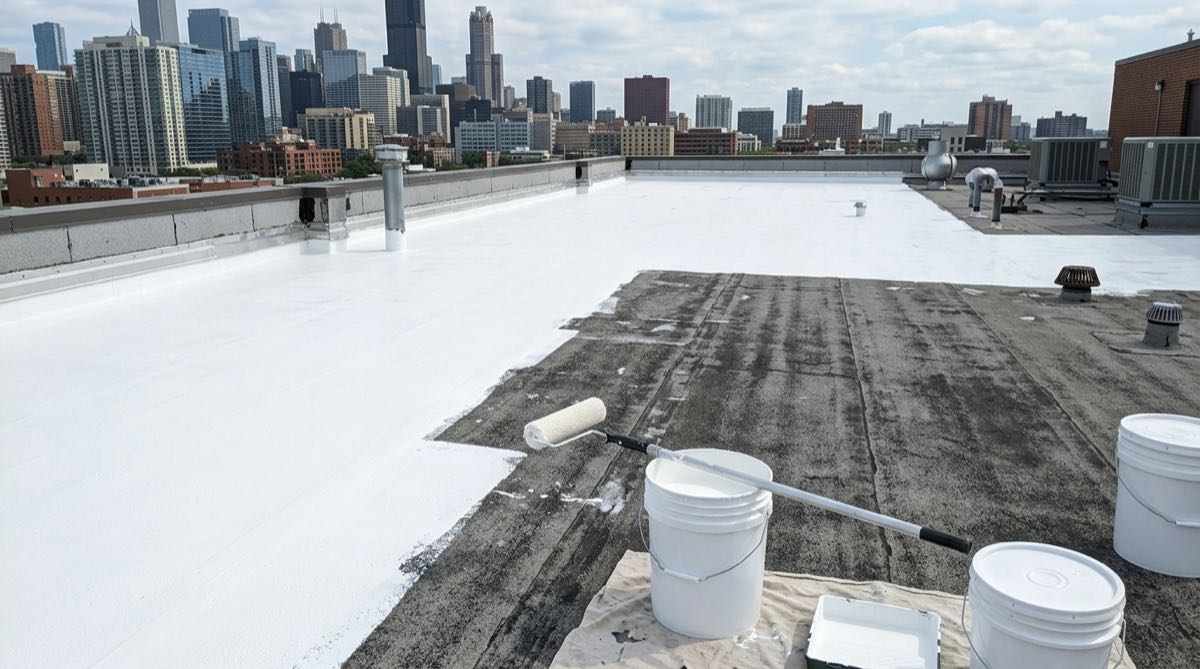
Replacement isn't the only path once a roof shows real age. On a flat or low-slope roof — commercial or residential — that's still structurally sound but nearing the end of its rated life, a liquid-applied coating can add real years of service for a fraction of what tearing off and replacing the whole system costs. It's a genuinely different repair path from the two most homeowners and building owners hear about, and it only works on a roof that actually qualifies.
What Is a Roof Coating, Actually?
Not a new membrane — a liquid one, applied directly onto the surface that's already there.
A roof coating is a fluid-applied system — commonly silicone, acrylic, or a similar elastomeric compound — rolled or sprayed onto the existing roof membrane, where it cures into a continuous, seamless, waterproof layer. It fills small cracks, seams, and blister edges as part of the application, and it's a genuinely different mechanism from recovering, which installs an entirely new physical membrane layer over the old one. Our flat roof cost guide covers recovering — and the specific conditions (layer count, deck condition, local code) that determine whether it's even allowed — in depth. Coating and recovering solve a similar problem through different means, at different price points, and a contractor should be specific about which one they're actually proposing.
What Conditions Actually Qualify a Roof for Coating?
Age and general wear, yes. Hidden moisture, no.
Coating is a good fit for a roof that's aging and due for renewal but still structurally intact — a membrane with surface wear, minor cracking, or reduced reflectivity, without deeper damage underneath it. What disqualifies a roof is moisture already trapped beneath the surface: coating over wet insulation doesn't solve that problem, it hides it, and trapped moisture under a fresh coating can cause blistering, freeze damage in cold climates, and leaks that continue despite the new surface looking intact (West Roofing Systems, retrieved 2026-09-03). That's why a reputable contractor runs a moisture survey — a core sample or an infrared scan — before quoting a coating job, not after. Our flat roof leak repair guide covers how infrared moisture detection actually works, since it's the same underlying method used to confirm a roof qualifies for coating in the first place.
What Does a Roof Coating Actually Cost?
Meaningfully less than a full tear-off, though the published range is wide.
Coating costs are commonly cited from roughly $2 to $7 per square foot installed, against roughly $6 to $8 per square foot for a complete tear-off and replacement (Construction Specifier, retrieved 2026-09-03) — a real, substantial gap, though the exact number for a given roof depends heavily on which coating chemistry is used, how much surface prep and minor repair the existing roof needs first, and the mil thickness required for the warranty term you want. That last variable is worth understanding on its own: coating thickness is commonly tiered directly to warranty length — roughly 20 mils for a 10-year warranty, 25 mils for 15 years, and 30 mils for 20 years (West Roofing Systems, retrieved 2026-09-03) — so a quote's mil spec is a real, checkable number, not a marketing detail.
How Long Does a Coating Actually Buy You?
A genuine multi-year extension, not a cosmetic patch — commonly 10 to 20 years depending on the system and conditions.
Coating chemistry, climate exposure (UV, ponding water, freeze-thaw cycling), and the mil thickness applied all affect where in that range a given roof lands. Many coating systems are also designed to be recoated with the same product roughly every decade, extending the surface's protective life further without another full application from bare membrane. The National Roofing Contractors Association's own guidance on the category sets an expectation that a well-formulated coating product should perform for at least 15 years under ordinary conditions (NRCA, cited via industry summary, retrieved 2026-09-03) — a useful baseline for what "well-formulated" should mean when a contractor's own claim runs longer.
Does the Membrane Type Underneath Matter?
Yes — coating compatibility depends on what's already on the roof, not just what condition it's in.
Our commercial roof cost guide covers how TPO, EPDM, and PVC membranes actually differ, and that same distinction matters here: not every coating chemistry bonds reliably to every membrane type without the right primer or surface preparation, and a contractor proposing a coating system should be able to name which coating is being matched to which existing membrane, not treat it as one universal product.
The Honest Limit of What a Coating Can Do
It's a maintenance extension, not a substitute for replacement on a roof that's genuinely past its service life.
The same honesty that applies to a warranty's headline number applies here: a coating buys real years on a roof that still has structural integrity, the way our roof lifespan guide is direct about a shingle warranty not being a field guarantee. It does not reverse damage that's already happened to the deck or insulation underneath, and a roof past the condition threshold — failed insulation, compromised deck, membrane damage beyond surface wear — needs replacement regardless of how good the coating product is. The moisture survey mentioned above is what tells you honestly which side of that line your roof is on.
What to Ask Before You Sign
Ask whether a moisture survey — core samples or infrared — was actually performed, and ask to see the results, not just be told the roof "looks dry." Ask which coating chemistry is being proposed and whether it's rated for the existing membrane type. Ask for the mil thickness being applied and confirm it matches the warranty term being offered, using the roughly 20/25/30-mil-per-10/15/20-year pattern above as a sanity check against the number in the quote.
Frequently Asked Questions
Is roof coating the same thing as a recover?
No. A recover installs a new physical membrane layer over the existing one. A coating is a liquid applied directly onto the existing membrane's surface, with no new membrane layer — a different repair mechanism, a different cost, and different conditions for when each makes sense.
How much does a roof coating actually cost per square foot?
Commonly cited in the $2 to $7 per square foot range installed, against roughly $6 to $8 per square foot for a full tear-off and replacement — the exact number depends heavily on coating type, mil thickness for the warranty tier you want, and how much prep or repair the existing roof needs first.
How long does a roof coating actually last?
Commonly cited in the 10 to 20 year range depending on coating chemistry, climate, and mil thickness, with many systems designed to be recoated roughly every 10 years to extend that further. It is a real, multi-year service life extension, not a cosmetic patch.
Can any roof be coated instead of replaced?
No. Coating over wet insulation hides the problem rather than solving it, and can trap moisture that causes blisters and continued leaks. A roof needs a moisture survey first — if the substrate is saturated or the membrane is too far gone, coating is the wrong call and tear-off is the honest answer.
Figures are published industry estimates and vary by product, region, roof condition, and system specified.
Weighing coating against a full replacement quote?
Open the calculator