Flat Roof Replacement: Drainage, Recover vs. Tear-Off, and What It Costs
What flat roof replacement costs per square foot, when you can recover instead of tearing off, and why tapered insulation shows up on the quote.
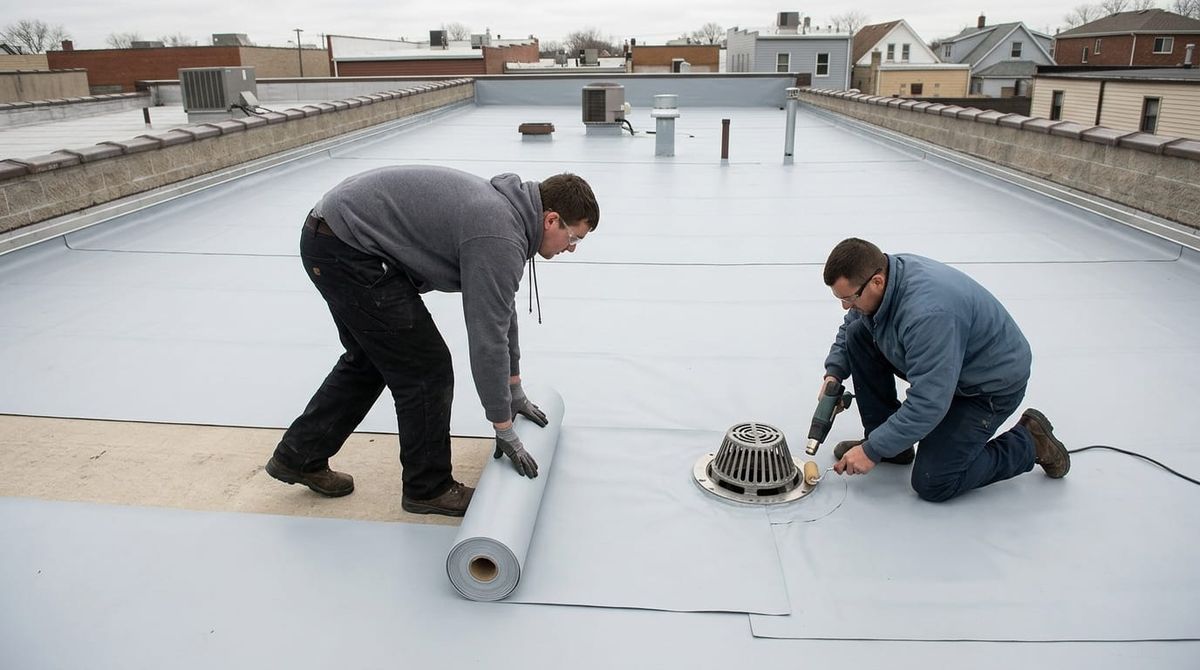
Flat roof replacement generally runs $4 to $10 per square foot installed — roughly $5,000 to $15,000 for a typical 1,500 sq ft residential flat roof. Two decisions move that number more than the membrane you pick: whether you can recover instead of tearing off, and whether the roof needs slope built into it.
What Does Flat Roof Replacement Cost?
Most flat roof replacements land between $4 and $10 per square foot installed, putting a typical 1,500 sq ft residential flat roof at roughly $5,000 to $15,000 (BuildVision, retrieved 2026-07-30).
That is a wide band, and the spread is not mostly about membrane brand. It is about how much of the existing roof comes off and whether slope has to be rebuilt.
The same figures in text:
| Line item | Cost per sq ft |
|---|---|
| Base flat roof replacement, installed | $4 – $10 |
| Recover instead of tear-off | saves $1 – $3 |
| Full tear-off | adds $2 – $4 |
| Tapered insulation for slope | adds $2 – $5 |
Cost data updated July 2026. Figures are published US ranges and vary by region, roof size, and access.
Why Do Flat Roofs Fail Differently?
Because water does not run off them. It sits.
A pitched roof uses gravity. Shingles overlap, water sheds, and a small defect often leaks only during heavy rain. A flat roof has no gravity assist. Water that cannot reach a drain stays there, and a membrane sitting under standing water degrades far faster than one that dries out between storms.
Ponding is the term for that standing water. It is the defining failure mode of low-slope roofing, and it is why drainage matters more than membrane brand on this kind of roof.
Two consequences follow:
- A "flat" roof is never truly flat. It needs a slight slope — built into the structure, or built with tapered insulation — so water reaches a drain.
- A small slope defect causes a large problem. A shallow low spot holds water for days, and that patch ages years faster than the rest of the roof.
Can You Recover Instead of Tearing Off?
Sometimes — and it is the single largest saving available on a flat roof.
Recovering means installing the new membrane over the existing one rather than stripping it. It skips tear-off labor and disposal, saving roughly $1 to $3 per square foot (RoofMedic, retrieved 2026-07-30).
It only qualifies under specific conditions:
| Recover is possible when | Full tear-off is required when |
|---|---|
| One existing layer, in sound condition | Two or more existing layers |
| Insulation underneath is dry | Insulation is wet or saturated |
| Deck is structurally sound | Deck shows rot or deflection |
| Local code permits the added layer | Code caps the number of layers |
The wet-insulation condition is the one that catches people. A roof can look fine from above while the insulation below holds water from an old leak. Covering that traps the moisture, and the new roof fails early from underneath.
For example, take a 2,000 sq ft flat roof quoted at $6 per sq ft installed, or $12,000. Recovering saves about $2 per sq ft — $4,000 — bringing it to $8,000. But if a moisture scan finds saturated insulation across a third of the deck, that saving disappears: you now pay tear-off plus insulation replacement. Paying for the scan first is what tells you which number is real.
That is why a moisture survey before the bid is worth it on any flat roof over about ten years old. It decides a four-figure question.
Why Is Tapered Insulation on My Quote?
Because your roof does not have enough slope, and slope has to come from somewhere.
Tapered insulation is polyisocyanurate board cut at an angle and laid in a pattern that builds a slight pitch across the roof, directing water toward drains. It runs about $2 to $5 per square foot installed (Flat Roofing Insights, retrieved 2026-07-30), and it is commonly the largest line item owners did not anticipate.
Correcting an existing ponding problem this way typically runs $3,000 to $8,000, scaling with roof size and how much thickness is needed (Frontier Foam, retrieved 2026-07-30).
It is worth the money when the roof ponds. It is unnecessary when the existing slope already drains within a day or two of rain. Ask the contractor to show you where the water currently sits before agreeing to it.
Insulation also has an energy role that is easy to overlook. Attic and roof insulation directly affects heating and cooling load, and improving it during a replacement is far cheaper than retrofitting later (ENERGY STAR, retrieved 2026-07-30). Current energy codes have also pushed required R-values up, which means a compliant re-roof may carry more insulation than the roof it replaces — and more thickness costs more.
Is This Different for Residential and Commercial?
The physics are identical. The scale, the language, and the decision frame are not.
| Residential flat roof | Commercial flat roof | |
|---|---|---|
| Typical size | 200 – 2,000 sq ft | 10,000 – 200,000+ sq ft |
| Common on | Additions, garages, row houses, modern builds | Warehouses, retail, offices |
| Priced as | Total job cost | Cost per square foot |
| Decision frame | "Can I afford this?" | "Repair to defer capex, or replace and depreciate?" |
| Extra factors | Access, matching adjacent roof | Tenant disruption, phasing, warranty terms |
If you are managing a commercial building, the membrane comparison and bidding process matter more than they do on a garage roof — that is a longer subject, and one worth reading separately before soliciting bids.
What Should You Ask Before Signing?
Five questions, specific to flat roofs.
- Where does water currently stand after rain? If they cannot answer, they have not surveyed it properly.
- Recover or tear-off, and why? The answer should reference layer count, insulation moisture, and deck condition — not just price.
- Has the insulation been moisture-scanned? On any flat roof over ten years old, this should not be optional.
- What slope will the finished roof have, and how is it achieved? Structural slope, tapered insulation, or neither.
- Where are the drains, and are they being reworked? New membrane draining into old, undersized drains is a recurring problem.
Regular inspection matters more on flat roofs than pitched ones, because the failure mode is slow and invisible from the ground. The National Roofing Contractors Association recommends inspecting at least twice a year plus after major storms (NRCA, retrieved 2026-07-30).
What do you want to do next?
Three ways we can help from here.
Get the free contractor checklist → 7 questions to ask any roofer before you call. Know what to ask, and what a good answer sounds like.Frequently Asked Questions
How long does a flat roof last?
It depends heavily on drainage and membrane type. A well-drained single-ply membrane commonly runs 20 to 30 years. The same membrane holding standing water can fail in a fraction of that, which is why slope is worth paying for.
Can I put a flat roof over an existing one myself?
Recovering is a professional job. It requires judging whether the existing layer and insulation are dry and sound, and that judgment is exactly what determines whether the new roof lasts. Getting it wrong traps moisture and shortens the roof's life.
Is ponding always a problem?
Standing water that clears within about 48 hours after rain is generally tolerated. Water that persists longer, or that leaves visible residue rings, indicates a drainage defect worth correcting.
Does a flat roof cost more than a pitched roof?
Per square foot, often less — flat roofs are simpler to walk and faster to cover. But the roof area is smaller than a pitched roof over the same footprint, and drainage work can offset the savings. Compare total job cost, not just the rate.
What if my quote does not mention insulation at all?
Ask why. Replacing a membrane without addressing wet insulation underneath is a common way to get a roof that fails early, and current energy codes may require more insulation than the original roof carried.

Comments ()