Shingle Roof Repair: Cost, Color Matching, and When to Redo the Whole Slope
What shingle repair costs, why matching old shingles is the hidden problem, and when replacing a whole roof face beats patching a small area.
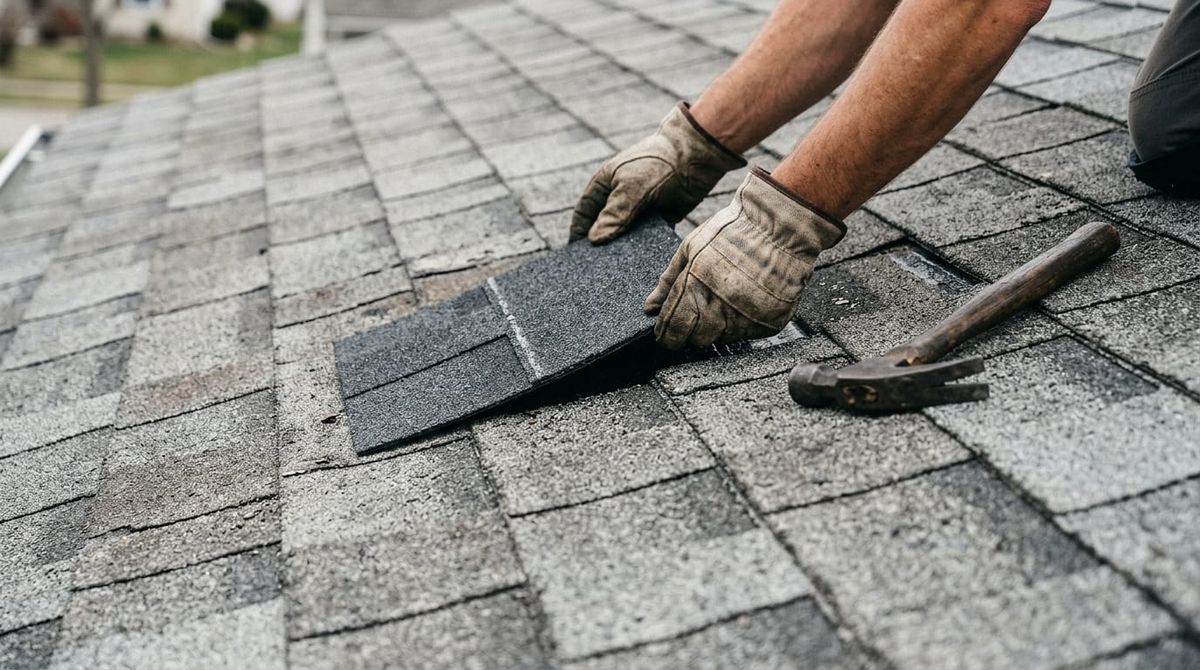
Replacing a few shingles can cost as little as $150, and most shingle repairs land between $350 and $1,000. But the cost isn't usually what surprises people. It's finding out the new shingles won't match the old ones.
What Does Shingle Repair Cost?
It scales with area, and small really is cheap.
Swapping a handful of blown-off shingles can start around $150. A full roofing square — that's 100 square feet — averages $500 to $1,500 installed. A typical repair project overall runs $350 to $3,000, with a national average near $950 (Angi, retrieved 2026-07-29).
The same figures in text:
| Scope of repair | Typical cost |
|---|---|
| A few blown-off shingles | From $150 |
| One roofing square (100 sq ft) | $500 – $1,500 |
| Typical repair project | $350 – $3,000 (avg ~$950) |
| Full roof face to a break line | Priced per square foot |
What Kind of Shingle Damage Are You Looking At?
Four conditions, and they don't all mean the same thing.
- Blown off or missing. Wind lifted them. Usually the simplest repair, and often the cheapest.
- Cracked or split. Thermal cycling or impact. Localized, but check nearby shingles for the same pattern.
- Curling or lifting at the edges. Age, heat, or poor attic ventilation. If it's widespread, this points at the roof's remaining life, not a patch.
- Granule loss. Bald patches, and grit in your gutters. On an older roof, this is the shingle mat wearing out.
Here's the useful distinction: the first two are events. The last two are conditions. An event gets repaired. A condition means the roof is aging out, and patching it buys less time than you'd hope.
Why Won't the New Shingles Match?
Because manufacturers change their color lineups, and your roof has been weathering since the day it went on.
Two things work against a match. First, shingle colors get discontinued — manufacturers refresh palettes every few years, so a roof more than about five years old may have a color that is no longer produced. Second, even the same product weathers. Sun fades the granules, so a brand-new bundle of the identical color still reads brighter than the roof around it (Angi, retrieved 2026-07-29).
What this means in practice: a small patch on an older roof will likely be visible. Not because the roofer did poor work, but because an exact match may not exist to buy.
Your realistic options:
- Accept a close-but-not-exact color. Cheapest. Fine on a rear slope nobody sees.
- Source discontinued stock. Sometimes possible through closeout suppliers. Adds time and cost, no guarantee.
- Replace the full roof face to a natural break line — a ridge, a valley, an eave. The color transition then sits where the eye expects a change anyway.
- Pull shingles from an inconspicuous slope to patch the visible one, then use the new mismatched bundle on the hidden slope. Costs labor, looks best.
Option 4 is underused and worth asking about. It trades a bit more labor for a result that actually looks intentional.
The same options in text:
| Option | Cost | Result | Best for |
|---|---|---|---|
| Accept a close colour | Lowest | Visible patch | Rear slopes nobody sees |
| Source closeout stock | Low, plus wait time | Near-exact | When you're not in a hurry |
| Redo full roof face | Highest | Seamless | Street-facing slopes |
| Relocate from a hidden slope | Mid, mostly labour | Seamless | A small visible damaged area |
When Should You Redo the Whole Slope?
When the patch would be visible from the street, or when a condition rather than an event caused it.
Remember the cost table. One square runs $500–$1,500, and a few shingles start at $150. That gap is real but not enormous — so once matching becomes a problem, expanding to a full roof face frequently costs less than homeowners fear, and it removes the mismatch entirely.
| Situation | Patch it | Redo the slope |
|---|---|---|
| Few shingles gone, rear slope, roof under 10 years | ✅ Patch | — |
| Few shingles gone, front slope, roof under 5 years | ✅ Patch (match likely available) | — |
| Front slope, roof over 10 years, color discontinued | — | ✅ Redo to a break line |
| Widespread curling or granule loss on the slope | — | ✅ Redo, and get a lifespan opinion |
| Storm damage across multiple slopes | — | ✅ Get a replacement bid too |
| Roof past 20 years | — | ✅ Replacement conversation |
For scale: full replacement runs roughly $9,000–$18,000 for asphalt shingle. If slope-level repairs are creeping toward a third of that on an aging roof, ask for a replacement bid beside the repair quote and compare.
Does Insurance Cover Matching?
Sometimes, and this is worth knowing before you accept a partial settlement.
Appearance matching is a recognised point of dispute in property claims, and how it gets handled depends on your state's regulations, your insurer, and your specific policy form. Some jurisdictions and some policies address uniform appearance; others do not. Where a shingle is discontinued and no match can be bought, that question becomes central to what a fair settlement looks like.
Rather than assume an entitlement, treat it as the question to put in writing early: if an exact match is unavailable, how will the settlement address appearance?
Two things help you ask it well. First, remember that any claim payment comes after your deductible (NAIC Consumer's Guide to Home Insurance, retrieved 2026-07-29) — a small mismatched patch may not be worth filing at all. Second, your declarations page is the summary sheet at the front of your policy listing your coverage limits and deductible. That is where your own numbers live.
For what actually applies in your state, contact your state insurance department — the regulator that oversees insurers where you live. They answer consumer questions like this directly, and their answer is authoritative in a way a contractor's is not.
General information only, not legal or insurance advice.
How Do You Vet a Shingle Repair Quote?
A good quote names the product, not just the work.
Look for five things:
- The shingle brand, line, and color being installed — not just "matching shingles."
- Whether an exact match was available, and if not, what the roofer proposes instead.
- Square footage or shingle count, so you can check it against the ranges above.
- A deck-repair unit price, since rot under missing shingles is common and often unseen until they open it up.
- Photos of the damage before work starts.
One warning sign: a roofer who promises a perfect match on a roof over ten years old without checking product availability. That promise is frequently unkeepable, and you'll be the one looking at the result.
And don't climb up to inspect it yourself. Roof falls cause serious injuries, and a storm-damaged slope can have compromised decking you can't see from above. Binoculars from the lawn and a flashlight in the attic will tell you most of what you need.
Regular inspection catches shingle problems while they're still events rather than conditions. The National Roofing Contractors Association recommends checking at least twice a year, plus after major storms (NRCA, retrieved 2026-07-29). Ventilation matters too — poor attic airflow accelerates curling, and winter airflow through a cold attic reduces ice damming (ENERGY STAR, retrieved 2026-07-29).
Cost data updated July 2026. Figures are published US ranges and vary by region, roof complexity, and access.
What do you want to do next?
Three ways we can help from here.
Get the free contractor checklist →7 questions to ask any roofer before you call. Know what to ask, and what a good answer sounds like.Will insurance pay?What claims cover — and what they don't.Find financingReal cost over the term, not the monthly.
Frequently Asked Questions
Can I just replace a few shingles myself?
Materially, a few shingles is a simple job. Practically, it means getting on a roof, and roof falls cause serious injury. There's also a real chance of damaging adjacent shingles or nailing incorrectly, which creates the next leak. For a handful of shingles low on a garage slope, some homeowners do it. On a two-story or steep roof, hire someone.
How long does shingle repair take?
Most small repairs take a couple of hours. A full roof face takes a day or more depending on size and whether decking needs work.
Will a patch reduce my home's value or fail an inspection?
A well-executed patch does not fail an inspection. A visibly mismatched patch on a street-facing slope can affect buyer perception, which is a separate issue from function — and a reason to consider redoing the full face if you're selling.
My shingles are curling but not leaking. Do I need to act?
Widespread curling means the shingles are near the end of their service life, even without a leak. It's not an emergency. It is a signal to get a lifespan assessment and start budgeting rather than waiting for water.
What if my shingle color is discontinued?
You have four options: accept a close color, hunt closeout stock, redo the full roof face to a break line, or relocate shingles from a hidden slope to patch the visible one. Ask your roofer to price at least two of them.
Comments ()