Commercial Roof Leak Repair: What to Do First, and What It Costs
What to do in the first hours of a commercial roof leak, what emergency tarping and permanent repair cost, and when a leak means replacement.
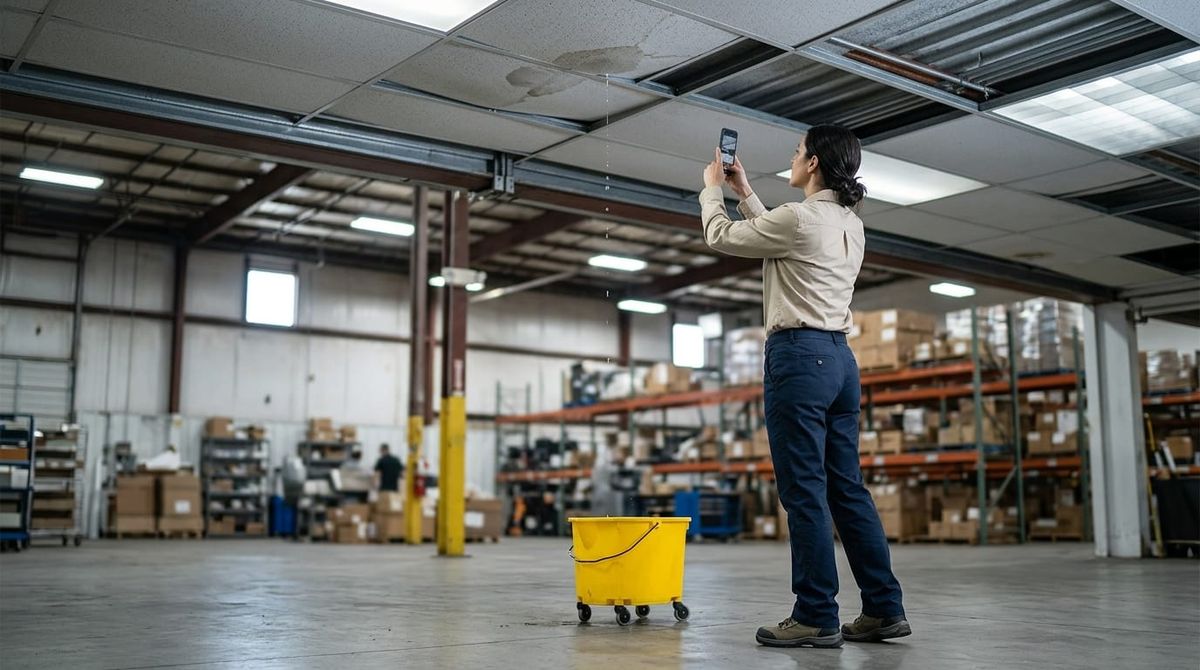
Water is coming into your building. Here's the order of operations: protect people and stock, document everything, get a tarp on it, then fix it properly. Skipping the documentation step is the mistake that costs the most.
What Should You Do in the First Hour?
Five things, in this order. The order matters.
Do not send your own staff onto the roof. A wet commercial membrane is slick, and OSHA requires fall protection for work six feet or more above a lower level (OSHA, retrieved 2026-07-29). A roofing crew arrives with harnesses and anchors. Your maintenance tech probably doesn't.
What Does Emergency Tarping Cost?
Tarping runs about $0.70–$2.00 per square foot during normal hours, and $1.00–$2.80 per square foot for emergency after-hours service (HomeGuide, retrieved 2026-07-29). Expect a temporary tarp to hold for 60 to 90 days.
Roofing companies also add roughly $200 to $500 for an after-hours callout. That premium covers mobilizing a crew and materials to reach you in hours rather than days (Angi, retrieved 2026-07-29).
For the tarp to actually work, it needs to extend well past the damaged area — roughly four feet of overhang on each side — and it needs to be heavy-duty and UV-rated. Thin tarps tear in wind and degrade fast in sun.
| Normal hours | Emergency / after hours | |
|---|---|---|
| Tarping, per sq ft | $0.70 – $2.00 | $1.00 – $2.80 |
| Callout premium | None | +$200 – $500 |
| Typical response | Days | Hours |
| How long it holds | 60 – 90 days | 60 – 90 days |
Is the After-Hours Premium Worth Paying?
Sometimes. It depends entirely on what's underneath the leak.
Pay the premium when water is actively reaching inventory, electrical equipment, servers, or anything with a replacement cost above the callout fee. A $400 premium is trivial against a flooded stockroom.
Wait until morning when the leak is contained by buckets, the space below is empty or low-value, and rain has stopped. You are not saving the roof by rushing. You are only limiting interior damage — and if there's little to damage, there's little to save.
What Does Permanent Repair Cost?
A minor leak repair generally runs $150 to $1,000. Once water damage or structural damage is involved, that climbs to $1,000 to $6,000 (WeatherShield, retrieved 2026-07-29).
The gap between those two bands is mostly about how long the leak ran. A membrane puncture caught in a week is a patch. The same puncture caught in eight months has soaked the insulation, corroded fasteners, and possibly rotted deck. You are then paying to replace materials, not to seal a hole.
Common commercial leak sources, roughly cheapest to most expensive:
- Seam separation — membrane seams pull apart with age and heat cycling
- Flashing failure at parapets, curbs, and roof-to-wall joints
- Penetration leaks around HVAC curbs, vents, and pipe boots
- Ponding water sitting on a low spot, slowly working through
- Saturated insulation under an intact-looking membrane — the expensive one
That last item is why an infrared scan sometimes pays for itself. Trapped moisture spreads sideways under the membrane, so the ceiling stain is often nowhere near the actual breach.
Do You Have to Close While It's Fixed?
Rarely for a leak repair. Almost never for tarping.
Emergency tarping happens entirely on the roof and takes hours, not days. Most businesses stay open through it. The permanent repair is a bigger conversation, and three things decide how disruptive it gets:
- Where the leak is. A repair directly above a sales floor or a server room needs interior protection and often after-hours scheduling. The same repair over a stockroom usually does not.
- Method. Torch-applied and hot-asphalt repairs produce fumes that can reach rooftop air intakes. Ask the contractor to confirm their method and whether your intakes need shutting during the work.
- Interior damage. If water reached ceiling tiles, insulation, or drywall, the drying and replacement work is often more disruptive than the roof repair itself — and it happens inside your space, not above it.
| Scenario | Typical disruption |
|---|---|
| Emergency tarping | Hours, roof only, stay open |
| Small membrane or seam repair | Half a day, roof only, usually stay open |
| Repair above sensitive space | Schedule after hours or on a weekend |
| Repair plus interior remediation | Days, and the interior work is the disruptive part |
Ask for working hours and expected duration in writing. On a tenanted building, you likely owe your tenants notice, and "we'll be on the roof Tuesday" is a very different message from "the unit below will be inaccessible."
When Does Repair Stop Making Sense?
When you're patching the same roof repeatedly, the math flips.
| Situation | Repair | Replace |
|---|---|---|
| One isolated leak, roof under 10 years | ✅ Repair | — |
| Two or three leaks, roof 10–15 years | ✅ Repair, plan ahead | — |
| Recurring leaks across different areas | — | ✅ Replace |
| Widespread saturated insulation | — | ✅ Replace |
| Roof past 20 years, active leaks | — | ✅ Replace |
Repeated leaks in different locations usually mean the system is failing generally, not in one spot. At that point repair spend is buying months, not years. Commercial replacement runs roughly $5.50–$15.00 per square foot depending on membrane, which is the number to weigh repeat repairs against.
There is also an accounting dimension worth raising with your finance side. A repair is generally treated as an operating expense and deducted in the year incurred. A replacement is typically capitalised and depreciated over a much longer schedule. So "repair to defer capex" is a real and often reasonable strategy — right up until the repairs become recurring, at which point you are expensing money every year against an asset that keeps aging. Confirm treatment with your accountant; the point is that this belongs in the decision, not just roof condition.
One more consideration: most commercial warranties require documented inspection and maintenance. The National Roofing Contractors Association recommends inspecting at least twice a year plus after major storms (NRCA, retrieved 2026-07-29). If a leak traces back to skipped maintenance, warranty coverage may not apply — which changes the repair-versus-replace math considerably.
Hail-prone regions carry an extra wrinkle. Impact damage can compromise a membrane without producing an immediate leak, and material choice makes a large difference to how a roof survives a storm (FEMA, retrieved 2026-07-29). Inspect after storms even when nothing is dripping yet.
What do you want to do next?
Three ways we can help from here.
Get the free contractor checklist →7 questions to ask any roofer before you call. Know what to ask, and what a good answer sounds like.Will insurance pay?What claims cover — and what they don't.Find financingReal cost over the term, not the monthly.
Frequently Asked Questions
Will insurance cover a commercial roof leak?
It depends on the cause. Sudden damage from a storm is typically covered. Gradual failure from age or deferred maintenance usually is not. Most policies also require prompt notice and reasonable steps to limit further damage, which is why tarping and documentation both matter.
Can my maintenance staff tarp the roof themselves?
Strongly discouraged. A wet membrane is slippery, and fall protection requirements apply at six feet. An injury on your roof becomes your liability. Hire a crew that arrives with proper equipment.
How long can I leave a tarp on?
Plan on 60 to 90 days. Tarps degrade in UV and tear in wind. Treat a tarp as a countdown clock toward the permanent repair, not as the repair itself.
The ceiling stain is in one spot — is the leak directly above it?
Often not. Water travels along decking, joists, and above insulation before it drops through. On flat commercial roofs the actual breach can be many feet away, which is why locating the source is a job for someone with a moisture meter or infrared camera.
Should I repair now or wait for the insurance adjuster?
Do emergency mitigation now — policies generally expect it. Hold off on permanent repairs until the adjuster has seen the damage, unless waiting would cause further loss. Photograph everything before and after any temporary work.
Comments ()