Emergency Roof Repair: The First 24 Hours, Step by Step
What to do in the first 24 hours after roof damage, how to document it for your insurance claim, and what emergency repair costs.
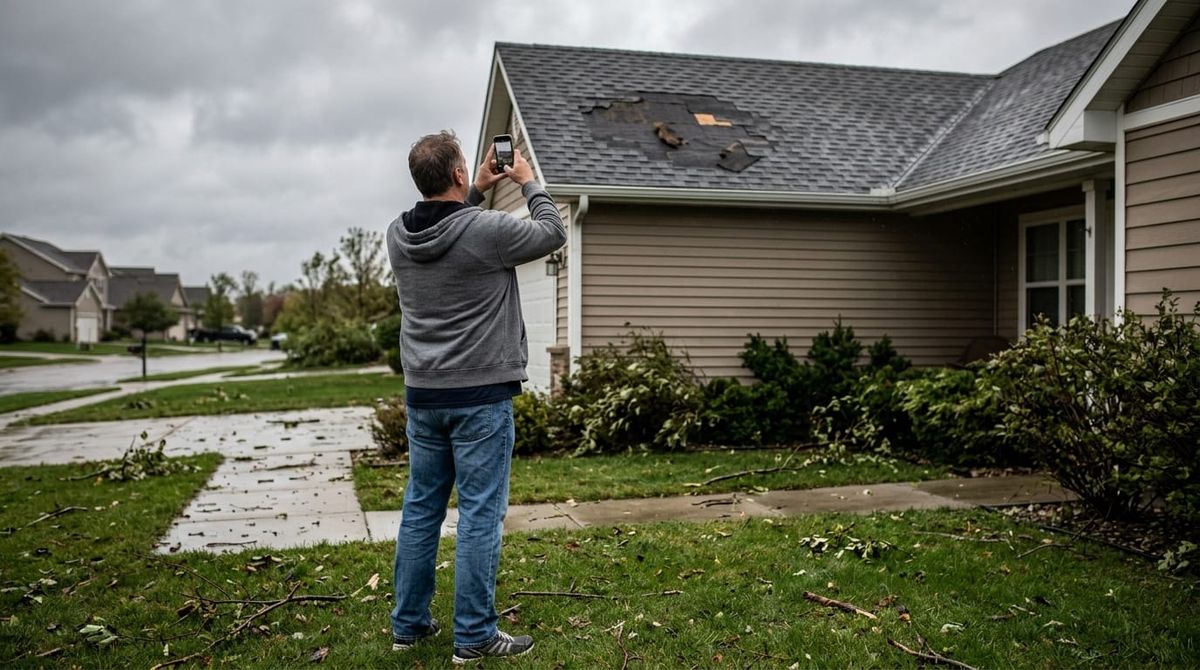
Your roof is damaged and water is getting in. The single most useful thing to know right now: photograph everything before you cover anything up. Most policies require you to limit further damage, but the evidence of the original damage disappears the moment a tarp goes on.
What Should You Do in the First 24 Hours?
Six steps, in this order. The order is what protects both your property and your claim.
The same sequence in text, with why each step matters:
| # | Step | What this means for you |
|---|---|---|
| 1 | Make the area safe | Standing water plus electricity is the immediate hazard, not the roof |
| 2 | Photograph before repair | Once covered, the original damage cannot be re-documented |
| 3 | Notify your insurer | Prompt notice is a policy condition, not a courtesy |
| 4 | Mitigate the damage | Most policies require reasonable steps to prevent further loss |
| 5 | Keep receipts | Reimbursement generally depends on proof of what you spent |
| 6 | Photograph after repair | Demonstrates both the loss and your compliance with step 4 |
How Should You Document the Damage?
Thoroughly, inside and out. FEMA advises photographing and filming both the building damage and your belongings, before you throw anything away — and to open closets and cabinets and shoot inside those too (FEMA, retrieved 2026-07-29).
For roof damage specifically, capture:
- Wide exterior shots showing the whole roof plane and the damaged section in context
- Close exterior shots of the specific damage, taken from the ground or a window if possible
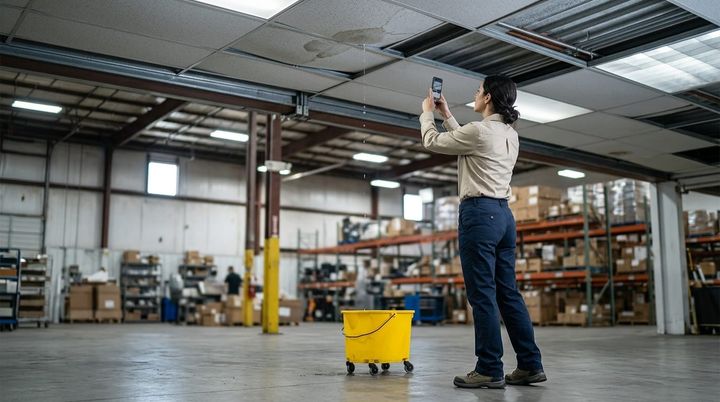
- Interior ceiling and wall stains, with something in frame for scale
- Attic conditions — wet insulation, staining on rafters, daylight through decking
- Water lines on walls and any damaged flooring below
- Damaged contents before you move or discard them
What this means for you: an adjuster who has never seen your property has to work out what happened from your photographs. If the record has gaps, they have nothing to work with. Good photos make their job easier and your claim faster.
One thing is worth knowing before you talk to anyone, and the wording matters.
Your policy almost certainly has a section called "Your Duties After Loss." That is the heading to look for — not "mitigation of loss," which is the legal name for the underlying principle rather than text in your document. Under those duties, you are generally required to protect the property from further damage, and to make reasonable and necessary repairs to do so. You are also typically expected to help verify the loss, get damage estimates, and prepare an inventory of what was damaged (NAIC Consumer's Guide to Home Insurance, retrieved 2026-07-29).
Tarping the roof counts. So does boarding a window, pumping out water, and moving dry belongings away from wet ones.
What this means for you: doing nothing is not a neutral choice. Damage that spreads because you waited may not be covered even when the original event was.
Here's a concrete example. A windstorm tears shingles off one slope on a Friday night. Rain keeps falling through Sunday.
One homeowner tarps on Friday and photographs both the damage and the tarp. Their claim is straightforward: wind damage, plus a tarping receipt.
The other waits until Monday. Same wind damage — but now also soaked insulation and a stained ceiling. Sorting out which part the storm caused and which part the delay caused takes time, and some of it may not be covered. Same storm, much messier outcome.
The same breakdown in text:
| Usually covered | Often contested | Usually excluded |
|---|---|---|
| Sudden wind damage | Damage that spread while you waited | Age and normal wear |
| Hail impact damage | Undocumented damage | Deferred maintenance |
| Tree striking the house (debris removal often sublimited) | Partial storm attribution | Pre-existing leaks |
| Tarping cost above your deductible | Late-filed claims | Dents that don't leak (some policies) |
Everything above is subject to your deductible, and coverage ultimately depends on your specific policy, state, and insurer. One note on the last row of the contested column: a claim filed past your policy's deadline is often denied outright rather than negotiated, so timing is not a soft factor.
What Does Emergency Roof Repair Cost?
Temporary protection is cheap relative to what it prevents.
Roof tarping runs about $0.70 to $2.00 per square foot including materials and labor (HomeGuide, retrieved 2026-07-29). On top of that, roofing companies typically add $200 to $500 for an after-hours callout, which covers mobilizing a crew to reach you in hours rather than days (Angi, retrieved 2026-07-29).
So do the math before you call. A 300 sq ft damaged section at $1.50 per square foot is about $450 in tarping. Add a $350 after-hours callout and you are near $800 for temporary protection. Then compare that against your deductible — if yours is $2,500, this is out of pocket, and it may still be the right call to protect $10,000 of contents.
Treat a tarp as temporary. It is holding water off a damaged roof, not fixing it, and it degrades under sun and wind. Schedule the permanent repair rather than letting the tarp become the plan.
Note one thing: even if you wait until morning to hire a crew, do the photographing tonight. Documentation does not keep.
Why Should You Not Go on the Roof Yourself?
Because a damaged roof is an unstable one, and the fall risk is the real hazard.
OSHA requires fall protection for work six feet or more above a lower level, and roofing crews arrive with harnesses, anchors, and training (OSHA, retrieved 2026-07-29). After storm damage, decking may be compromised in places you cannot see from above.
What this means for you: a fall converts a covered property claim into a medical event. Contain water from inside, document from the ground and from windows, and let a licensed crew handle anything above the eave.
How Does This Affect Your Claim Later?
The record you build in the first day determines how much of the conversation you control weeks later.
Three things carry outsized weight:
- Dated photos taken before you tarped. Without them, the original damage becomes a matter of opinion.
- Receipts for the emergency work. They support getting that money back, and they prove you did what the policy asked.
- A professional inspection report with photos. More convincing than your own photos, especially with hail.
Hail is where documentation matters most, and where a professional inspection is worth the most. Hail damage is often hard to read from ground level, which is why an inspector's photographed report carries more weight than yours. Material choice also changes how much damage a given storm does — FEMA's case-study work on hail-resistant roofing shows how differently products survive the same event (FEMA, retrieved 2026-07-29).
Routine inspection records help too. The National Roofing Contractors Association recommends checking at least twice a year, plus after major storms (NRCA, retrieved 2026-07-29). A maintenance history shows the roof was in good shape before the storm. That makes the storm the obvious cause, which is exactly what you want on record.
What this means for you: keep inspection reports even when nothing is wrong. Their value shows up during a claim, not before one.
What do you want to do next?
Three ways we can help from here.
Get the free contractor checklist →7 questions to ask any roofer before you call. Know what to ask, and what a good answer sounds like.Will insurance pay?What claims cover — and what they don't.Find financingReal cost over the term, not the monthly.
Frequently Asked Questions
Will my insurance pay for emergency tarping?
Often, when the underlying loss is covered — but the deductible comes first. A claim pays out only after you have covered your deductible (NAIC, retrieved 2026-07-29). So an $800 tarping bill against a $2,500 deductible is money you will not see back, even on a valid claim. Keep receipts either way, and call your insurer before authorizing large emergency work where you have time to.
Should I wait for the adjuster before doing any repairs?
Do emergency mitigation immediately — policies generally expect it. Hold off on permanent repairs until the adjuster has inspected, unless waiting would cause further damage. Photograph before and after any temporary work.
What if the damage happened weeks ago and I did nothing?
File anyway, but expect more scrutiny. Deadlines vary by policy and state, and delay can affect coverage for damage that spread. Document current conditions and be straightforward about the timeline.
Is a tarp enough to get through winter?
No. Plan on 60 to 90 days of service life. Tarps degrade under UV exposure and tear in wind. Schedule the permanent repair while the tarp is still doing its job.
Do I need a public adjuster?
Not usually for a straightforward claim. They can help on large or disputed losses, and they charge a percentage of the settlement. If you are considering one, verify licensing with your state insurance department first.
Comments ()