How to Read a Roof Estimate: Line by Line, and What to Challenge
What every roofing estimate should itemize, where padding actually hides, and which exclusions are worth challenging before you sign.

A roofing estimate that gives you one number and no breakdown cannot be checked, compared, or challenged. A good one lists twelve or more line items. This guide walks each of them, then covers what to question before you sign.
What Should Every Roof Estimate Include?
Twelve items. If any are missing, that is your first question rather than a reason to walk away.
The same list in text, with what each one tells you:
| # | Line item | Why it matters |
|---|---|---|
| 1 | Legal name and physical address | A P.O. box only is a warning sign |
| 2 | License number | You can verify it with your state board |
| 3 | Liability and workers' comp | An uninsured injury on your roof can reach your policy |
| 4 | Tear-off layers | Each layer adds labor and disposal weight |
| 5 | Deck price per sheet | Rot is invisible until they open it up |
| 6 | Flashing | Most leaks start here, and it is the commonest omission |
| 7 | Ventilation and ridge cap | Poor airflow shortens the roof's life |
| 8 | Property protection | Landscaping, AC units, windows |
| 9 | Shingle brand, line, color | "Architectural shingles" is not a specification |
| 10 | Underlayment | Type and coverage |
| 11 | Permits, named separately | Should never sit inside "miscellaneous" |
| 12 | Warranty terms | Two separate warranties, see below |
Where Does Padding Actually Hide?
Not usually in overhead and profit, which is where homeowners look first. It hides in vagueness.
Watch for four patterns:
- "As needed" pricing. Flashing "replaced as needed" or decking "repaired as needed" means the price is not settled. Ask for a unit rate.
- Bundled labor. A single "labor and materials" figure prevents you from comparing bids at all.
- Permits inside miscellaneous. Permits are a knowable, documentable cost. Burying them hides a markup.
- Vague material names. "Premium shingles" is marketing. A brand, product line, and color is a specification.
Overhead and profit deserves a different reaction than most people give it. It covers general liability, workers' compensation, licensing, manufacturer certification, vehicles, and office staff — plus the margin that keeps a company solvent enough to answer the phone when you call about a leak in year seven. A contractor with no overhead line is not cheaper. They are either hiding it or they do not carry the coverage.
What Does an Unusually Low Bid Actually Mean?
Usually that something has been left out, not that you found a deal.
A bid landing 25 to 40 percent below the others typically omits labor-heavy work — tear-off, flashing replacement — or conceals it behind vague language. Compare the scope first, and only then the totals.
For example, follow Bid A through to the end. It comes in at $9,200, with tear-off "as needed" and no flashing line at all. Two layers turn out to need removing. The flashing does need replacing, because it usually does. Those two change orders land at $2,800 and $1,400.
Your final cost is $13,400. That is Bid B's original number — except you never got to compare it, and you had no leverage once the crew was already on the roof.
Which Exclusions Should You Challenge?
Any exclusion that covers work the job obviously requires.
Read the exclusions section closely, because it is where scope quietly narrows. Three worth pushing on:
- Deck replacement excluded entirely. Some rot is likely on most tear-offs. An excluded deck means an open-ended change order. Ask for a per-sheet rate instead.
- Flashing excluded or "existing to remain." Reusing old flashing on a new roof is a common source of early leaks. If they plan to reuse it, get that stated and understand why.
- Permits excluded. Somebody has to pull them. If it is you, that is a real cost and a real responsibility.
A useful rule: if you expect something to be included and it is neither listed nor named as excluded, ask. Silence in an estimate is not a commitment.
The same three conversions in text:
| Vague wording | What it really means | What to ask for |
|---|---|---|
| "Replaced as needed" | The price is not settled | A unit rate, e.g. $68 per sheet |
| "Premium shingles" | Marketing, not a specification | Brand, product line, and color |
| "Miscellaneous" | Often where permits hide | An itemized breakdown of that line |
What Should the Warranty Section Say?
Two warranties, described separately, with terms you can read.
- Manufacturer warranty covers the shingles themselves. Terms often run 25 to 30 years on architectural products, and some tiers require a certified installer.
- Workmanship warranty covers the installation and comes from the contractor. Length varies widely and is usually much shorter.
Confirm three things in writing: what voids each warranty, whether coverage transfers if you sell the house, and what inspection or maintenance is required to keep it valid. Many manufacturer warranties are conditional on documented upkeep — the National Roofing Contractors Association recommends inspection at least twice a year plus after major storms (NRCA, retrieved 2026-07-29).
While you are reading the scope, check that ventilation appears. Attic airflow protects the roof you are buying: winter airflow through a cold attic reduces ice damming, and summer airflow moves out superheated air that ages shingles (ENERGY STAR, retrieved 2026-07-29). A replacement is the cheapest moment to fix poor venting.
How Should You Compare Bids Fairly?
Give every contractor the same written scope, then compare line by line.
- Write the scope yourself first. Material tier, tear-off expectations, flashing replacement, warranty term.
- Get three or more bids against that identical scope.
- Line up the twelve items from the checklist above, side by side.
- Ask each bidder about the same three exclusions. Their answers are as informative as their prices.
- Check licensing and insurance independently — verify the license number with your state board rather than accepting a document.
For context on whether the totals are plausible at all, most asphalt shingle replacements run $9,000 to $18,000, with labor at roughly 40 to 60 percent of the job (This Old House, retrieved 2026-07-29; SquareDash, retrieved 2026-07-29). A bid far outside that band deserves an explanation in either direction.
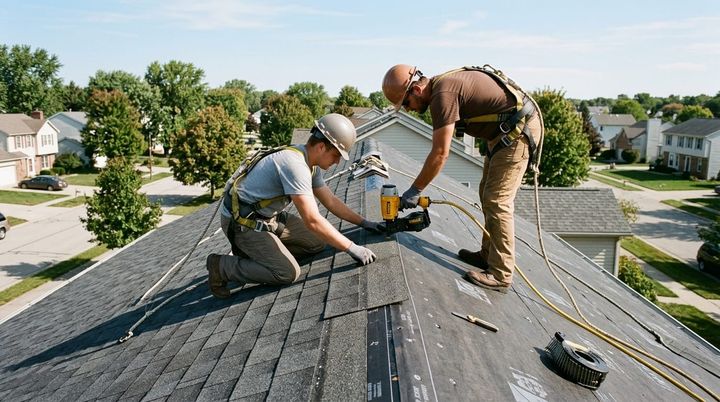
One last thing on process. Roofing crews carry real safety obligations — OSHA requires fall protection for employees working six feet or more above a lower level (OSHA, retrieved 2026-07-29). That compliance is part of what a legitimate bid prices in, and part of why the cheapest number is not always the cheapest job.
Cost data updated July 2026. Figures are published US ranges and vary by region, roof complexity, and access.
What do you want to do next?
Three ways we can help from here.
Get the free contractor checklist → 7 questions to ask any roofer before you call. Know what to ask, and what a good answer sounds like.Frequently Asked Questions
How many roofing estimates should I get?
Three, against one written scope. Fewer gives you no baseline. More than four rarely adds information and slows the job down.
Is a large deposit normal?
A deposit of 10 to 30 percent is standard, mainly to order materials. Requests above 50 percent up front are a warning sign, and paying the full amount before work begins removes your leverage entirely.
Should the estimate include photos?
It helps considerably, especially for repairs. A contractor who has been on your roof should be able to show you what they found. Photos also make the scope harder to dispute later.
What is a change order, and how do I limit them?
A change order is added work priced after the contract is signed. You limit them by getting unit prices in advance for the two things most likely to be discovered mid-job: deck replacement per sheet, and additional tear-off layers.
The estimate is one page with one number. Is that disqualifying?
Not automatically, but ask for an itemized version before you decide anything. If the contractor will not provide one, you have learned something useful about how the project would be run.
Comments ()