Commercial Roof Inspection: How Often, What It Costs, and Why Records Matter
How often commercial roofs need inspecting, what it costs, and why a documented inspection history protects your insurance and warranty coverage.
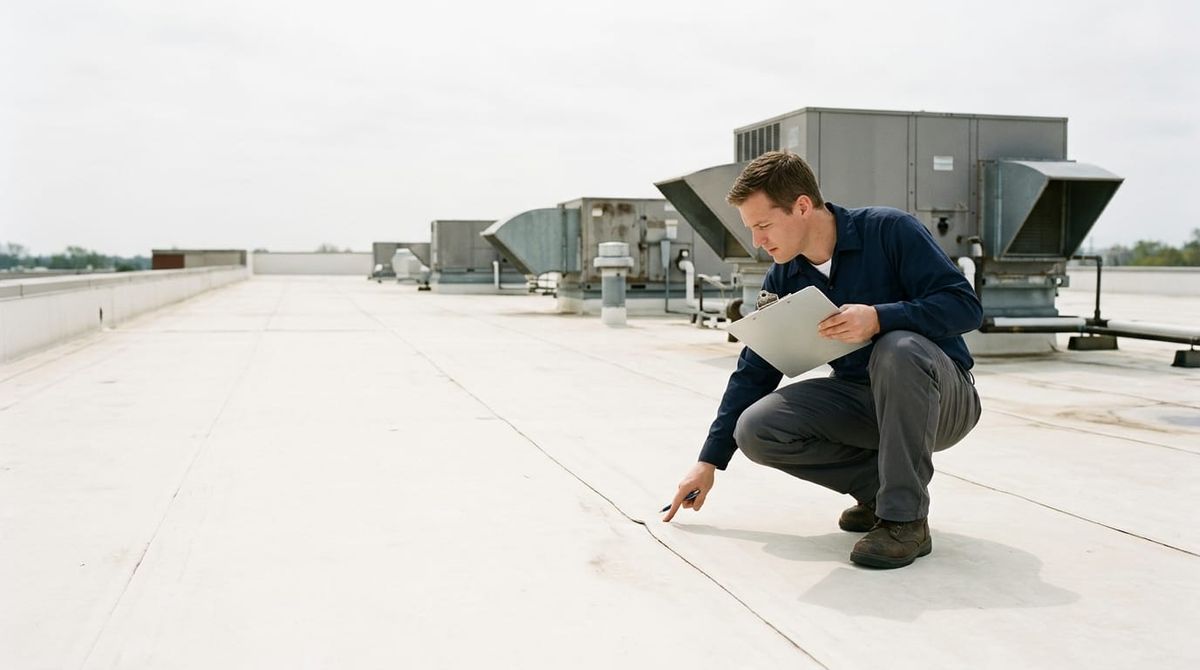
A commercial roof inspection is a systematic check of a flat or low-slope roof's membrane, drainage, and penetrations, and most commercial properties need one at least twice a year. This is for property owners, facility managers, and anyone responsible for a building where the roof isn't something you can just glance at from the driveway.
What Makes a Commercial Roof Inspection Different?
The building type changes what gets inspected and who's liable if it isn't.
Most commercial buildings use a flat or low-slope roof. Think membrane systems like TPO, EPDM, or modified bitumen — not the pitched asphalt shingles you'd see on a house. That construction fails differently. You're not looking for missing shingles. You're looking for membrane seams pulling apart, ponding water, and drainage that fails slowly instead of leaking dramatically.
The stakes are different too. A homeowner who skips an inspection risks their own repair bill. A commercial property owner risks more: a voided warranty, a denied insurance claim, and sometimes liability if a roof failure damages a tenant's property.
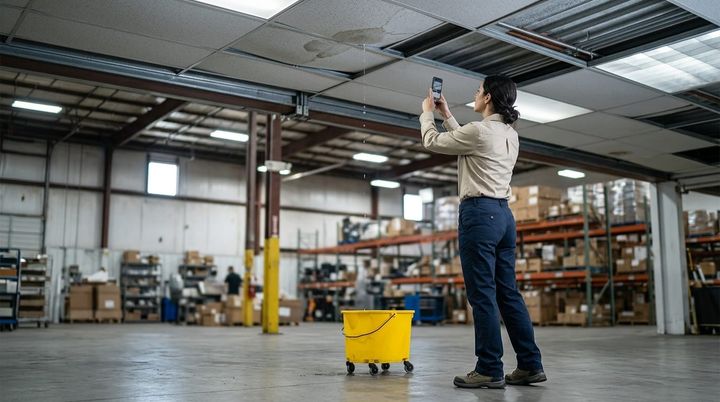
For example, a warehouse owner who skips two straight inspection cycles has no problem until a storm causes a leak. The insurer asks for inspection records. There are none. The claim gets challenged on neglect grounds — not because the storm wasn't real, but because there's no paper trail proving the roof was maintained.
How Often Should a Commercial Roof Be Inspected?
Twice a year, at minimum — spring and fall — plus after any major storm.
This mirrors the residential standard. The National Roofing Contractors Association recommends inspecting roof systems at least twice a year — ideally spring and fall — plus again after major storms (NRCA, retrieved 2026-07-29). The same logic applies to commercial roofs, and arguably matters more: a bigger membrane means more surface exposed to weather cycling.
- Spring catches winter's damage — membrane contraction cracks, ice-related seam separation, debris accumulation.
- Fall catches summer's damage before winter arrives — UV degradation, heat-cycling wear, clogged drains from falling debris.
- Post-storm matters because on a flat roof, wind uplift and hail bruising are often invisible from ground level and can void a warranty claim if not documented promptly. Hail performance varies enormously by roofing material — FEMA's own case-study work on hail-resistant roofing documents how much difference impact-rated products make to post-storm outcomes (FEMA, retrieved 2026-07-29).
Some roofs need more frequent checks. Watch for three cases: roofs older than 15 years, roofs carrying HVAC or solar equipment, and roofs under a warranty with its own stricter inspection clause. Read your warranty document. Some manufacturers require quarterly inspections to keep coverage active.
What Does a Commercial Roof Inspection Cost?
Most commercial inspections run $300 to $1,000 or more — but on a commercial building that total is close to meaningless on its own, because the roofs vary from 10,000 to 200,000+ sq ft. Price it per square foot instead.
As a working figure, routine visual inspections commonly land in the range of $0.02–$0.05 per square foot, with infrared and moisture-scanning surveys running several times that. Run the arithmetic against your own building before judging any quote:
| Roof area | Routine visual inspection, indicative |
|---|---|
| 10,000 sq ft | roughly $300 – $500 |
| 25,000 sq ft | roughly $500 – $1,000 |
| 50,000 sq ft | roughly $1,000 – $2,000 |
| 100,000+ sq ft | quoted per project, usually with a survey scope |
Treat those as orientation, not a quote — access, roof complexity, and rooftop equipment density move them substantially. The reason to think in $/sq ft anyway is that it is the only way to compare a bid on a 15,000 sq ft retail strip against one on an 80,000 sq ft distribution centre.
For scale on the residential side, homeowner inspections generally sit in the $150–$400 band (Homewyse, retrieved 2026-07-29; Angi, retrieved 2026-07-29). Commercial pricing starts roughly where residential ends and scales from there.
Cost data updated July 2026.
Five things drive the cost above a residential inspection:
- Square footage. Bigger roof, more time walked.
- Access and safety compliance. Multi-story buildings need lift equipment or fall-protection rigging. OSHA requires fall protection for work six feet or more above a lower level, and permits warning-line and safety-monitoring systems as alternatives on low-slope roofs (OSHA, retrieved 2026-07-29). That compliance overhead is built into what a commercial inspector charges. Single-story warehouses are faster and cheaper.
- Rooftop equipment. HVAC units, solar arrays, and satellite mounts each need their own flashing check.
- Report depth. A report built for an insurance claim or a warranty condition costs more than a basic visual check — same pattern as residential.
- Infrared or moisture scanning. A common add-on for larger properties, used to catch trapped moisture under a membrane before it becomes a visible leak.
Why Does the Inspection Record Matter More Than the Inspection?
The document protects you. The inspection is just how you get the document.
Two parties will ask for that record eventually. Both can deny you money without it:
- Your roofing warranty. Most commercial warranties are conditional, not automatic. They require you to maintain and document regular inspections. Manufacturers deny warranty claims over missing paperwork — even when the actual defect is a genuine manufacturing flaw.
- Your insurer. After storm damage, insurers ask for inspection history. They want to know the damage is storm-related, not long-term neglect. No records means a weaker negotiating position, even for a real, sudden event.
The practical takeaway: keep every inspection report, dated and with photos, in one place — ideally both a physical file and a cloud folder. When a claim or warranty question comes up, you want to hand over a paper trail, not reconstruct one from memory.
What Should a Commercial Roof Inspection Report Include?
A usable report documents four things, and a report missing any of them is worth pushing back on:
- Date and roof identification — which building, which roof section, inspected when.
- Photo documentation of every finding, not just a written description.
- Membrane and seam condition, drainage performance, and any ponding water observed.
- A clear severity rating — urgent, needs monitoring, or cosmetic — so you know what to act on first.
If a report you receive is missing photos, that's the same red flag as on the residential side: a finding without an image is an assertion, not documentation.
What do you want to do next?
Three ways we can help from here.
Get the free contractor checklist →7 questions to ask any roofer before you call. Know what to ask, and what a good answer sounds like.Will insurance pay?What claims cover — and what they don't.Find financingReal cost over the term, not the monthly.
Frequently Asked Questions
Do commercial roof inspections require going on the roof, or can it be done from the ground?
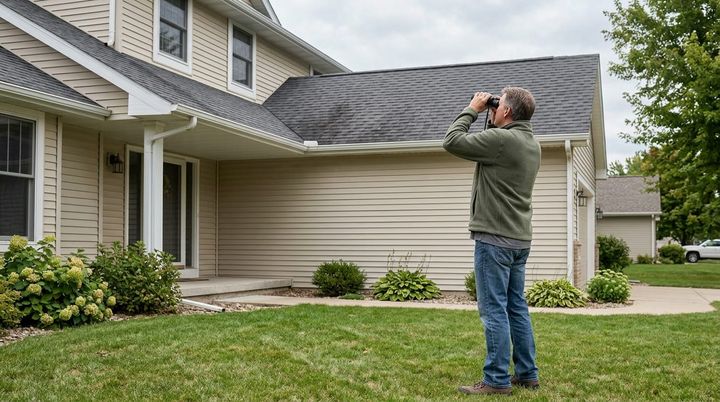
A real inspection requires roof access. Ground-level or drone-only checks can spot obvious surface issues but miss membrane seam condition, ponding, and rooftop equipment flashing — the areas that fail most often on commercial roofs.
How long does a commercial roof inspection take?
It varies widely with size — a small single-story building might take an hour, while a large multi-section commercial roof with rooftop equipment can take half a day or more.
Does a new roof still need biannual inspections?
Yes. New membrane systems can still develop installation defects, and most warranties require documented inspections from day one regardless of roof age — skipping them early is one of the more common ways owners accidentally void coverage.
Who should perform a commercial roof inspection — the manufacturer, a roofer, or a third party?
Any of the three can do it, but they carry different incentives. A manufacturer-affiliated inspector protects the warranty relationship, a roofing contractor may also be positioned to bid the repair work, and an independent inspector has no stake in the outcome. For a routine biannual check, the first two are fine. For a warranty dispute or an insurance claim, independence is worth paying for.
Comments ()