When Does Storm Damage Mean Full Roof Replacement, Not a Repair?
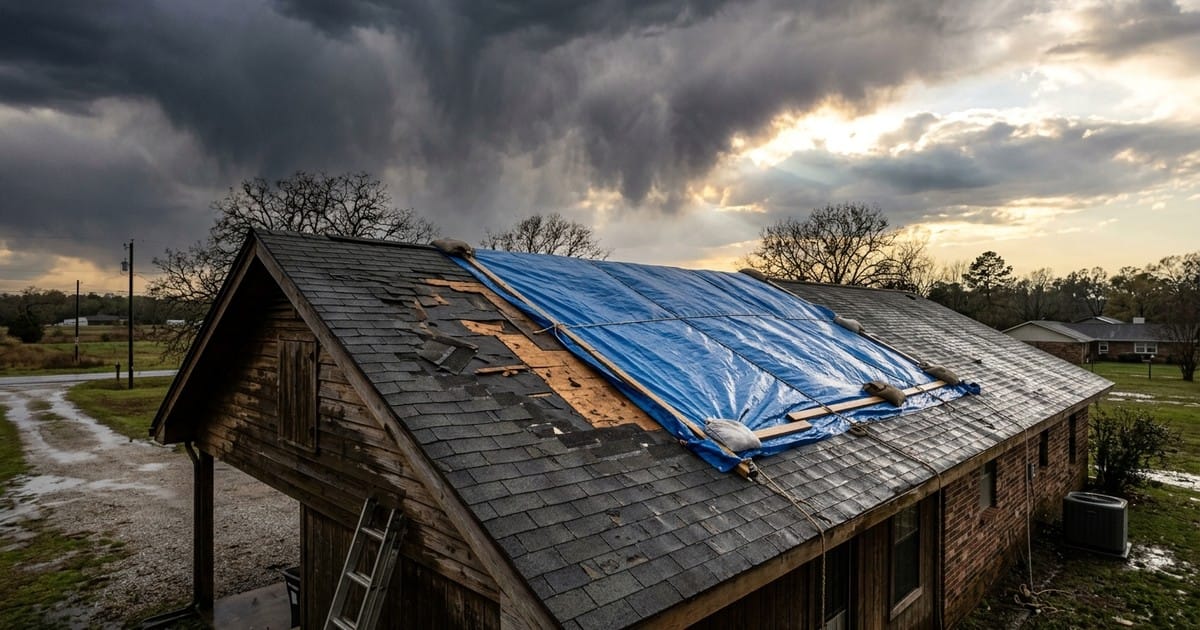
A storm can damage one slope of a roof and still end with your insurer paying to replace all four. The reason usually isn't generosity, and it isn't always about how bad the damage was — it's a specific rule about matching that most homeowners never hear about until they're in the middle of a claim.
If you're still figuring out whether what happened to your roof actually qualifies as storm damage, our damage-identification guide covers how to tell hail, wind, and debris damage apart. This post picks up from there — your roof has storm damage, and the real question is how much of it gets replaced.
The Matching Rule Most Homeowners Never Hear About
Insurance regulators built a specific rule for exactly this situation: what happens when new materials don't match what's already there.
The NAIC's own model regulation for claims settlement states plainly: "When a loss requires replacement of items and the replaced items do not match in quality, color or size, the insurer shall replace all items in the area so as to conform to a reasonably uniform appearance" (NAIC Model Regulation 902, Section 9.A(2), retrieved 2026-08-04). In plain terms: if your discontinued shingle can't be color-matched, the fix isn't a visibly patched roof — it's replacing enough of it that the whole thing looks uniform again.
This is a model regulation, not a single national law — individual states adopt it, adapt it, or skip it, and the practical result varies a lot by where you live. Some states have built strong matching requirements into their claims-handling rules; others leave it almost entirely to the policy language and the adjuster's judgment. Don't assume either answer. Ask your insurer directly, in writing, what happens if your existing shingle can't be matched — and get that answer before repair work starts, not after.
Ordinance-or-Law Coverage: The Separate Coverage Most People Don't Know They Have
There's a second mechanism that can also push a repair toward a much bigger job, and it has nothing to do with matching.
Building codes change. If your roof was installed under an older code and a storm forces a permitted repair, that permit can pull the work under current code — updated decking, underlayment, or ventilation requirements that didn't exist when your roof was built. A standard policy often won't pay for that upgrade gap; a separate coverage called ordinance-or-law (or law-and-ordinance) coverage does.
Florida makes this concrete and mandatory: state law requires every homeowners insurer to offer this coverage, and unless a policyholder specifically refuses it in writing, it's included by default at 25% of the dwelling coverage limit (Florida Statute § 627.7011, retrieved 2026-08-04). Outside Florida, availability and the percentage offered vary by insurer and state, but the coverage itself is common enough that it's worth a direct question rather than an assumption you either have it or don't.
| The matching rule | Ordinance-or-law coverage | |
|---|---|---|
| What it's about | Appearance, not damage severity | Code-upgrade costs, a separate coverage |
| Example | NAIC model regulation, adopted by some states | Florida requires it be offered, 25% default |
| ## What Actually Pushes an Insurer From Repair to Full Replacement |
Three separate mechanisms, and they don't always point the same direction.
The matching rule, where it applies, is about appearance, not damage severity — even minor damage to a small area can trigger a broader replacement if the material can't be matched. The extent of physical damage is the more intuitive trigger: widespread bruising or creasing across a whole slope usually exceeds what a spot repair can reasonably fix, independent of any matching question. Ordinance-or-law coverage is different again — it doesn't decide repair versus replacement on its own, but it can be the reason a "simple repair" turns into a bigger, code-compliant job once a permit is involved.
A contractor or adjuster citing one of these to justify a bigger scope should be able to tell you which one they mean. "The code requires it," "the policy's matching provision applies," and "the damage is too extensive to spot-repair" are three different claims, and each has a different kind of answer behind it.
| Situation | Mechanism | Likely outcome |
|---|---|---|
| Shingle can't be matched | State matching rule may apply | Broader replacement may be required |
| Damage spans multiple slopes | Extent-of-damage judgment | Full replacement likely, matching aside |
| Permit pulls in current code | Ordinance-or-law coverage applies | Bigger, code-compliant scope |
| ## What Should You Ask Before You Assume Either Way |
Three questions, asked early, save the most confusion later.
Ask your insurer directly whether an appearance-matching standard applies in your state and policy, and what happens specifically if your shingle is discontinued. Ask whether you have ordinance-or-law coverage and at what percentage of your dwelling limit, since it's often included by default and just as often never mentioned. Confirm the deductible still applies to whatever scope is settled on — a bigger replacement doesn't change how the deductible works, it just changes the total the deductible is subtracted from. Our insurance claim guide covers the deductible mechanics and the filing process in full.
| Tier | Coverage |
|---|---|
| Default (no selection made) | 25% of dwelling limit |
| Optional upgrade tier | up to 50% of dwelling limit |
| ## Frequently Asked Questions |
Does my insurer have to replace my whole roof if the shingles don't match?
It depends on your state and policy. Many states have adopted some version of the NAIC's model matching standard, which can require replacing enough of the roof to restore a reasonably uniform appearance rather than leaving a visible patch. Other states leave this largely to policy language and adjuster judgment. Ask your insurer directly rather than assuming either way.
What is ordinance-or-law coverage, and do I have it?
It's a separate coverage that pays the added cost of bringing a repair up to current building code, on top of restoring what was damaged. Some states, including Florida, require insurers to offer it by default. Elsewhere, check your policy directly — it's commonly included at a set percentage of your dwelling coverage limit but easy to overlook if no one points it out.
Is the extent of damage or the matching rule more likely to trigger a full replacement?
Either can, independently. Extensive physical damage across multiple slopes can require full replacement regardless of matching. A matching rule can require a broader replacement even when the physical damage itself is limited to one area, if the material can't be matched. They're separate questions worth asking separately.
What do you want to do next?
Three ways we can help from here.
Get the free contractor checklist → 7 questions to ask any roofer before you call. Know what to ask, and what a good answer sounds like.