Storm Damage Roof Repair: How to Tell Hail from Wind, and What Gets Fixed
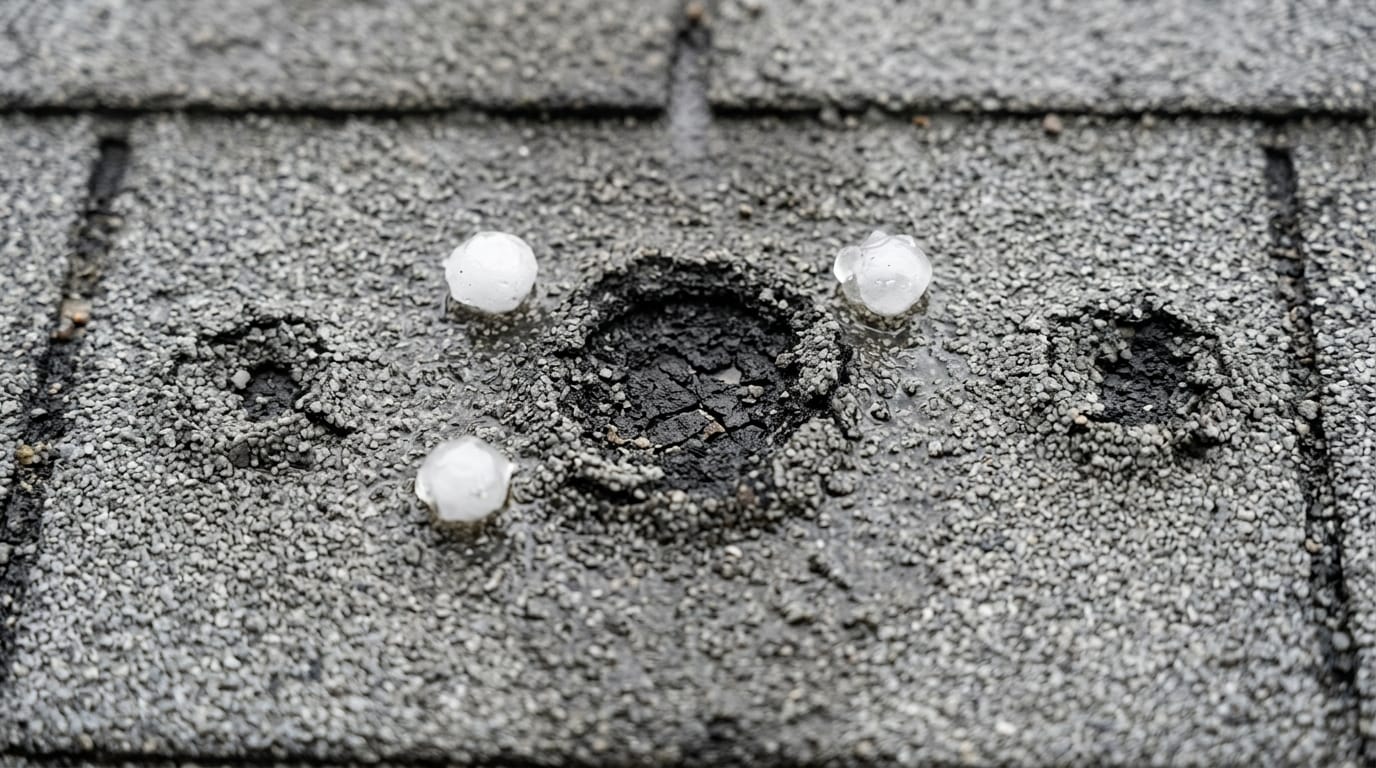
Storms damage roofs in three distinct ways, and they look nothing alike. Hail leaves round bruises. Wind leaves creases and gaps. Debris leaves punctures. Knowing which one you have changes what gets repaired, what it costs, and how a claim is likely to go.
What Does Storm Damage Actually Look Like?
Three damage types, three different signatures. If the damage is severe enough to need a fast response, our emergency roof repair guide covers the first 24 hours.
The same comparison in text:
| Hail | Wind | Debris | |
|---|---|---|---|
| Looks like | Round bruises, dark spots | Creased, lifted, missing shingles | Punctures, gouges |
| Pattern | Scattered randomly | One slope, usually windward; edges first | Isolated spots |
| Feels | Soft, spongy under thumb | Loose, lifts by hand | Torn through |
| Also damages | Vents, gutters, AC fins, siding | Ridge caps, eaves, flashing | Whatever it struck |
What this means for you: dented gutters and AC fins alongside roof marks point toward hail across the property, because wind alone rarely dents metal. One caution: dents on metal can be years old. Ask the inspector whether the impacts look fresh, or compare against older photos of the same fixtures.
How Do You Identify Hail Damage?
Look for round marks, then press them.
Bruising is the most common form of hail damage. A hailstone compresses the shingle and knocks granules loose, leaving a circular depression. The damage that matters is underneath: a fracture in the fiberglass mat — the reinforcing layer inside the shingle that holds it together — which compromises the shingle's ability to shed water long before anything looks broken from outside.
The Insurance Institute for Business & Home Safety evaluates shingles against the damage modes hailstorms actually produce: dents and ridges, tears, and granule loss (IBHS, retrieved 2026-07-30).
The touch test is the inspector's tool, not yours. A bruised area feels soft or spongy where sound shingle feels firm. That is genuinely diagnostic — but it requires being on the roof, which you should not be. Ask your inspector to demonstrate it and photograph the spots they find.
Two things make the test less certain than it sounds, which is worth knowing before anyone reads it back to you as proof:
- Heat softens asphalt. Shingles pressed on a hot afternoon feel yielding whether or not hail touched them.
- A single soft spot proves little. What matters is whether the softness appears in a scattered pattern consistent with a hailstorm.
Other hail signals:
- Granule loss in a splatter pattern around impact points, with exposed asphalt appearing darker than the surrounding surface
- Dents on soft metal — gutters, downspouts, vent caps, AC condenser fins. Metal records hail reliably
- Fresh-looking marks with sharp edges, rather than weathered, rounded wear
Now the caveat that separates an honest assessment from a sales pitch. Granule loss by itself does not prove hail. Age, oxidation, blistering, foot traffic, tree contact, and ordinary weathering all shed granules. Storm damage assessment depends on the pattern across the entire roof, not one bare patch.
What this means for you: a contractor who points at a single bald spot and recommends a full claim has not made a case. Ask them to show you the pattern, and to show you the metal.
Material choice changes how much damage a given storm does. IBHS publishes impact-resistance ratings covering a wide range of shingle products, and the spread between them is substantial (IBHS, retrieved 2026-07-30).
How Do You Identify Wind Damage?
Look at the edges, and look for creases.
Wind does not make round marks. It lifts. The shingle bends back, cracks along the fold, then lays back down looking almost normal — which is why wind damage gets missed from the ground.
- Creasing. A horizontal line across the shingle where it folded. The seal is broken even if nothing is missing.
- Missing tabs. Straightforward, and usually the first thing anyone notices.
- Lifted edges that move when pressed, meaning the adhesive strip has released.
- Damage concentrated on one slope — the side that faced the wind — and worst at ridges, eaves, and corners where uplift is strongest.
What this means for you: creased shingles are damaged even though they look intact. A roof that appears fine after a windstorm can have a whole slope of broken seals, and the leaks show up months later.
The four stages in text:
| Stage | What happens | Visible from ground? |
|---|---|---|
| 1 | Shingle sealed and flat | Normal |
| 2 | Wind lifts the tab, breaking the adhesive seal | Only during the storm |
| 3 | Shingle folds and cracks along the fold line | Briefly, if you're looking |
| 4 | Shingle lays back down over the crack | Looks normal — damage hidden |
Is Storm Damage Repairable, or Does It Need Replacing?
It depends on how much of the roof is affected, and on the roof's age.
| Situation | Repair | Replace |
|---|---|---|
| Debris punctured a small area, roof under 15 years | ✅ Repair | — |
| Wind took shingles off one section | ✅ Repair | — |
| Wind creasing across a whole slope | — | ✅ Usually replace that slope |
| Scattered hail bruising across all slopes | — | ✅ Replace |
| Any storm damage on a roof past 20 years | — | ✅ Replacement conversation |
| Matching shingle is discontinued | Depends | Often replace the full face |
Two things push toward replacement more than people expect. Widespread hail bruising usually resists spot repair, because the mat can be compromised over a broad area even where nothing is missing. Note that the roofing judgment and the insurer's scope determination are separate questions, and they do not always land in the same place. And color matching frequently fails on older roofs, which can make patching a visible repair rather than an invisible one — our guide to when storm damage forces a full replacement covers the specific matching rule and ordinance-or-law coverage that often decide this.
The same ladder in text:
| How far the damage reaches | Usual response |
|---|---|
| Isolated spots | Spot repair |
| One section | Section repair |
| A whole slope | Redo that roof face |
| Every slope | Full replacement — typical of widespread hail |
What Looks Like Storm Damage But Usually Isn't?
Several things, and knowing them protects you from paying for a claim you do not have.
Every diagnostic above points toward finding damage. That is how most content on this topic is written, and it is why homeowners get talked into claims that go nowhere. Here is the other direction.
| What you see | Storm damage? | More likely |
|---|---|---|
| Granule loss in gutters | Maybe | Age, oxidation, or normal weathering |
| Curling or cupping shingle edges | No | Age, heat, poor attic ventilation |
| Blistering — small raised bubbles | No | Trapped moisture in manufacture or install |
| Scuff marks in a walking line | No | Foot traffic from earlier work |
| Scraped shingles under a branch | Sometimes | Ongoing tree contact, not one event |
| Cracks running with the shingle grain | No | Thermal cycling over years |
| One dark patch, no pattern | Unlikely | Localised wear or a previous repair |
The distinction that matters: storm damage is an event, and wear is a condition. An event leaves a pattern consistent with a single moment — one direction, one slope, one size of impact. A condition shows up gradually and tends to appear where the roof is oldest or hottest, not where the weather hit hardest.
What this means for you: if a contractor points to curling edges or bald patches and calls it storm damage, ask what makes it an event rather than wear. A good inspector will answer that comfortably.
What Does Storm Damage Repair Cost?
There is no clean published figure for storm repair specifically, so treat the general roof-repair band as a proxy and say so: repairs commonly run $350 to $1,500, averaging near $800 (Fixr, retrieved 2026-07-30) — that source prices leak repair, not storm damage, so read it as an order of magnitude rather than a quote.
Full replacement is better documented: most asphalt shingle replacements run $9,000 to $18,000 (This Old House, retrieved 2026-07-30).
The number that decides whether you file is your deductible, not the repair cost — our insurance claim guide covers that decision and the filing process in full.
For example, say wind takes shingles off one section and the repair quotes at $1,400. Your deductible is $2,500. The claim would pay zero, because payment only begins above the deductible (NAIC, retrieved 2026-07-30). Now change one detail: the same storm left hail bruising across every slope and the quote is $16,000. The deductible is then a small fraction of the recovery.
What this means for you: the quote and your deductible together are what the decision turns on, and neither tells you much alone. Get the damage assessed and quoted first so you are deciding with both numbers in front of you.
Cost data updated July 2026. Figures are published US ranges and vary by region, roof complexity, and access.
How Do You Check for Damage Without Getting on the Roof?
Five steps, in order.
- Look from the ground first. Walk the perimeter with binoculars. Check gutters, downspouts, and the AC unit for dents — metal records hail even when shingles look ambiguous.
- Photograph everything, dated. Wide shots and close-ups, exterior and interior, before anyone repairs or covers anything.
- Check the attic. Daylight through decking, damp insulation, or fresh staining tells you more than the roof surface does.
- Get a professional inspection. Hail in particular is hard to judge from the ground, and an inspector's photographed report carries far more weight with an insurer than homeowner photos alone.
- Compare the quote against your deductible before filing.
Do not climb up to check yourself. A storm-damaged roof can have compromised decking that looks intact from above, and falls from height cause serious injuries. Binoculars from the lawn and a flashlight in the attic tell you what you need in order to decide whether to call someone.
What do you want to do next?
Three ways we can help from here.
Get the free contractor checklist → 7 questions to ask any roofer before you call. Know what to ask, and what a good answer sounds like.Frequently Asked Questions
How long do I have to file a storm damage claim?
Deadlines vary by policy and by state, and they are set out in your policy rather than by a single national rule. Check your declarations page and contact your insurer promptly. Delay can also make it harder to establish that the storm caused the damage rather than ordinary wear.
Can hail damage a roof without me seeing anything?
Yes, and this is the most common surprise. The reason inspectors check for bruising at all is that the reinforcing mat inside a shingle can be compromised while the surface still looks largely intact — which is why a professional inspection after a significant hailstorm tells you more than a look from the driveway does.
Will my insurer pay for a full replacement if only one slope was hit?
It varies by state, insurer, and policy form, and appearance matching is a recognised point of discussion in property claims. Rather than assume either answer, put it in writing early: if an exact match is unavailable, how will the settlement address appearance? Your state insurance department can tell you what applies where you live, and remember any settlement still sits behind your deductible (NAIC, retrieved 2026-07-30).
Should I use the contractor who knocked on my door after the storm?
Be cautious. The Better Business Bureau has a standing scam alert on post-storm roofing offers and notes that reputable roofers rarely canvass door to door (BBB Scam Alert, retrieved 2026-07-30). Storm-chasing crews typically arrive within days of a hail or wind event. Verify licensing and insurance independently before letting anyone on your roof.
Does a repair reset my roof's lifespan?
No. A repair restores the damaged area. The rest of the roof continues aging on its original schedule, which is part of why widespread damage on an older roof usually points to replacement rather than patching.