Skylight Leaks and Replacement Cost: What Homeowners Actually Pay
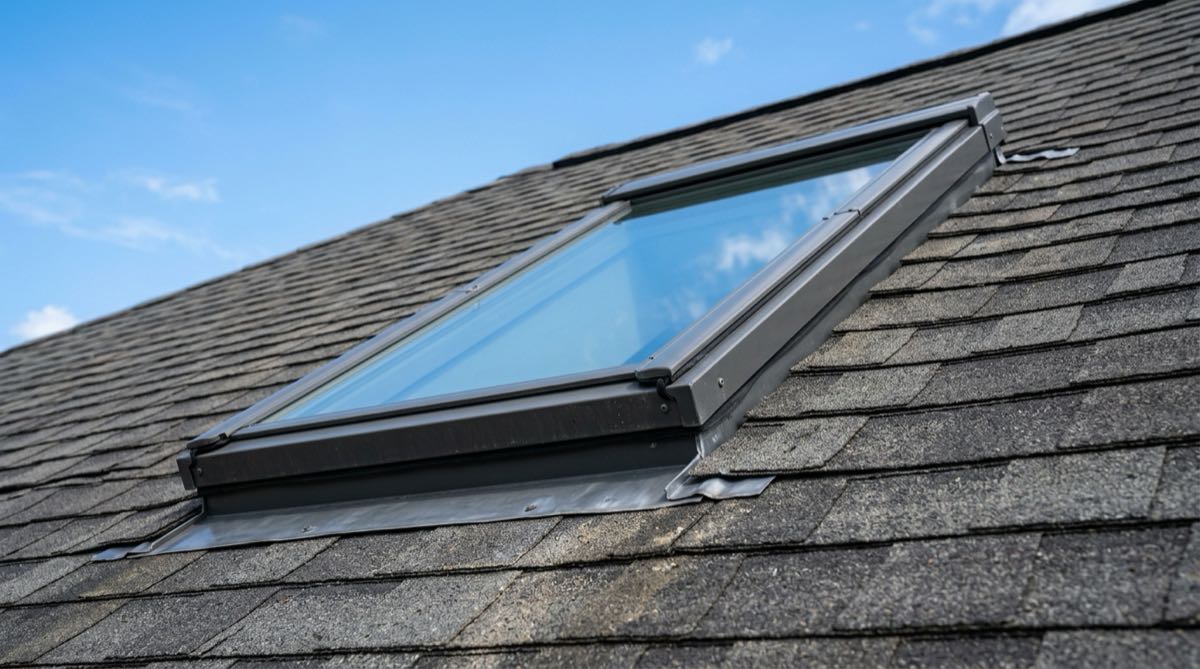
A skylight is the roof's most complicated opening — a hole cut into the deck, sealed by flashing and a seal system rather than the continuous, overlapping shingle pattern that sheds water everywhere else. That's the actual reason skylights leak more often than the rest of the roof, and it's also why fixing one starts with figuring out which of two genuinely different failures you actually have.
Why Do Skylights Leak More Than the Rest of the Roof?
Because the roof surface around a skylight isn't shingles doing what shingles do — it's a manufactured seal doing a harder job.
Everywhere else on a pitched roof, water sheds off a continuous, overlapping pattern that doesn't depend on any single component staying intact. A skylight breaks that pattern: flashing wraps the perimeter of the opening to route water around it, and for a curb-mounted unit, a separate seal joins the skylight itself to that curb. Both are wear parts. Metal flashing expands and contracts with temperature swings, which ages the seal against it faster than a flat field of shingles ages; gaskets and sealants harden and crack over time regardless of how well the rest of the roof is holding up (Yeager Roofing, retrieved 2026-09-03). That's the mechanical reason a skylight is disproportionately likely to be the leak point our leak repair cost guide points to when it talks about penetrations.
Flashing Failure or Seal Failure? How to Tell the Difference
The two failures look different if you know what to check.
Signs of a flashing failure show up on the outside and correlate with weather: shingles that cup, crack, or look wavy near the flashing; rust or loose nails where the flashing meets the roof or the skylight frame; stains or soft wood on the curb; and — the key tell — water marks that only appear after rain or wind-driven storms, not on a still, dry day.
Signs of a seal failure show up on the unit itself, independent of weather: fog or a hazy film trapped between the panes that never wipes off or clears, mineral trails or "snail tracks" visible inside the glass cavity, a cracked dome on an acrylic bubble skylight, or drafts and whistling from a worn gasket. Fog between the panes is the clearest tell of all — it means the seal inside the glazing unit itself has failed, and no amount of exterior flashing work will fix it, because the moisture is trapped between two layers of glass, not coming from outside (Yeager Roofing, retrieved 2026-09-03). Our general leak-finding guide covers the broader attic-tracing method for leaks anywhere else on the roof; this distinction is specific to skylights and doesn't require an attic at all in most cases, since the unit's own condition tells you most of what you need to know.
What Does Skylight Repair Actually Cost?
Meaningfully less than replacement, and it resolves most cases.
A straightforward reseal or a small flashing patch commonly runs in the $50 to $200 range; more involved flashing work — a fuller kit replacement rather than a caulk-and-patch fix — can run higher, up into the hundreds, with published figures for the full range of repair scope commonly falling between $50 and $800 depending on what's actually being redone (Fixr, retrieved 2026-09-03). Most contractors default to replacing the whole seal rather than patching a small section of it, since the labor difference is often small and a full seal replacement is more reliable.
What Does Full Replacement Cost?
It depends heavily on two choices: fixed or venting, and glass or plastic glazing.
A full replacement is commonly cited in the $800 to $2,400 range for a standard like-for-like swap, with removal of the old unit typically priced as a separate line item on top. Fixed (non-opening) units are the cheapest starting point; venting units — manual or electric-powered — cost meaningfully more for the unit itself before installation is even added, because they include an opening mechanism and, on electric models, wiring (Fixr, retrieved 2026-09-03). Glazing material matters too: polycarbonate (acrylic/plastic) units are the least expensive and lightest option but scratch more easily and insulate less well over time; tempered and laminated glass cost meaningfully more but hold up better and are the standard choice for anything but a budget replacement.
Does Fixed vs. Venting Matter for Leaks Specifically?
Yes — a venting skylight has more that can go wrong.
A fixed skylight has one seal system to worry about: where the unit meets the curb. A venting skylight adds a second seal — the one around the operable sash itself — plus, on an electric unit, a motor and wiring penetration that's its own potential entry point if not properly sealed. That doesn't mean venting skylights are a bad choice; it means they carry a slightly higher long-run maintenance profile, worth factoring in alongside the higher upfront cost when you're choosing between the two.
Working Around a Skylight Is a Different Risk Profile
Glass on a slope changes the calculation for what's safe to do yourself.
Checking a skylight's interior condition — looking for fog, checking interior trim for staining — is safe for most homeowners from inside the house. Getting onto the roof to inspect flashing up close is a different matter: professional fall-protection requirements apply once work moves above six feet (OSHA, retrieved 2026-09-03), and a sloped surface with a glass unit set into it is a meaningfully worse place to lose footing than an open field of shingles. If exterior inspection or repair is needed, this is a reasonable point to hand it to a professional rather than climb up yourself.
What to Ask Before You Sign
Ask the contractor to specify, in writing, whether they diagnosed a flashing failure, a seal failure, or both — the two-failure distinction above should show up in their own explanation, not just "the skylight is leaking." If replacement is recommended, confirm whether it's fixed or venting, and glass or polycarbonate, since those choices move the price substantially. And ask what the flashing kit warranty covers separately from the skylight unit's own warranty — they commonly come from different manufacturers and carry different terms.
Frequently Asked Questions
Why do skylights leak more than the rest of the roof?
Because a skylight is a cut opening in the roof deck, sealed by flashing and a curb seal rather than the continuous, overlapping shingle pattern that sheds water everywhere else. Both the flashing and the seal are wear parts that age and fail well before the surrounding shingles do.
How do I know if my skylight has a flashing problem or a seal problem?
Fog or moisture trapped between the panes that never clears points to a failed seal inside the unit itself. A stain that only appears during or after rain, tan rings on the drywall, or visible damage to the flashing or shingles around the skylight points to a flashing failure instead — an exterior problem, not an internal one.
How much does it cost to reseal or reflash a leaking skylight?
Commonly in the $50 to $800 range depending on the scope — a straightforward reseal or a small flashing patch sits at the low end, while a full flashing kit replacement runs higher. It resolves the majority of skylight leaks without needing to replace the unit itself.
How much does a full skylight replacement cost?
Commonly $800 to $2,400 for a standard like-for-like replacement, with venting units and glass glazing running toward the higher end of that range and beyond it for larger or premium units. Removal of the old unit is typically a separate line item on top of the new unit and installation.
Figures are published industry estimates and vary by region, skylight size, brand, and roof access.
Weighing a skylight repair against a broader roof cost?
Open the calculator