Roof Replacement Cost in Seattle: What You'll Actually Pay
Seattle's official NOAA climate normal for annual rainfall moved up to 39.34 inches under the newest 1991–2020 baseline, a real increase from the prior 37.49-inch figure (Seattle Weather Blog, reporting NOAA/NWS data via Patch, retrieved 2026-08-09). That's not an unusually high total next to cities like Miami or New Orleans — what makes it a roofing problem here is how that rain arrives.
What Does a Roof Replacement Cost in Seattle?
$14,600 to $20,000 for a typical single-story home, using the same state-level figures as the rest of Washington in our model.
That range assumes a 2,000 sq ft home, moderate roof pitch, architectural shingle, and one layer of tear-off, priced against Washington's 1.05× labor rate and a $235 baseline permit fee. Size, pitch, material, and layer count move it from there — the calculator below prices your actual roof.
First time here? for a 2,400 sq ft home.
We can't load current pricing data right now — and we'd rather show you nothing than guess at a number this big. Please refresh in a moment.
Why Sustained Dampness, Not Rain Totals, Is the Real Local Factor
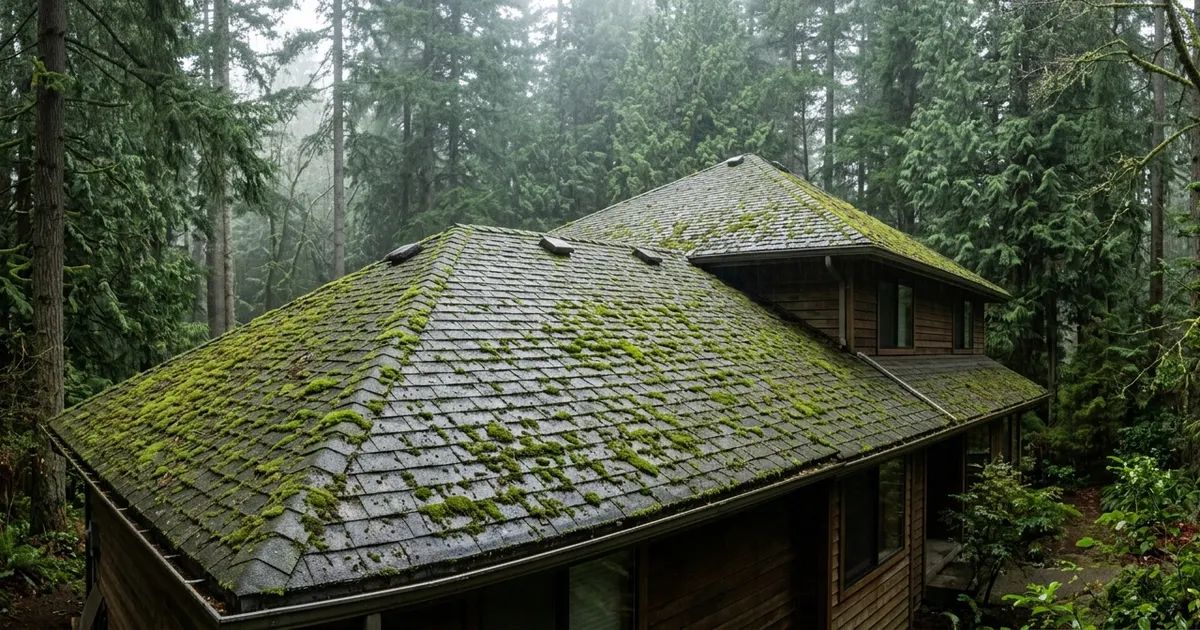
Seattle doesn't get an unusual amount of total rain by national standards. What it gets is rain and overcast skies spread across far more days of the year, with weaker winter sun to dry a roof out between them — the exact combination that lets moss take hold and spread, especially on shaded north-facing slopes.
We've covered the biology and the removal method in detail already: our moss removal guide explains why pressure washing voids most shingle warranties, what manufacturers actually recommend instead, and how zinc or copper strips work as prevention rather than a cure. The angle that matters at replacement time is different — it's what to build into the new roof so you're not fighting the same growth again in three years.
That mostly comes down to two choices made at install, not after: algae- and moss-resistant shingle granules, available across most shingle tiers rather than only premium lines, and confirming the roof has enough ridge and soffit ventilation to actually dry between storms. Neither adds much to the range above, and both are far cheaper to specify now than to retrofit later.
How Washington Actually Regulates Roofing Contractors
There's no separate "roofing license" exam to pass here — but there is a real, checkable registration requirement, and skipping it isn't a paperwork technicality.
Under Washington's Contractor Registration Act (RCW 18.27), every contractor performing paid construction work, roofing included, must register with the state Department of Labor & Industries before taking on a job. Registration requires a surety bond — $12,000 for a general contractor, $6,000 for a specialty contractor, the category most roofing-only businesses fall into — plus general liability insurance (Washington Roof Authority, retrieved 2026-08-29). It's not a trade exam the way some states run it, but it is a real financial backstop: that bond is what a homeowner can potentially claim against if a registered contractor's work fails or the job is abandoned.
L&I's own online verification tool checks registration status in under a couple of minutes, and it's worth doing before signing rather than after a problem shows up — an unregistered contractor operating in Washington is doing so illegally, and the bond protection simply isn't there if something goes wrong.
How Does Seattle's Re-Roof Permit Actually Work?
Faster than most homeowners assume, and lighter-touch than the multi-week reviews common in other cities on this site.
Seattle's Department of Construction & Inspections issues re-roof permits the same day you apply online, and — unlike a typical building permit — no on-site inspection is required at all. Closing out the permit is a paperwork step, not a site visit: the property owner or contractor completes an "Affidavit — Roof Replacement" form and emails it directly to SDCI's inspections team, and that affidavit is what finalizes the permit (Seattle Department of Construction & Inspections, retrieved 2026-08-29). Applications go through the Seattle Services Portal rather than an in-person counter.
That speed cuts both ways for a homeowner. It means permitting itself is rarely the bottleneck on a Seattle reroof — but it also means the city isn't sending an inspector to verify the work matches what was permitted, so more of that verification burden sits on you and your contractor's own documentation than it would in a city that inspects every job.
What to Ask About Before You Sign in Seattle
Ask specifically whether the quoted shingle line offers algae-resistant granules, and whether that's already included in the price or a separate upgrade line.
Ask about ridge and soffit ventilation as its own item, not an assumption bundled into "standard install" — on a shaded lot, it's doing real work against moss, not just attic temperature. And if mature trees overhang the roof, ask whether canopy trimming or gutter clearing is included before work starts, since debris sitting in a valley is exactly what starts a moss mat in the first place.
Verify the contractor's L&I registration number directly through the state's own lookup tool, not a number printed on a business card, and confirm the bond is current. Ask who's pulling the re-roof permit and when — it's fast in Seattle, so a contractor who hasn't filed it yet this late in the process is worth a direct question, not an assumption it's handled.
For what a complete quote should itemize beyond these local specifics, how to read a roof estimate covers it line by line, and how to get roofing quotes walks through comparing three bids fairly.
Frequently Asked Questions
Is Seattle really the rainiest city in the US?
No — Miami averages 67.4 inches of rain a year and New Orleans 63.4 inches, both well above Seattle's roughly 39. What Seattle actually leads on is frequency: about 156 days a year with measurable precipitation, more than either city (Current Results, compiled from NOAA data, retrieved 2026-08-09). That's the real driver behind the moss problem — not volume, frequency.
Do I need algae-resistant shingles in Seattle?
Not required, but worth specifying given the local climate. They cost little more than standard shingles on most lines and directly address the shaded, damp conditions that let moss and algae take hold here.
Does visible moss mean I need a full roof replacement?
Not usually. Established moss on an otherwise sound roof is typically a cleaning and prevention job, covered in our moss removal guide. Replacement becomes the right call when the roof is also near the end of its material life or has damage moss has been masking.
Will homeowners insurance cover moss-related roof damage in Seattle?
Generally no — moss and algae growth is treated as gradual wear rather than sudden damage, which most policies exclude. Our insurance claim guide covers what insurers typically do and don't consider a covered event.
Do roofers need to be licensed in Washington state?
Not through a trade exam, but they do need to register with the Department of Labor & Industries under the Contractor Registration Act, carrying a $6,000 surety bond for specialty (roofing) contractors and general liability insurance. Verify registration through L&I's online tool before signing.
How long does it take to get a re-roof permit in Seattle?
Typically the same day, applied for online through the Seattle Services Portal. No on-site inspection is required — the permit is closed out with a signed affidavit instead, so it's rarely the bottleneck on a Seattle reroof.
Cost data updated August 2026. Figures are published estimates and vary by roof size, pitch, material, and local permit fees.
What do you want to do next?
Three ways we can help from here.
Get the free contractor checklist → 7 questions to ask any roofer before you call. Know what to ask, and what a good answer sounds like.