How Long Do Gutters Last? Lifespan by Material, and What Actually Shortens It
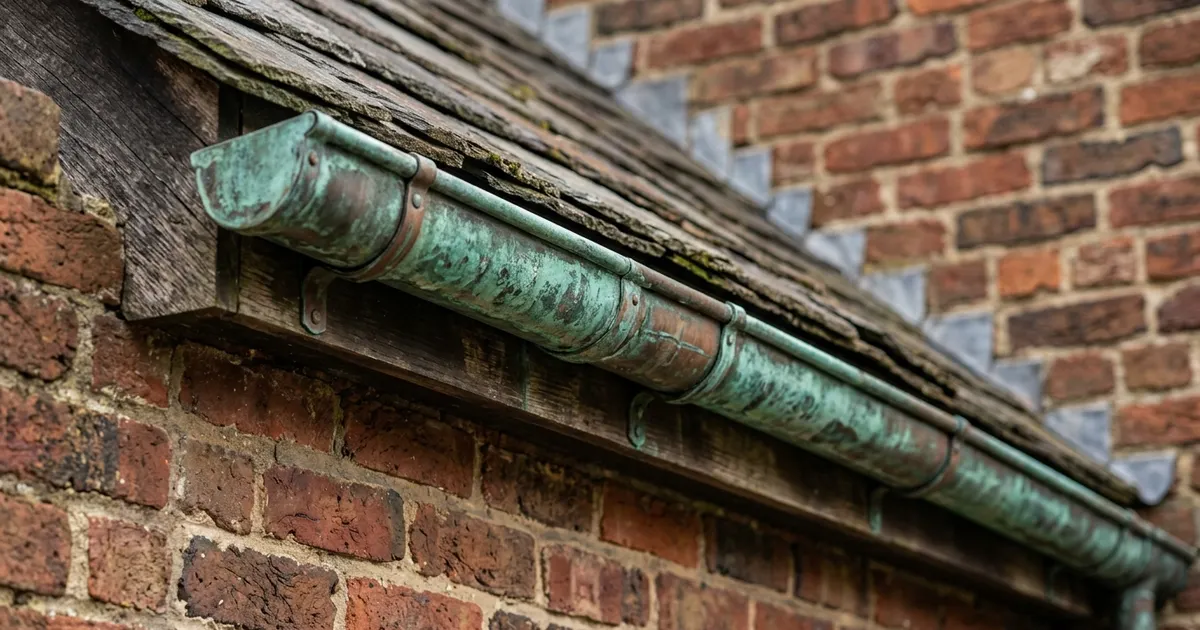
Vinyl gutters commonly need replacing within 10 to 20 years. Copper gutters, installed on plenty of homes still standing today, routinely pass the century mark. That's not a small spread — it's the difference between replacing your gutters two or three times over the life of a roof, or never again. The material you pick decides which of those you're signing up for.
How Long Does Each Material Actually Last?
Four materials cover nearly every gutter installed in the US, and the range between them is wider than almost any other exterior material choice you'll make.
| Material | Typical lifespan | What limits it |
|---|---|---|
| Vinyl | 10–20 years | UV degradation and thermal cycling, both climate-dependent |
| Galvanized steel | ~20 years | Zinc coating wears through, then the steel underneath rusts |
| Aluminum (.027", standard) | ~20 years | Denting and stress fatigue in heavy snow/ice climates |
| Galvalume steel | 30–40 years | Coastal salt exposure degrades the coating faster than inland use |
| Copper | 50–100+ years | Essentially doesn't corrode — patina is protective, not destructive |
Why Vinyl's Range Swings So Wide
Because vinyl's two enemies — UV light and temperature swings — vary enormously by where you live.
Sun exposure degrades vinyl steadily: intense UV exposure accelerates degradation enough that fading and warping commonly show up within a decade in sun-heavy climates (Home Genius Exteriors, retrieved 2026-08-11). Temperature cycling compounds it — vinyl expands in summer heat and contracts in winter cold, and that repeated stress works on the joints specifically, which is why vinyl gutters tend to fail at the seams first rather than along a flat run. In a mild, moderate-rainfall climate, vinyl commonly reaches 15 to 20 years; almost everywhere else, the realistic figure drops closer to 10. Vinyl is also the one material here that noticeably becomes brittle with age, which is why an old vinyl gutter is more likely to crack than bend under a ladder or a heavy branch.
Why Aluminum's Lifespan Depends on a Number Most Homeowners Never Hear
The gauge — the metal's actual thickness — not just "aluminum" as a category.
.027 inch is the industry-standard gauge for residential seamless aluminum gutters, and the majority of homes in North America carry it, with properly installed .027 systems reasonably reaching 20 or more years (Spectra Gutter Systems, retrieved 2026-08-11). That figure assumes mild-to-moderate conditions, though — installers in harder climates routinely report standard-gauge systems needing section repairs well inside that window under sustained heavy snow load. .032 inch — roughly 18% more material — costs more but resists that cumulative freeze-thaw stress meaningfully better, which is why it's the recommended upgrade specifically for regions with heavy snow, frequent ice storms, or intense wind-driven rain, rather than a universal upgrade. The practical upshot: two houses with "aluminum gutters" installed the same year can have genuinely different lifespans ahead of them if one is standard gauge in a heavy-snow region and the other is heavier gauge, or the same gauge in a milder climate.
Aluminum's other real advantage, regardless of gauge, is that it doesn't rust — the metal forms a thin, self-limiting oxide layer on the surface that protects what's underneath, which is a meaningfully different failure mode than steel's.
Steel, Galvalume, and the Difference a Coating Makes
Steel gutters aren't one material — they're steel plus whatever's protecting it, and that coating decides most of the lifespan.
Galvanized steel is coated in zinc, and that zinc is deliberately sacrificial: it corrodes in place of the steel underneath, protecting it for as long as the coating lasts. Once the zinc layer is fully consumed — or scratched through to bare steel — rust can start on the exposed metal. That's the mechanism behind galvanized steel's roughly 20-year typical lifespan (New Tech Machinery, retrieved 2026-08-11) — the clock is really counting down the zinc, not the steel.
Galvalume — a coating that's roughly 55% aluminum, 43.5% zinc, and 1.5% silicon — outperforms plain galvanizing by a wide margin, at roughly four times the corrosion resistance, which is where its meaningfully longer typical lifespan comes from. The tradeoff: galvalume isn't the right call directly on the coast, where salt exposure degrades the coating faster than it does inland.
Stainless steel, the least common of the three in residential gutters, is virtually immune to ordinary oxidation and is the strongest choice specifically for coastal, high-salt environments where galvanized and galvalume both underperform their inland numbers.
Why Copper Outlives Every Other Material by Decades
Because the thing that happens to copper over time is the opposite of what happens to steel.
Copper develops a patina — the color shift from bright copper to brown to, eventually, the green verdigris most people associate with old copper roofing and gutters. That patina is a protective layer of copper carbonate, and critically, it's self-healing and protective rather than destructive: unlike rust, which flakes away and exposes fresh metal to more corrosion, copper's patina sits on the surface and actually slows further change underneath it. That's the whole reason copper gutters can last up to 50 years or more with proper maintenance, with some documented installations reaching 80 to 100 years (This Old House, retrieved 2026-08-11) — the aging process is working in the material's favor, not against it.
The patina timeline itself varies by environment: in industrialized or coastal areas, the full green verdigris can develop in 10 to 15 years; in dry, rural, inland areas, it takes considerably longer, and some copper installations stay in the brown "penny" stage for years before shifting green at all. Neither timeline affects the metal's underlying durability — patina color is cosmetic, not a lifespan indicator.
What Actually Shortens Gutter Life, Regardless of Material
Three factors move the needle on every material above, not just one.
Trapped moisture from debris. Clogged gutters hold standing water against the material far longer than a clear, draining gutter ever would, and that constant moisture accelerates corrosion on steel specifically and adds structural weight that stresses hangers on every material. Twice a year — once in late spring after seed pods and pollen, once in late autumn after leaf-drop — is the standard baseline for an average home with moderate deciduous tree coverage; a heavily pine-covered lot needs three to four cleanings a year, since needles and cones shed outside the normal spring/fall window and reaccumulate faster than a twice-yearly schedule assumes (Gutter Cleaning Authority, retrieved 2026-08-11).
Mismatched metals. This is the one most homeowners never hear about until something's already corroding. Galvanic corrosion happens when two dissimilar metals stay in contact in the presence of moisture, and copper is a particularly aggressive offender against zinc, aluminum, and steel — rainwater running off a copper roof or copper flashing and into an aluminum or galvanized gutter carries trace copper ions that measurably accelerate corrosion in the less noble metal downstream. The American Galvanizers Association puts a number on how to manage this risk when dissimilar metals can't be avoided entirely: keep the more corrosion-resistant metal's contact area to roughly one-tenth or less of the other metal's surface area, and separate direct contact with a non-conductive barrier wherever possible (American Galvanizers Association, retrieved 2026-08-11). Practically: don't fasten galvanized steel or aluminum gutters with copper or brass hardware, and be cautious about copper roofing or flashing draining directly into a different metal's gutter system. Our flashing guide covers this same galvanic-corrosion risk where it shows up on the roof itself, not just at the gutter.
Undersized or failing hangers. Every material needs enough hanger support to carry its own weight plus water, ice, and debris without sagging — and heavier materials like steel and copper need support closer together than lightweight aluminum or vinyl. A gutter sagging more than about half an inch is a sign hangers need tightening or adding, not a material defect, and catching it early is a five-minute fix rather than a section replacement.
Which Material Actually Fits Your Climate?
The national averages above assume average conditions. Almost nobody lives in average conditions.
Coastal, high-salt air: salt spray is hard on any coating that relies on a sacrificial metal — galvanized steel's zinc coating wears faster here than its inland 20-year figure suggests, and even galvalume's stronger coating isn't the ideal pick directly on the coast. Stainless steel and aluminum both handle salt exposure meaningfully better than plain galvanized steel, and copper's patina is unaffected by salt in the way a sacrificial metal coating is.
Heavy snow and freeze-thaw cycling: this is where gauge and material stiffness matter more than corrosion resistance. Standard .027 aluminum is the material most likely to underperform its typical lifespan here; upgrading to .032 gauge, or choosing steel or copper for their added structural stiffness, holds up better against repeated ice loading.
Intense sun and heat: vinyl is the clear underperformer in this climate specifically — UV degradation is the dominant failure mode, and no maintenance schedule fully offsets it. Every metal option is essentially UV-indifferent by comparison.
Heavy tree cover, any climate: this isn't really a material question — it's a maintenance-frequency question that applies on top of whichever material you choose, since debris load and trapped moisture stress every material's weak point (joints on vinyl, coating on steel, hangers on all of them).
One factor that isn't about material at all, and shortens every material's real-world lifespan if it's wrong: pitch. Gutters need a slight slope toward the downspout — too flat and water sits in the trough itself even when the gutter is otherwise clear, which recreates the same standing-moisture problem debris causes, on a perfectly clean system. If a relatively new gutter is already showing corrosion or algae staining in a specific low spot rather than generally, check the pitch before assuming the material is underperforming.
How Do You Know a Gutter Is Actually Failing, Not Just Aging?
Every material shows its own specific warning signs before it fails outright, and they're different enough that "gutters look old" isn't a useful diagnosis on its own.
Vinyl telegraphs failure early and visibly: hairline cracks at seams and corners, a chalky or faded surface from UV breakdown, and sections that flex or crack rather than bend when you press on them. Any of those, especially combined, means the material's remaining life is short regardless of the calendar age.
Aluminum fails more quietly. Look for pinhole leaks along the trough (not just at joints), visible dents that have started to hold water on their own, and a chalky white oxidation residue — a normal, mostly cosmetic byproduct of aluminum's protective oxide layer, but heavy buildup combined with thinning metal underneath is worth a closer look.
Galvanized steel gives a genuinely useful visual cue: rust. Unlike aluminum's cosmetic oxidation, any visible rust on galvanized steel means the sacrificial zinc coating has already failed at that spot, and the steel itself is now actively corroding — this is the one material where surface appearance directly tells you the protective layer is gone, not just aging.
Copper almost never shows a "failing" signal in the way the other three do — the patina that would look like damage on any other metal is, on copper, evidence the material is doing exactly what it's supposed to. The real question with old copper gutters is usually joint and seam integrity rather than the metal itself, since soldered seams can eventually need attention long before the copper sheet does.
Does the Material You Pick Change How Often You Need to Clean?
Not the frequency — every material needs the same basic debris clearing on the same rough schedule. What changes is the consequence of skipping it.
Clogged, standing water sitting in a corrosion-resistant material like copper or aluminum is mostly a structural weight and overflow problem. The same standing water sitting in galvanized steel is also actively working through whatever zinc coating remains, quietly shortening a lifespan that was otherwise on track for 20 years. Material choice doesn't excuse you from cleaning — it just changes what happens if you don't.
The lifespan numbers above are also only half the picture on cost. A material that lasts twice as long isn't automatically the better buy if it costs three times as much per foot — our gutter installation cost guide breaks down real per-foot pricing by material, useful for weighing that tradeoff against the lifespan figures here rather than choosing on price or longevity alone.
Frequently Asked Questions
What gutter material lasts the longest?
Copper, by a wide margin — commonly 50 to 100+ years against roughly 20 years for standard aluminum or galvanized steel, and 30 to 40 for galvalume steel. Vinyl has the shortest realistic lifespan of the common materials, at 10 to 20 years depending heavily on climate.
Do gutter guards extend a gutter's lifespan?
They can, indirectly — by reducing how often debris sits trapped against the material, gutter guards reduce the moisture-driven corrosion and weight-related sagging that shorten lifespan on every material. They don't change the underlying material's own aging process, and a guard doesn't make a 20-year aluminum gutter last as long as copper.
Is .032 aluminum worth paying more for over standard .027?
In a climate with heavy snow, frequent ice storms, or intense wind-driven rain, yes — the added thickness resists the cumulative stress that shortens standard-gauge aluminum's life in those conditions specifically. In a mild climate with limited snow load, standard .027 gauge is a reasonable, well-tested default.
Can I mix aluminum gutters with copper flashing or a copper roof?
Not without a plan for it. Runoff carrying trace copper accelerates corrosion in aluminum gutters downstream, so if copper flashing or roofing drains into an aluminum gutter system, ask your contractor about isolating the contact points or budgeting for faster gutter wear as a known tradeoff, rather than discovering the corrosion later.
Is galvanized steel or galvalume steel the better choice?
Galvalume, in most cases — it's roughly four times more corrosion-resistant than plain galvanized and typically lasts 30 to 40 years against galvanized's 20, for a moderate cost premium. The exception is homes directly on the coast, where salt exposure degrades both coatings faster and stainless steel is usually the more durable choice of the two metals.
My gutters are corroding in one specific spot, not overall — is the material bad?
Probably not the material itself. Localized corrosion or algae staining in one low point, rather than general wear across the whole run, is a common sign of a pitch problem — water sitting in a flat or reverse-sloped section rather than draining toward the downspout. Worth checking before assuming the material underperformed.
Figures are published lifespan estimates and vary by climate, maintenance, and installation quality.
What do you want to do next?
Three ways we can help from here.
Get the free contractor checklist → 7 questions to ask any roofer before you call. Know what to ask, and what a good answer sounds like.