Emergency Roof Leak Repair: What to Do in the First 30 Minutes
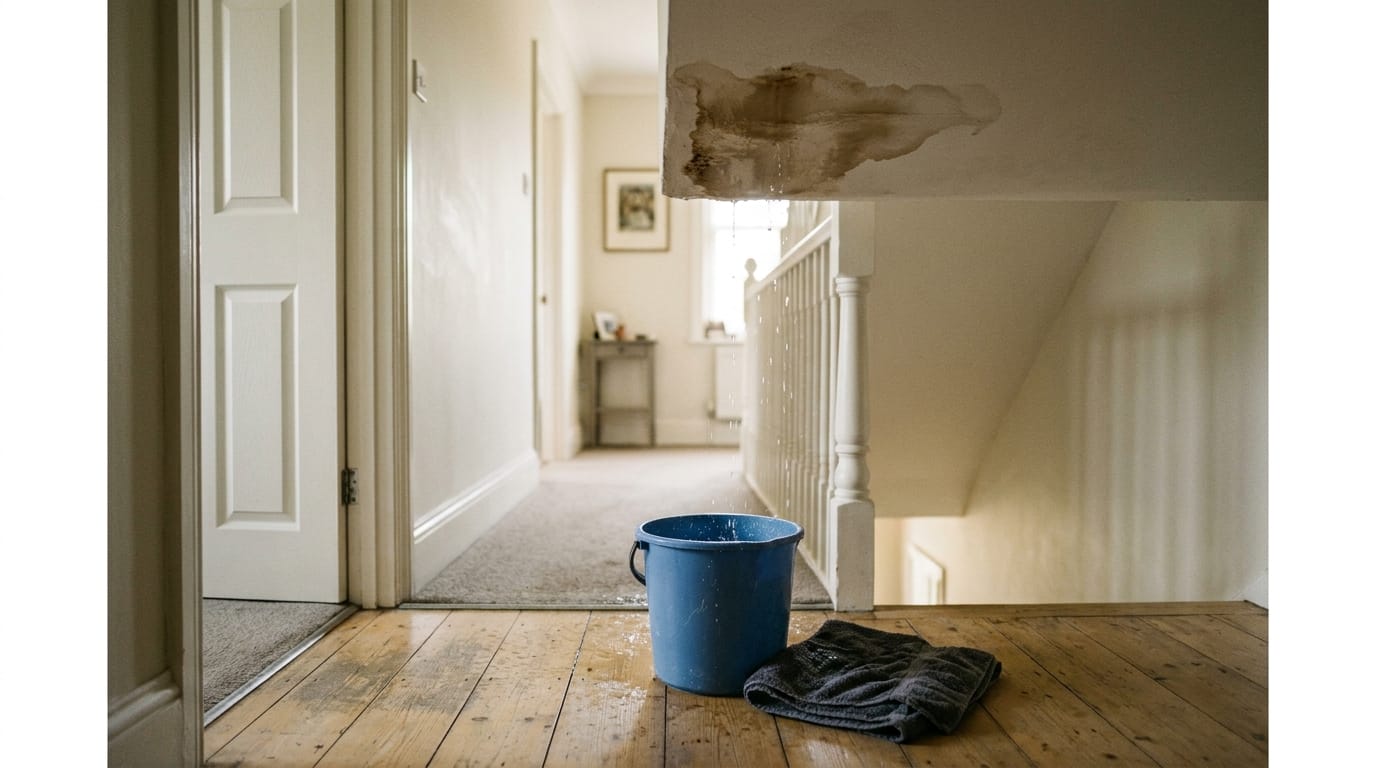
Kill the power to that area, move anything water can ruin, catch the water in a bucket, photograph everything before you touch it, and start drying. Then call a roofer. Emergency roof leak repair runs $379 to $1,755, with an after-hours premium of $100 to $300 on top. This page is for a leak happening right now — most of them arrive with no storm at all.
What Should You Do in the First 30 Minutes?
Six things, in this order. The order matters more than the speed.
The same sequence in text:
| # | Action | Why it comes here |
|---|---|---|
| 1 | Kill power to the area | Water and energised fixtures do not mix |
| 2 | Move what water can ruin | Water spreads laterally, not just down |
| 3 | Catch and channel it | A bucket plus string stops splash spread |
| 4 | Photograph before touching anything | Evidence disappears once you clean up |
| 5 | Relieve a bulging ceiling | A controlled hole beats an uncontrolled collapse |
| 6 | Start drying | The 24–48 hour drying window starts now |
On the power, plainly. No safety authority publishes specific guidance about water dripping onto a ceiling light — the published advice concerns flooding and submerged equipment. The underlying principle is authoritative, though. Never touch electrical equipment that has been in contact with water — it may still be energised. And water-damaged equipment should be checked by a qualified electrician before it is powered again (ESFI, retrieved 2026-08-02). Applying that to a ceiling leak is our own reasoning, not a rule someone published: if water is tracking anywhere near a fixture, switch the circuit off at the panel and leave it off.
How Do You Contain the Water From Inside?
Give it somewhere to go, and stop it spreading sideways.
A bucket alone splashes, and splash is how a two-foot stain becomes a six-foot one. Tie a length of string to the drip point and run the other end into the bucket. The water follows the string down instead of falling free. A plastic sheet or shower curtain under the whole area catches what the bucket misses.
Empty the bucket before it is full rather than after. A steady drip fills a household bucket faster than people expect. An overflow puts you back where you started, with an hour of soaking added.
Should You Relieve a Bulging Ceiling?
Yes — deliberately, and at the lowest point of the bulge.
A sagging, discoloured bulge in drywall is a pocket of trapped water. It is heavier than it looks. Left alone it does one of two things. It seeps outward and soaks a much wider area of ceiling. Or it lets go all at once, dumping several litres of dirty water on whatever is below. Neither is better than draining it on your terms.
Put a bucket down, stand to one side rather than underneath, and make one small hole at the very bottom of the sag with a screwdriver. The water drains in a controlled stream. One hole is enough — the instinct to make several is what turns a patchable ceiling into a replaced one.
If the bulge is large, spreading while you watch, or the ceiling is plaster rather than drywall, stop and call someone. Plaster fails in sheets.
Why Is Water Coming In When There Was No Storm?
Because most roof leaks are wear, not weather. If yours turns out to be an ongoing, non-urgent version of this, our roof leak repair guide covers cost by leak type once the water is under control.
The same four in text:
| Cause | What it is | Why it fails | Where the stain shows |
|---|---|---|---|
| Failed pipe boot | Rubber collar around a vent pipe | Dries out, cracks, splits open | Near a bathroom or kitchen |
| Worn flashing | Metal at a chimney, wall or valley | Sealant-only installations give way | Beside a chimney breast or wall |
| Clogged gutters | Blocked run or downspout | Water backs up under the roof edge | On or near an outside wall |
| Ice dam | Ridge of ice at a cold eave | Meltwater refreezes and pools | Cold climate, snow on the roof |
The pipe boot is the one to suspect first. It is a rubber collar sealing the gap where a plumbing vent passes through the roof. Rubber in full sun has a harder life than the shingles around it. Inspection guidance is blunt about how they fail. As these boots age they dry out, crack and leak. Some go missing entirely. And a vent relying on sealant alone was an improper installation from the start (InterNACHI, retrieved 2026-08-02).
In cold climates, add ice dams. They need snow on the roof and a split temperature — the upper roof surface above freezing while the eave stays below it. Meltwater runs down and refreezes at the cold edge. That builds a dam, and the dam holds a pool of water behind it. The pooled water finds cracks in the roof covering and flows into the attic. From there it reaches the ceiling below (University of Minnesota Extension, retrieved 2026-08-02). Keeping gutters and downspouts clear of debris reduces both ice dam and leak risk (IBHS, retrieved 2026-08-02).
Why Isn't the Leak Directly Above the Stain?
Because water travels along the roof structure before it drops. Water entering at a failed boot lands on the underside of the decking and runs down the slope of a rafter until something stops it — a nail, a joint, a run of insulation — before it finally falls. The interior stain marks where it fell, which can be several feet horizontally from where it entered, so do not assume the hole is directly above the stain; a roofer who assumes that will patch the wrong spot and you will call them back. Our full guide to finding a roof leak covers the systematic attic walkthrough and controlled water test for pinning down the exact spot once the emergency itself is under control.
Can You Fix a Roof Leak From Inside the Attic?
Yes, temporarily — and it's a genuinely different move from the bucket-and-string containment above. This is sealing the source from the underside of the decking, not managing the water once it's already through.
This is a stopgap, not a repair. The same source that recommends it is blunt about the limit: never treat an inside patch as the permanent fix — it holds the water back until a roofer can address the actual roof-level cause (MARS Roofing, retrieved 2026-08-29).
What Can a Temporary Fix Actually Do?
Buy you time. Nothing more, and that is the point.
The same figures in text:
| Item | Cost |
|---|---|
| After-hours callout premium | $100 – $300 on top of the repair |
| Emergency roof leak repair | $379 – $1,755 |
| Waiting until decking and insulation are wet | Multiples of the above |
Emergency work can cost up to twice a standard repair, and the after-hours premium sits on top of that (This Old House, retrieved 2026-08-02). Tarping is usually a few hundred dollars, though published per-square-foot figures for it come from consumer price aggregators rather than any industry body, so treat them as indicative.
For example, take a failed pipe boot leaking into an upstairs hallway on a Saturday night. Calling out-of-hours might mean a $250 premium on a $500 repair — $750 to stop it tonight. Waiting until Monday costs nothing extra in callout, but adds roughly 36 hours of water into the decking and insulation. If that pushes the job from a boot swap to a boot swap plus a sheet of decking and a bay of insulation, you have spent the $250 you saved several times over. The honest test is not "is the premium fair" but "what is under the leak, and is it still raining."
What Should You Document Before You Fix Anything?
Everything, and before you touch it.
Homeowners are expected to take reasonable steps to protect the property from further damage. The cost of that protective work is typically reimbursable — provided you keep receipts (Insurance Information Institute, retrieved 2026-08-02). State regulators put it in similar terms. Reasonable costs to protect your property are reimbursed, as long as you save the receipts. And failing to secure the property can affect coverage for the damage that follows (California Department of Insurance, retrieved 2026-08-02).
Two cautions worth more than they look.
Temporary repair payments generally count toward your total settlement rather than sitting outside it. An expensive temporary fix can therefore leave less for the permanent one (Insurance Information Institute, retrieved 2026-08-02). And your deductible still applies to the claim. Whether mitigation spending counts toward that deductible varies by policy — it is a question for your adjuster, not something to assume.
One more thing specific to a no-storm leak: a claim arising from sudden storm damage and a claim arising from a boot that wore out over ten years are different conversations with an insurer. If yours is the second kind, read our insurance and claims guide before you file rather than after.
Frequently Asked Questions
Can I just put a bucket under it and wait until morning?
Sometimes. If the drip is slow, the bucket is holding it, nothing valuable is underneath and the rain has stopped, morning is a reasonable call. If water is near electrics, the ceiling is bulging, or it is still raining, it is not.
How quickly does mold become a problem?
The figure to work to is the drying window, not a countdown to mold. The EPA's guidance is that if wet materials are dried within 24 to 48 hours of a leak, in most cases mold will not grow (EPA, retrieved 2026-08-02). That is a target for your fans and dehumidifier, and it is why drying starts in the first 30 minutes rather than after the roofer has been.
Should I go up on the roof to look?
No. Roofing crews must be given fall protection above six feet. That rule binds their employer, not you (OSHA, retrieved 2026-08-02). Nothing obliges you to wear a harness on your own roof — which is exactly why climbing it is the riskier choice. A wet roof is worse again. Look from the ground, and from the attic.
Will my insurance pay for the emergency call-out?
Reasonable protective costs are generally reimbursable with receipts, but the claim as a whole is still subject to your deductible, and a leak caused by gradual wear is treated differently from sudden storm damage. Photograph everything, keep every receipt, and ask your adjuster before assuming.
Does a temporary patch mean I can put off the real repair?
No. A tarp or a patch is a dam, not a fix, and it has a short life in sun and wind. Treat it as buying days or weeks to get a proper quote, not months.
Can I fix a roof leak from inside without going on the roof?
Temporarily, yes. Find the entry point in the attic, dry the surrounding area, and apply roofing cement or a patch directly over the hole from underneath, extending a few inches past the damage. It's a stopgap that buys time until a roofer addresses the actual cause at the roof surface, not a substitute for that repair.
What do you want to do next?
Three ways we can help from here.
Get the free contractor checklist → 7 questions to ask any roofer before you call. Know what to ask, and what a good answer sounds like.