Commercial Roof Replacement Cost: Per Square Foot, By Membrane Type
Commercial roof replacement costs by membrane type, what drives the total beyond materials, and how commercial roofing bids actually work.
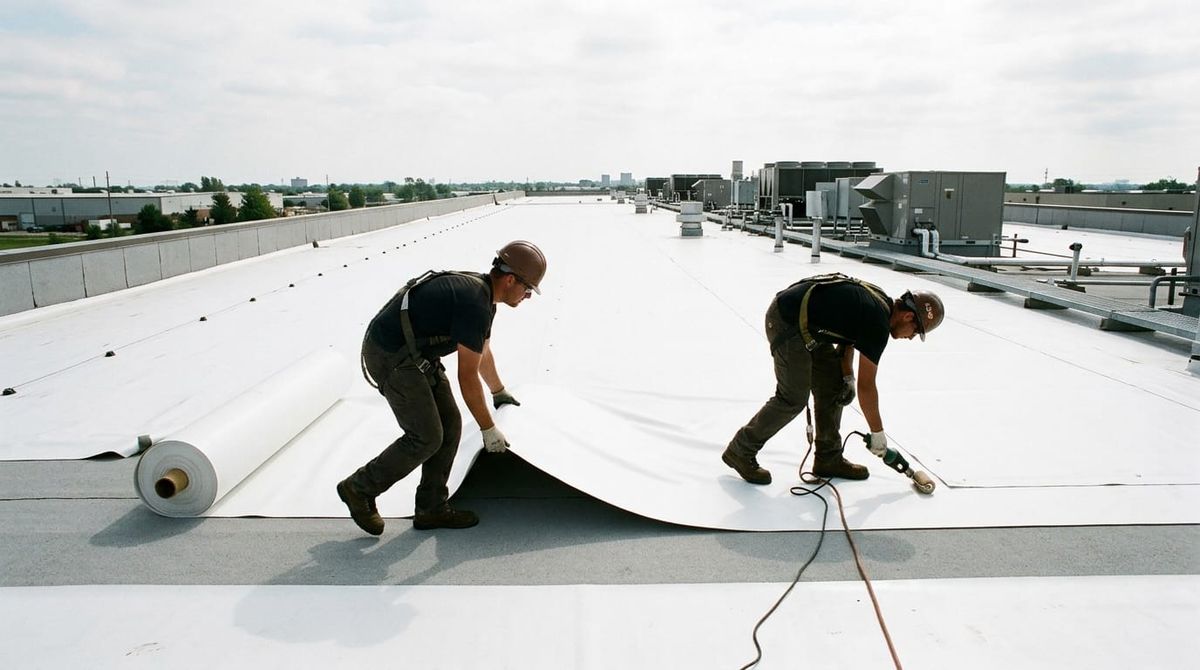
Commercial roof replacement generally runs $5.50 to $15.00 per square foot installed. The membrane system you select accounts for most of that spread. Building size, deck condition, and code requirements account for the rest.
What Does Commercial Roof Replacement Cost Per Square Foot?
Published 2026 ranges place most commercial systems between $5.50 and $15.00 per square foot installed. Single-ply membranes occupy the lower and middle portions of that band. Metal systems occupy the upper portion (RoofVista, retrieved 2026-07-29).
Do the multiplication before you read any bid. A 20,000 sq ft roof at the low end of TPO pricing is about $130,000. The same roof in PVC at the high end gets close to $300,000. Both numbers are fair. They just answer different questions.
How Do the Membrane Types Compare?
Each system solves a different problem. The price gaps track those differences, not quality.
TPO is a single-ply plastic membrane. It's usually white, which reflects sunlight. Material alone runs about $1.75–$3.75 per square foot depending on thickness (General Roofing, retrieved 2026-07-29). That reflectivity cuts cooling costs, so it earns its keep in hot climates.
EPDM is a rubber membrane, traditionally black. A standard 60-mil system with good insulation usually lands between $6.00 and $7.50 per square foot installed (General Roofing, retrieved 2026-07-29). It stays flexible in the cold and has decades of field history behind it.
PVC costs more and resists chemicals. That matters if your building vents grease or industrial fumes — think restaurants, food plants, some manufacturing. In those buildings the premium isn't a luxury. It's the reason the roof lasts.
The same data in text form, since the chart above is an image:
| TPO | EPDM | PVC | |
|---|---|---|---|
| Installed cost / sq ft | $6.50 – $11.50 | $6.00 – $12.00 | $8.00 – $15.00 |
| Best climate | Warm, sunbelt | Cold, northern | Any |
| Key strength | Reflectivity | Cold flexibility | Chemical resistance |
| Grease resistant | Limited | No | Yes |
| Typical building | Warehouse, retail | Office, school | Restaurant, plant |
One more factor matters in hail country. Material choice changes storm outcomes a great deal. FEMA case-study work on hail-resistant roofing documents wide performance gaps between products hit by the same storm (FEMA, retrieved 2026-07-29). In those markets, put impact resistance in the spec.
What Drives the Total Beyond the Membrane?
The membrane is one line item. Four others move the total materially.
Two of these deserve extra attention when you budget.
Tear-off scope. Old layers usually have to come off first. More layers means more labor hours and more disposal weight. Some cities cap how many layers a roof may carry, which forces a full tear-off whether you wanted one or not.
Deck condition. Damage to the deck is often invisible until the old system comes off. Good contractors put a unit price for deck replacement in the bid up front. A proposal without that line hands you the risk as a change order later.
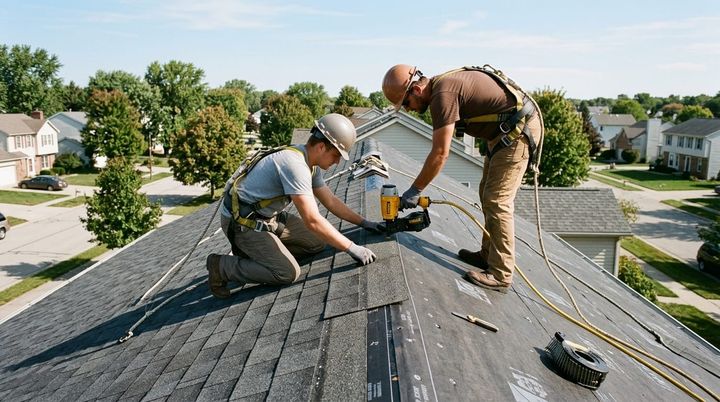
Safety compliance costs money too. OSHA requires fall protection for work six feet or more above a lower level, with specific rules for low-slope roofing (OSHA, retrieved 2026-07-29). Every legitimate commercial bid has that cost baked in.
Can You Operate the Building During the Work?
Usually yes, but the answer shapes your scheduling and sometimes your system choice.
Re-roofing an occupied building is routine. What varies is how much your tenants or staff notice, and that depends mostly on the installation method.
- Noise. Tear-off is the loud phase. Mechanically fastened systems mean sustained drilling directly over occupied space.
- Odor. Hot asphalt and some adhesives produce fumes that can enter through rooftop air intakes. If you run a restaurant, clinic, or daycare, raise this early — the fix is usually shutting intakes or scheduling around occupancy, not changing systems.
- Access and parking. Crews need a staging area and dumpster placement. On a tight retail lot, that costs you customer spaces for the duration.
- Interior protection. Tear-off vibration dislodges dust above ceiling tiles. Warehouses with open inventory usually want covering.
Three scheduling options, in rough order of cost:
| Approach | Cost impact | When it makes sense |
|---|---|---|
| Standard weekday work | Baseline | Warehouses, light industrial, low foot traffic |
| Sectional phasing | Modest premium, longer schedule | Multi-tenant, keeps most of the building unaffected |
| Weekend or after-hours | Highest premium | Retail, restaurants, medical, anywhere daytime noise is unacceptable |
Ask every bidder to state working hours, expected duration, and their plan for your air intakes. A bidder who has not thought about your operations is telling you something about how the job will run.
Is Repair or Replacement Better on the Books?
This is partly an accounting question, not only a condition question — and on a commercial property that distinction moves real money.
Broadly, a repair is treated as an operating expense and generally deducted in the year you incur it. A replacement is typically capitalised and depreciated over a much longer schedule. Same roof, same building, very different effect on this year's numbers.
That creates a genuine tension worth naming:
- Deferring capex with repairs protects the current year's budget and avoids a capital request. It also means paying repeatedly on an asset that keeps aging.
- Replacing is a larger single ask, but it resets service life, often improves the warranty position, and can improve NOI over the hold period through lower maintenance and better thermal performance.
How to decide: if you are holding the asset long-term, replacement usually wins once repair spend becomes recurring. If you are selling within a couple of years, a documented repair history plus a transferable warranty may serve you better than a capital outlay you will not recover.
Tax treatment depends on the specifics and on current rules, so confirm the classification with your accountant before you assume it. The point here is only that the roof decision belongs in that conversation, not just the facilities one.
How Does Commercial Roof Bidding Work?
Commercial bidding works backward from residential quoting in one key way. You write the spec first. The bids answer it.
- Write the scope before you ask anyone. Membrane type, thickness, insulation R-value, warranty term, tear-off — identical for every bidder.
- Get three or more bids against that same spec.
- Compare line items, not totals. A lower total often means thinner membrane, less insulation, or no tear-off.
- Ask what's excluded. Deck repair, permits, and code upgrades get left out often.
- Check licensing, insurance, and manufacturer certification. Some warranties only apply if an approved installer does the work.
Bids written against different specs can't be compared. That's the most common mistake on commercial roofing projects, and it's an expensive one.
What Warranty Terms Should You Verify?
Two separate warranties apply. They cover different failures.
- Manufacturer warranty covers the membrane itself. Terms usually run 10 to 30 years. Some terms only apply if a certified contractor does the install.
- Workmanship warranty covers installation mistakes and comes from the contractor. The length varies a lot, and it's often much shorter.
Most commercial warranties come with conditions. They require documented inspection and maintenance. The National Roofing Contractors Association recommends inspecting at least twice a year plus after major storms (NRCA, retrieved 2026-07-29). Miss that paperwork and coverage can lapse — no matter what actually caused the failure.
Get three things in writing before you sign: what voids the warranty, whether it transfers if you sell the building, and who has to perform the required inspections.
Cost data updated July 2026. Figures are published US ranges and vary by region, roof complexity, and access.
What do you want to do next?
Three ways we can help from here.
Get the free contractor checklist →7 questions to ask any roofer before you call. Know what to ask, and what a good answer sounds like.Will insurance pay?What claims cover — and what they don't.Find financingReal cost over the term, not the monthly.
Frequently Asked Questions
How long does a commercial roof replacement take?
Duration scales with area and complexity. A small single-membrane roof may require several days. A large facility with extensive rooftop equipment can require several weeks. Weather delays are common and should be assumed in scheduling.
Can a commercial roof be coated instead of replaced?
Sometimes. Restoration coatings can extend service life when the existing membrane is structurally sound and the deck is dry. Coating over saturated insulation traps moisture and accelerates deterioration. An inspection determines eligibility.
Does replacement require a full tear-off?
Not always, but frequently. Some jurisdictions limit the permitted number of roofing layers. Overlaying also prevents inspection of the deck below, which introduces risk that a tear-off eliminates.
Why do bids vary so widely on the same building?
Most variance traces to specification differences rather than markup. Membrane thickness, insulation R-value, tear-off inclusion, and warranty term all move the number substantially. Bids written against an identical specification typically cluster far more closely.
Comments ()