Roof Replacement Cost in Austin: What You'll Actually Pay
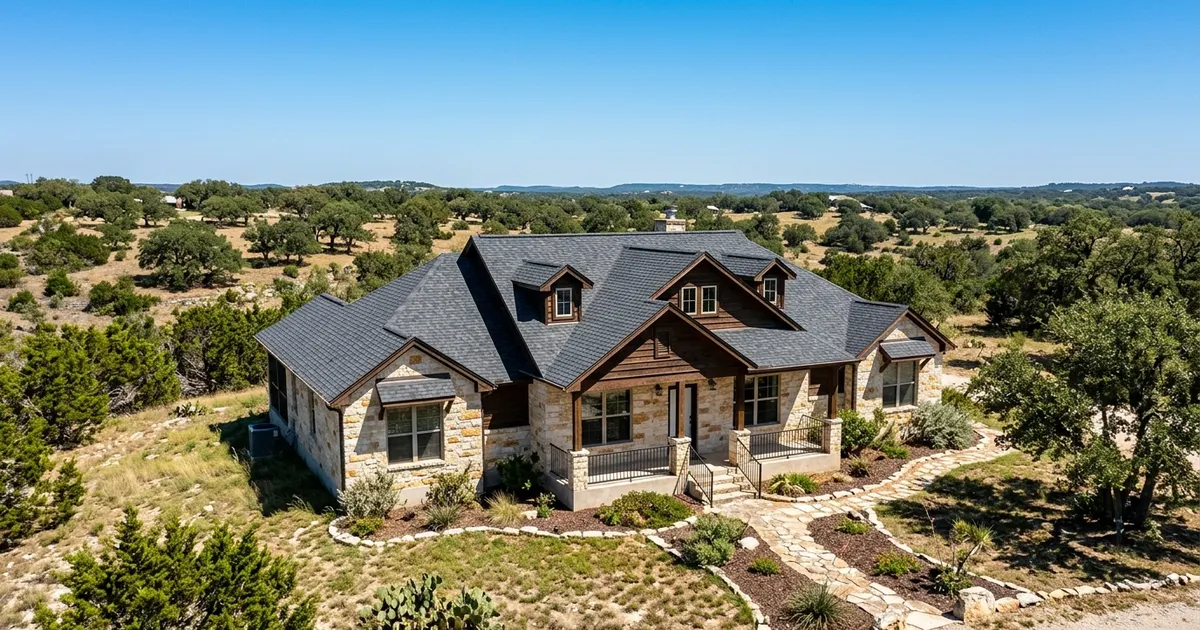
Austin averages roughly 2,996 hours of sunshine a year against a 1991–2020 baseline — enough direct sun exposure that it changes how fast an asphalt roof actually ages here, independent of anything a calendar-based lifespan estimate would tell you (Weather Spark, compiled from NOAA/NCEI climate normals, retrieved 2026-08-09).
What Does a Roof Replacement Cost in Austin?
$12,100 to $16,400 for a typical single-story home, the same range this site's Texas page and Houston page show — our model prices labor and permits at the state level, and Austin doesn't currently carry its own separate multiplier in the dataset.
That range assumes a 2,000 sq ft home, moderate roof pitch, architectural shingle, and one layer of tear-off, priced against Texas's 0.82× labor rate and a $175 baseline permit fee. Change the size, material, pitch, or number of layers and the number moves — the calculator below runs your specific inputs.
First time here? for a 2,400 sq ft home.
We can't load current pricing data right now — and we'd rather show you nothing than guess at a number this big. Please refresh in a moment.
Why Sun Exposure Is Austin's Real Local Factor
Heat and ultraviolet light age asphalt shingles by drying out the oils that keep them flexible and wearing away the granules that shield the asphalt underneath — a slower version of the same oxidation that cracks old asphalt pavement. A roof in a climate like Austin's is doing that work harder, more days of the year, than one in a milder region.
This is a genuinely different consideration than the code-jurisdiction questions covered on our Texas and Houston pages, and it's one most cost guides skip because it doesn't show up as a line item. It shows up later, as a roof that needs attention sooner than its rated lifespan suggested.
One real lever against it: reflective, or "cool," roofing materials. The EPA notes that cooling energy savings from a reflective roof are highest in hot climates specifically, and that a cool roof can cut peak cooling demand by 10 to 15 percent — meaningful in a market where air conditioning runs most of the year (ENERGY STAR, retrieved 2026-08-09). It's a material upgrade worth pricing against the range above, not an automatic add.
| Standard dark shingle | Reflective ("cool") roof | |
|---|---|---|
| Sunlight | Mostly absorbed | Mostly reflected |
| Attic temperature | Higher | Lower |
| Peak cooling demand | Baseline | 10–15% lower |
How Fast Does an Austin Roofing Permit Actually Move?
Faster than most homeowners expect, if the job qualifies for the city's express track — but that track has real conditions attached, not a blanket fast-pass.
Standard residential re-roofing permits in Austin typically process in a few business days when the application is complete and correctly documented. For a defined set of larger roofing scopes — repairs replacing more than 128 square feet of decking, or jobs replacing over half the roof on a property inside Austin's own Wildland-Urban Interface Code Area — the city's Express Permit track can issue a permit in as little as one business day (City of Austin Development Services, retrieved 2026-08-29). That timeline shifts if the property sits in a floodplain or historic district, where additional review applies regardless of which track the permit is filed under.
Austin having its own Wildland-Urban Interface designation is worth knowing on its own — it's the same underlying concept as California's WUI fire code, applied locally in parts of the Texas Hill Country's wildfire-exposed terrain around the city, not something most homeowners associate with Central Texas.
Does Austin Require Roofers to Register With the City?
Yes — but it's worth being precise about what that registration actually is, since it's not the same thing as a roofing license.
Texas has no statewide roofing contractor license, and Austin doesn't administer a roofing-specific trade exam or bond requirement either. What Austin does require is contractor registration through its Build + Connect portal before any general or trade contractor — roofers included — can pull a permit, submitted with a completed Letter of Authorization (City of Austin Development Services, retrieved 2026-08-29). That's a real administrative hurdle, distinct from a licensing exam: it confirms a contractor is a known, registered entity in the city's permitting system, not that they've passed any roofing-specific competency test.
Practically: a contractor who can't produce a Build + Connect registration isn't legally positioned to pull your permit in Austin — worth confirming directly, separate from any conversation about broader trade credentials like the voluntary RCAT program.
What to Ask About Before You Sign in Austin
Ask whether the quote includes any ridge or soffit ventilation upgrade, since attic airflow does real work against heat buildup and is easy for a bid to leave out silently.
Ask directly whether the shingle line being quoted has a reflective or "cool roof" rated option, and what it adds to the price — some architectural shingle lines offer it as a color/finish choice, others don't carry it at all. And since Austin sits under the same statewide permitting patchwork covered on our Texas page, confirm which code edition your specific permit is filed under rather than assuming it matches a neighboring city.
For the rest of what a complete quote should itemize, how to read a roof estimate covers it line by line.
Frequently Asked Questions
Is roofing actually more expensive in Austin than the rest of Texas?
Not in our cost model — Austin uses the same statewide labor multiplier and permit baseline as the rest of Texas. Local material choices, like a reflective shingle upgrade, can move your specific number more than location within the state does.
Does Austin's heat really shorten a roof's lifespan?
Sustained UV exposure and heat cycling accelerate the oxidation that ages asphalt shingles, and Austin gets close to 3,000 sunshine hours a year. It's a real factor, though actual lifespan also depends on ventilation, installation quality, and the shingle line itself.
Are reflective shingles worth the extra cost in Austin?
For most homes running air conditioning through the summer, the 10–15% peak cooling demand reduction ENERGY STAR cites is a genuine, ongoing offset — whether it pays back the upgrade cost depends on your specific shingle price difference and energy rates.
Will homeowners insurance cover hail damage in the Austin area?
Often, for sudden hail damage specifically — but not for granule loss from ordinary sun and heat aging, which insurers generally treat as wear rather than a covered event. Our insurance claim guide covers how that distinction typically gets decided.
Do roofers need to register with the City of Austin?
Yes, through the city's Build + Connect portal, before pulling any permit. This is contractor registration, not a roofing-specific license or exam — Texas has no statewide roofing license and Austin doesn't administer a trade exam for roofers either.
How fast can I get a roofing permit in Austin?
Standard applications typically take a few business days. Larger scopes — over 128 sq ft of decking repair, or 50%+ roof replacement in Austin's Wildland-Urban Interface Code Area — can qualify for Express Permits, issued in as little as one business day. Floodplain and historic district properties face additional review.
Cost data updated August 2026. Figures are published estimates and vary by roof size, pitch, material, and local permit fees.
What do you want to do next?
Three ways we can help from here.
Get the free contractor checklist → 7 questions to ask any roofer before you call. Know what to ask, and what a good answer sounds like.